





 Portuguese
  English
  Spanish
  3 min of reading
  0 comments



An Analysis Of The F-X2 Project, The Choice Of Swedish Gripen Fighters, And The Central Role Of Technology Transfer For The National Defense Industry, In One Of The Largest Investments In The Country’s History.
The acquisition of the Swedish Gripen fighters by the Brazilian Air Force (FAB) marks a milestone in the modernization of Brazil’s air defense. The investment, which can reach SEK 39.3 billion, is one of the most significant ever made by the country and aims to guarantee sovereignty over airspace for the coming decades.
This article details Brazil’s journey to acquire 36 of these advanced aircraft. We will analyze the selection process, the dimensions of the contract, the crucial role of technology transfer, and the capabilities of the new F-39 Gripen fighter.
The Pursuit Of Air Superiority: F-X2 Project
The decision to modernize Brazil’s fighter aviation was driven by the need to replace an aging fleet. Aircraft such as the Mirage 2000 and the F-5 Tiger II were nearing the end of their useful life. The F-X2 Project was launched to acquire a next-generation multirole fighter.
-
Larger than entire cities in Brazil: BYD is building a 4.6 km² complex in Bahia with a capacity for 600,000 vehicles per year, but the discovery of 163 workers in conditions analogous to slavery has shaken the entire project.

-
With an investment of R$ 612 million, a capacity to process 1.2 million liters of milk per day, Piracanjuba inaugurates a mega cheese factory that increases national production, reduces dependence on imports, and repositions Brazil on the global dairy map.

-
Brazilian city gains industrial hub for 85 companies that is equivalent to 55 football fields.

-
Peugeot and Citroën factory in Argentina cuts production by half and opens a layoff program for more than 2,000 employees after Brazil drastically reduced purchases of Argentine vehicles.


The objectives went beyond mere purchase. Brazil sought to foster its defense industry through a robust technology transfer program. The competition attracted top global manufacturers. The finalists were the Saab Gripen NG (Sweden), the Dassault Rafale (France), and the Boeing F/A-18 Super Hornet (USA).
The Decision For The Gripen: Cost, Performance, And The Decisive Factor Of Technology Transfer
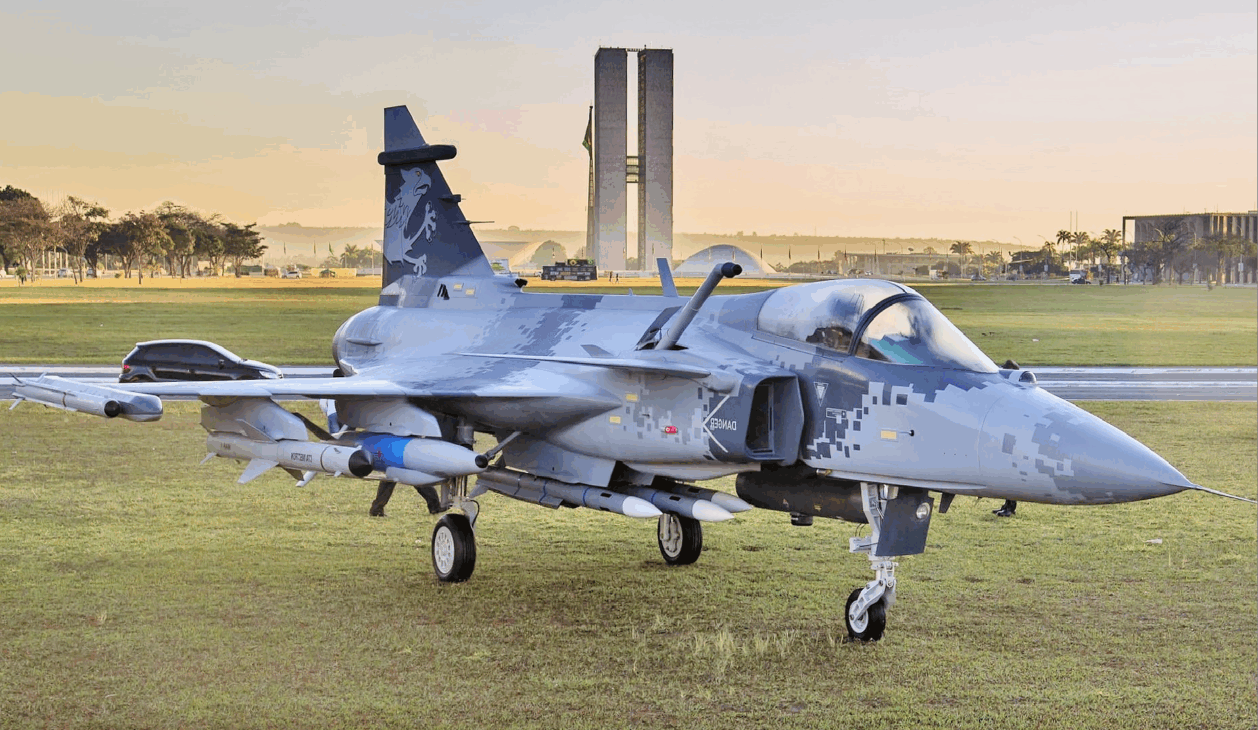
In December 2013, the Brazilian government announced the selection of the Saab Gripen NG. The decision was based on three pillars: performance, costs, and technology transfer. The Gripen was assessed as an aircraft that met the operational requirements of the FAB, with advanced avionics and agility.
The Swedish fighter was also presented as the solution with the best cost-benefit ratio, considering the acquisition price and operational and maintenance costs over its life cycle. However, the most determining factor in the choice was Saab’s promise of broad and unrestricted technology transfer, aligned with Brazil’s strategic goal of strengthening its industrial base and reducing external dependency.
The Numbers Behind The Purchase Of Swedish Gripen Fighters
The contract for the acquisition of 36 Swedish Gripen fighters was signed in October 2014. The initial value was US$ 5.44 billion, which amounted to about R$ 13 billion at the time.
The figure of R$ 29 billion, often mentioned, reflects a later estimate of the total program cost. This higher value is a result of the depreciation of the real, inflation, and modifications requested by Brazil, such as the inclusion of the advanced Wide Area Display (WAD) cockpit panel. The agreement also included a substantial package of industrial and technological offsets, valued at US$ 9 billion.
Technology Transfer As A Strategic Pillar
The opinion of defense experts and analysts is unanimous: technology transfer (ToT) was at the core of the Brazilian decision. The agreement with Saab was designed to be as comprehensive as possible, aiming to empower Brazil to achieve autonomy in the operation, maintenance, and future development of the Gripen.
The program involves a network of Brazilian companies, led by Embraer, which is co-responsible for the development of the twin-seat version (F-39F) and the final assembly of 15 aircraft in Gavião Peixoto (SP). AEL Sistemas, in Porto Alegre (RS), developed the innovative WAD panel. Other companies, such as Akaer and Saab Aeronáutica Montagens (SAM), in São Paulo, produce complex structural components. This technological ecosystem is the program’s greatest legacy.
F-39 Gripen: The Capabilities Of Brazil’s New Air Defense Vector


The Saab F-39 Gripen is a 4.5 generation fighter. It represents a qualitative leap for the FAB. Equipped with the AESA Raven ES-05 radar and the IRST Skyward-G infrared sensor, it has superior situational awareness.
Its General Electric F414 engine gives the aircraft the capability for supercruise, that is, to fly at supersonic speed without using afterburners, saving fuel. With a maximum speed of Mach 2, the Gripen can carry a wide range of armaments, including long-range missiles like the Meteor. Its open architecture facilitates the integration of new technologies throughout its 50-year lifespan.









-

Uma pessoa reagiu a isso.