





 Portuguese
  English
  Spanish
  9 min of reading
  1 comment


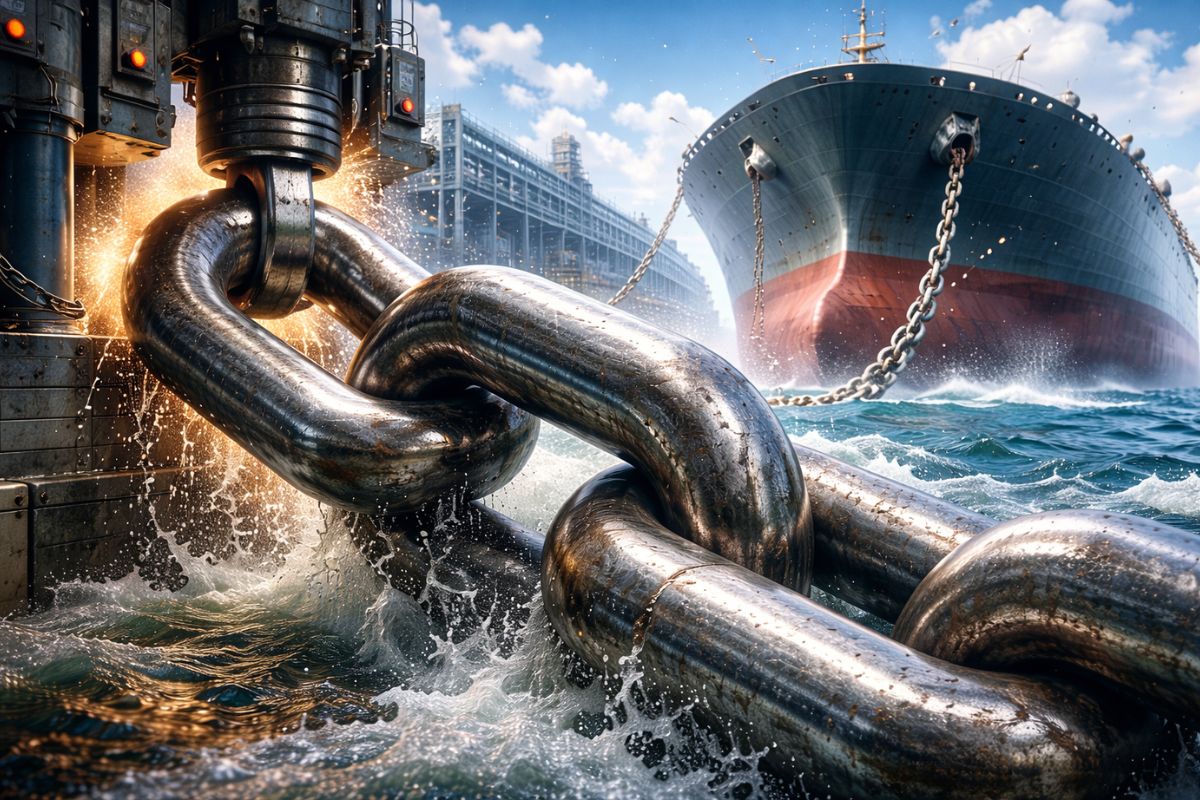


The Anchor Chain That Holds 200 Thousand Ton Ships Is the Strongest Chain in the World and the Critical Mooring System of Naval Engineering.
The anchor chain that holds ships afloat is not a prototype, nor a marketing phrase. It is currently installed on fully loaded mega tankers, exceeding 200 thousand tons, and relies on its ability to remain motionless when wind, waves, and currents push forcefully in the opposite direction. If this system fails, the ship loses control in seconds.
Contrary to what many people believe, it is not the anchor alone that truly holds ships. What keeps the largest ships on the planet in position is the anchor chain, designed to withstand not only a maximum force but millions of cycles of tension, impacts, vibrations, and corrosion, always at the limit. It is this chain, built to be the strongest chain in the world, that turns the mooring system into the final shield between safety and disaster.
What Really Holds Ships of 200 Thousand Tons

There is a very common idea: to imagine the anchor lodged in the seabed as the decisive element. In practice, in a mooring system, what holds 200 thousand ton ships is the anchor chain.
-
Motorola launched the Signature with a gold seal from DxOMark, tying with the iPhone 17 Pro in camera performance, Snapdragon 8 Gen 5 that surpassed 3 million in benchmarks, and a zoom that impresses even at night.

-
Satellites reveal beneath the Sahara a giant river buried for thousands of kilometers: study shows that the largest hot desert on the planet was once traversed by a river system comparable to the largest on Earth.

-
Scientists have captured something never seen in space: newly born stars are creating gigantic rings of light a thousand times larger than the distance between the Earth and the Sun, and this changes everything we knew about stellar birth.

-
Geologists find traces of a continent that disappeared 155 million years ago after separating from Australia and reveal that it did not sink, but broke into fragments scattered across Southeast Asia.

A moored mega tanker generates immense forces when pushed by wind, waves, and currents.
The anchor alone would not be able to withstand these forces without the help of a line that absorbs, distributes, and cushions the loads. The real work is done by the chain, and not just any chain.
This chain was not designed for static and predictable loads. It was made to survive extreme dynamic loads, irregular pulls, abrupt direction changes, constant vibrations, and repeated cycles of tension and relief. That is what destroys metals: not isolated maximum force, but repetition.
Meanwhile, all this happens underwater, in saltwater, under constant corrosion and extreme temperature variations. Either the chain withstands this scenario or it is useless.
When Failure Comes from an Invisible Defect
This type of chain that holds ships rarely fails due to average resistance. It fails because of a tiny detail: a microcrack, an imperfect weld, an internal area with altered structure, something that would be irrelevant in another component, but here is fatal.
When the strongest chain in the world fails, there is no warning. It does not give way slowly; it breaks. At that moment, even with the anchor on the seabed, the ship begins to drift.
Close to the shore or in congested ports, this initially nearly imperceptible movement can turn into a gigantic problem, posing risks to docks, other ships, and millions in cargo.
That is why the anchor chain that holds ships is not designed just to resist. It is designed to fail in a controlled manner.
The priority is to not break suddenly, to deform in a controlled manner, absorb energy, and behave predictably even when everything around it is at the limit.
How the Strongest Anchor Chain in the World Is Birthed

Manufacturing the strongest chain in the world does not start with fire and hammering but with a critical decision: choosing the right steel.
At this level of demand, very hard steel can be brittle, while very soft steel deforms too much. The steel used in the anchor chain that holds 200 thousand ton ships is an alloy designed to withstand extreme cyclic loads for years without losing tenacity. It was designed not to break suddenly.
From this steel come massive bars, not tubes. Any internal void or microscopic pore could be the starting point for a crack.
The bars are cut into segments measured to the millimeter, each with exactly the mass necessary to become a link capable of distributing the load without concentrating stress. Just this segment already weighs more than 100 kg.
Next, the segments go into induction furnaces. Unlike a traditional forge, the steel is heated from the inside out by electromagnetic fields.
This ensures uniform temperature, something essential to avoid creating weak areas or internal stress points.
Too much heat causes the grain of the steel to grow and weaken. Too little heat creates invisible stresses. Neither is acceptable.
When the steel reaches the exact point, it becomes malleable, not soft. This difference determines whether the link will last for years or fail too early.
The glowing segment goes to the press, where giant jaws shape the link. The geometry is not aesthetic: it is engineering.
The shape of the link is designed not only to withstand more maximum load but to distribute the load better, avoiding points where the force consistently concentrates in the same area. An incorrect radius or a poorly sized section could be the beginning of a future failure.
Invisible Weld and Internal Reinforcement: Each Link Is a Critical Point
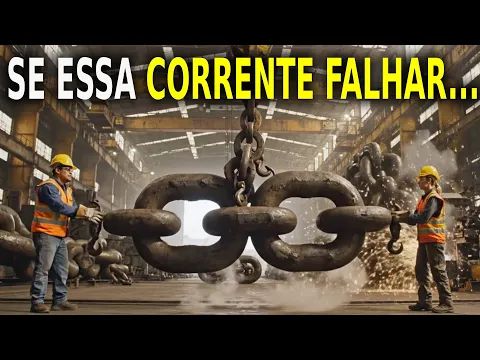

The still-open link is inserted into the already formed chain. It is the only moment that the system is assembled link by link. From then on, there’s no way to correct mistakes without destroying the piece.
A horizontal press pushes the ends to close the link, but closing is not enough. A link closed only by pressure would be a ticking time bomb. Under load, that area would be the first to open. Then the resistance welding comes in play.
Two electrodes press the joint point and pass a massive electric current. The resistance of the steel itself generates extreme heat exactly where it matters.
The metal fuses from the inside, on a microscopic level, transforming two segments into a continuous piece.
On the outside, it may seem simple, but a perfect weld inside determines whether the anchor chain remains the strongest chain in the world or a dangerous piece.
The welding generates burr, a leftover material that is not just unsightly but dangerous. It can concentrate stresses and alter the behavior of the link under repeated loads.
That is why the link immediately goes through another press that precisely removes the burr. Excess is not disguised; it is eliminated.
Still, the link is not ready. It lacks the internal reinforcement, the stud. Each link incorporates a massive bar inside.
The function is not to increase the maximum load but to prevent the link from flattening, twisting, or turning under stress. Without the stud, the chain’s lifespan would plummet.
The stud is forged in parallel, with minimal tolerances. Too loose, it doesn’t work. Too tight, it creates dangerous stresses.
The still-hot link is placed in a vertical press, the cold stud is inserted, and the expanded hot steel embraces the reinforcement.
When the set cools down, the link contracts and locks it in with colossal force. There is no slack, no possible movement.
Shackle and Pin: The Small Set That Can Topple Everything

The anchor chain may be perfect, each link correct, every weld controlled, every internal reinforcement in place, and yet, the mooring system that holds ships can fail because of a single piece: the shackle.
The shackle is the element that connects the chain to the anchor. It is through it that all the forces of the system pass. If the shackle fails, the chain remains intact, the anchor stays on the bottom, but the ship loses its only connection to the sea.
Therefore, the shackle starts as a massive carbon steel block, not a rolled bar or hollow piece.
It needs to deform without cracking when the load does not align, because in the sea, forces rarely arrive perfectly. Each section of the block can weigh over 120 kg.
The steel spends hours in the oven until it exceeds 2000º Fahrenheit. The first forge compacts the metal, eliminating microscopic voids and aligning the internal grain to withstand extreme efforts for years.
This work barely shows on the final piece, but decides whether it survives or not when it needs to hold 200 thousand ton ships.
The ears of the shackle, where the pin will pass through, concentrate gigantic stresses. If the hole lacks the exact diameter or the surface is not even, the load does not distribute, it concentrates. And where it concentrates, the steel fails. That is why the curvature is slow and controlled, with millimeter hydraulic pistons.
The pin, which seems simple, is another critical point. It starts as a massive ingot, is forged, machined with exact diameter, smooth surfaces, and precise threading. Any slack generates repeated impacts that, over time, can destroy the mooring system.
Then comes the heat treatment: the pin is heated, quickly cooled in oil, becomes extremely hard, and then is reheated at a lower temperature for hours to regain tenacity. The goal is for it to absorb impacts without breaking.
The same applies to the nut. Only after being inspected are the shackle, pin, and nut assembled and locked with a secondary system that prevents loosening under vibration.
Tests That Try to Destroy the Strongest Chain in the World
When the manufacturing ends, the anchor chain has not yet earned the right to hold ships. Now comes the phase where engineering literally tries to destroy it.
Each standard section of the chain, the shot, goes through inspections that look for invisible defects: microscopic cracks, internal discontinuities, signs of something that may grow over time.
Magnetic fields and fluorescent particles capable of revealing cracks invisible to the naked eye are used. If the slightest anomaly appears, that section is discarded.
Next comes the final heat treatment. Complete chains enter giant vertical furnaces. Temperature, time, and cooling speed are precisely controlled.
The goal is not just to harden the steel but to give it the exact behavior it needs at sea: resistance without brittleness, hardness without excessive rigidity, and the ability to absorb energy without collapsing.
Only then does the load test begin. The chain is installed on a traction machine capable of applying colossal forces, far exceeding normal working loads.
Thousands of tons of force spread link by link, weld by weld, reinforcement by reinforcement. The technicians observe safely, knowing that a rupture would release brutal energy.
If the chain supports the load without permanent deformation, it passes. If any abnormal sign appears, it is rejected, no negotiation.
After that, the chain is extended on the factory floor, and each link is reviewed again. Small surface imperfections are removed because any irregularity can be the start of corrosion or fatigue.
Protection Against the Silent Enemy: The Sea
Even the strongest chain in the world has an enemy that does not attack with an impact but over time: saltwater.
The sea corrodes slowly, month after month, year after year. If there is no protection, even the best steel weakens. That is why the chain goes through a complete immersion coating.
It is dipped in a pool with a compound that seals the entire surface. It is not a simple paint; it is almost an encapsulation.
This coating needs to be flexible. The chain moves, bends, and rests on the bottom. A rigid coating would crack, allowing the sea to enter. After the coating, everything is inspected again. Nothing is presumed.
Next, external inspectors come in, representatives from classification societies. Their job is to be skeptical: review processes, documentation, and traceability. Each shot receives a unique number, allowing for tracking the history of that piece if there is ever a failure.
From Factory Floor to Ocean: The Mooring System That Holds Ships in Silence
When this chain leaves the factory, it ceases to be just steel and becomes part of a mooring system that holds 200 thousand ton ships during storms, critical maneuvers, and emergencies.
Installed on board, connected to the anchor by the shackle, tested on the winch, it is ready for the sea. There are no more presses, furnaces, or second chances. Just wind, currents, and time.
The anchor chain that holds ships is not measured by how much it can withstand in a machine, but by how many storms it withstands without anyone thinking of it.
When it works, it is invisible. When it fails, the result is immediate: a ship out of control, a port at risk, cargo in danger, and decisions in minutes.
That is why this assembly is not just heavy metal. It is a silent safety system, one of the most demanding that engineering has ever created.
Next time you see a seemingly stationary ship off the coast, remember that it is only still because, underwater, the strongest chain in the world and the whole mooring system are doing their job with zero margin for error.
In your opinion, do people have an idea of the level of engineering involved in something that “merely holds ships” still off the coast, or does this type of system go unnoticed too much?







Somente quem fábrica ou maneja esse Sisma abordo, tem a exata noção de sua importância e resistência. Aproveito para sugerir uma outra matéria sobre os cabos de ancoragem de poliéster, usados nas plataformas de produção de petróleo.