





 Portuguese
  English
  Spanish
  5 min of reading
  0 comments


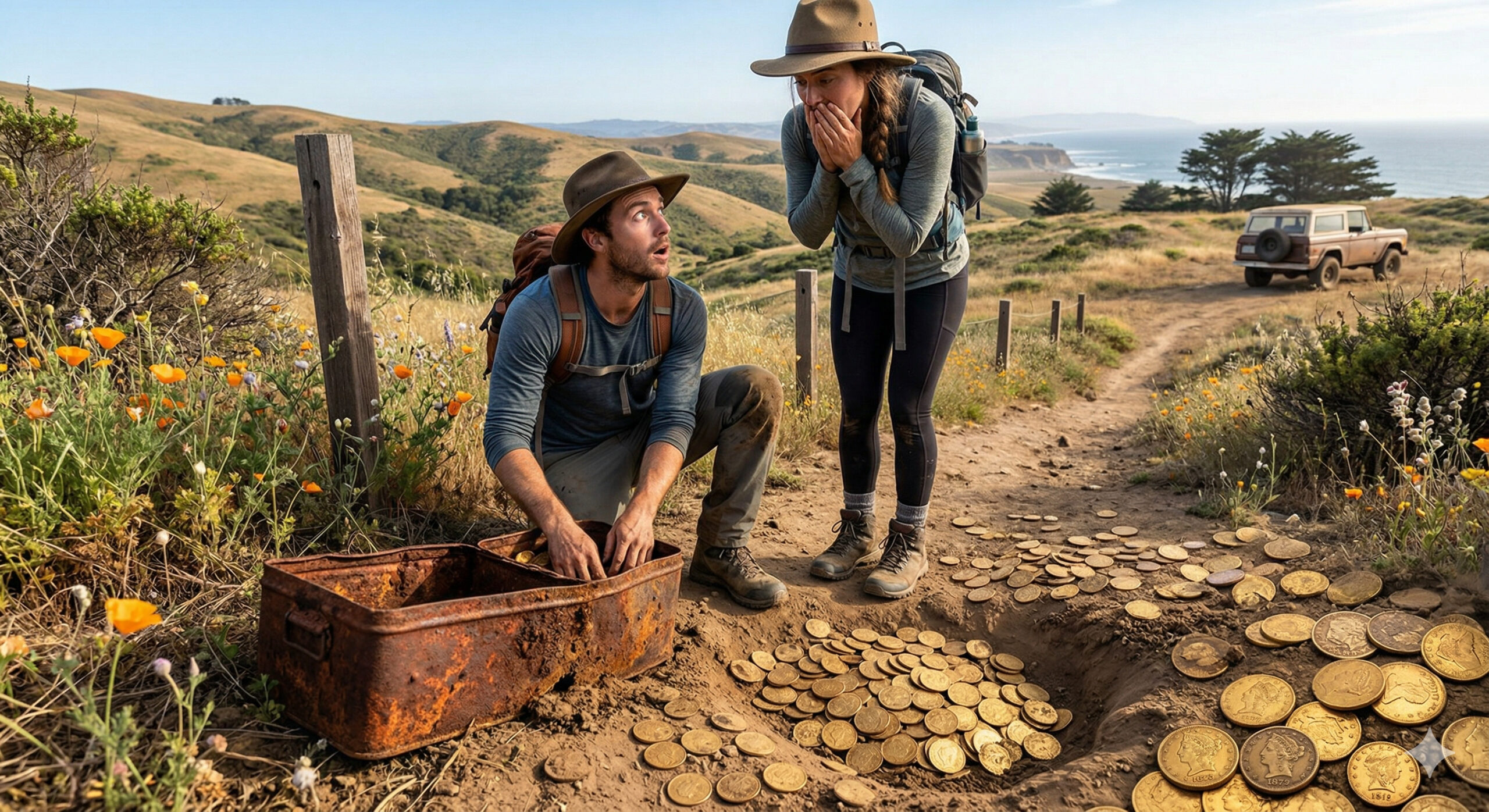
Couple finds 1,427 gold coins buried in California during walk and reveals the largest treasure ever discovered in the US, valued at $10 million.
In February 2013, a couple living on a 200-acre rural property in the northern California hills was taking their routine walk with their dog along a trail they had walked for years. It was Mary — a fictitious name adopted to protect the couple’s identity, publicly known only as John and Mary — who noticed something unusual that day: the rusty edge of a can partially exposed on the slope. According to National Geographic, which published a detailed account of the discovery, John used a stick to pry the can from the ground. The weight immediately caught their attention. The initial hypothesis seemed logical: it could be old lead paint, something common on rural properties in the region. They decided to carry the object back to the house. However, on the way, the can fell. The lid broke open and revealed something unexpected: the edge of a $20 gold coin.
John would later report that, upon realizing what was in front of him, he instinctively looked around, as if expecting witnesses to that improbable moment.
What was found in the cans: composition of the Saddle Ridge Hoard and historical value of the gold coins
In the following weeks, the couple returned to the site with simple tools and later with a metal detector. What they discovered exceeded any expectations: eight cans buried at different depths within a relatively small area, under a tree whose trunk had grown around one of them, clear evidence that they had been there for decades.
-
More than 13,000 fragments of pottery used as tickets, accounts, school exercises, and everyday messages resurface from the sands of Egypt, revealing a colossal archive of ordinary life hidden for centuries in Athribis.

-
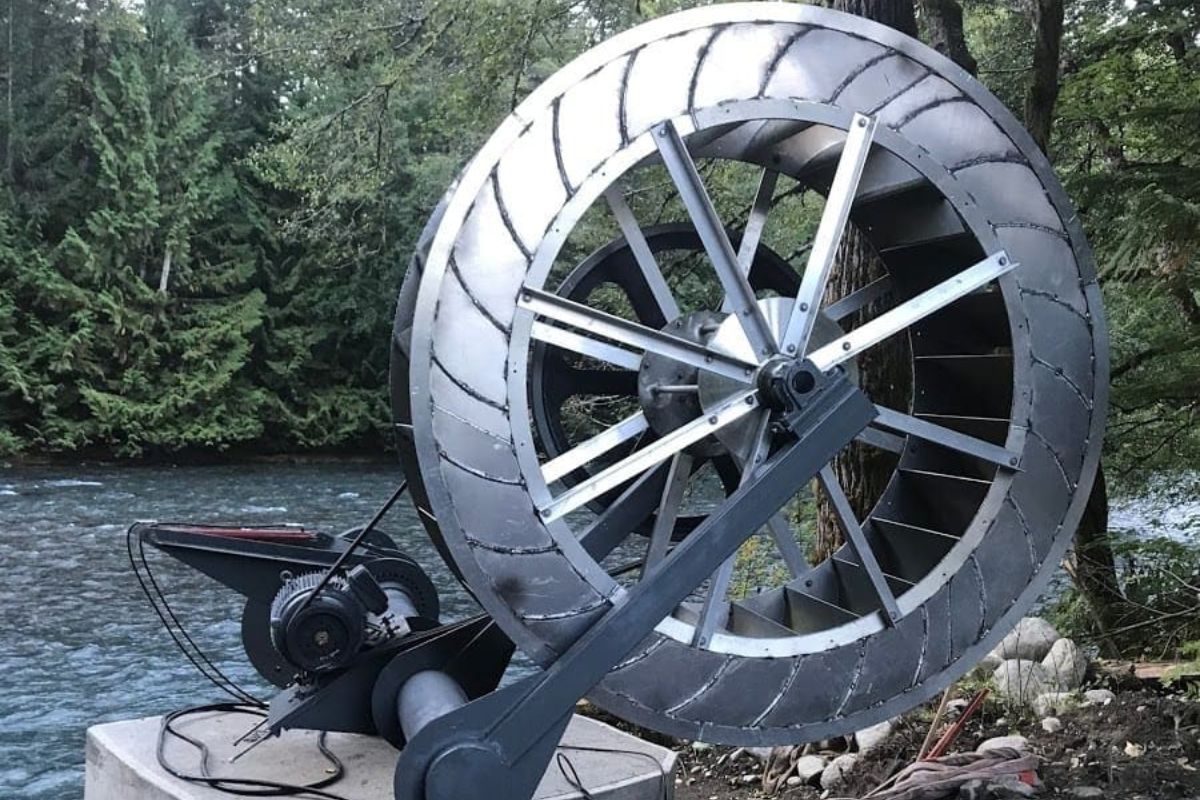
A retired engineer in Canada built a water wheel by the river next to his house that generates 36 kWh per day without needing a dam, and now it produces so much energy that he exports the surplus to the power grid.
-
A huge Maya city has been detected beneath the Mexican jungle with the help of LiDAR, a system that shoots laser pulses from above to map the ground beneath the vegetation, revealing 6,764 structures.

-
About 6,000 residents live concentrated along a single street nearly 9 km long in the interior of Poland, with houses forming a continuous row and narrow agricultural strips emerging behind them, creating one of the most unusual rural patterns in Europe.


Inside these cans were 1,427 gold coins minted between 1847 and 1894, many of them in exceptional condition, practically untouched since their production at the San Francisco Mint.
The treasure was temporarily stored in an old ice chest and later hidden under a pile of firewood while the couple discreetly sought to understand the value of what they had found.
It was officially the largest buried coin treasure ever discovered in the United States.
Numismatic detailing of the coins reveals unique rarities and million-dollar examples
The collection became known as the Saddle Ridge Hoard, named after a rock formation on the property.
The composition is dominated by $20 Double Eagle coins, considered iconic pieces of American monetary history. Of the 1,427 coins:
- 1,373 are $20 Double Eagles
- 50 are $10 Eagles
- 4 are $5 Half Eagles
The total face value sums to $27,980, an extremely significant amount at the end of the 19th century, equivalent to decades of income for an average worker.
However, the true value of the treasure lies in the condition of the coins. After contacting the numismatic company Kagin’s, specialist David J. McCarthy conducted the initial analysis and classified the find as extraordinary.

The certification performed by the Professional Coin Grading Service (PCGS) revealed that several coins were among the best examples ever recorded in the world, including pieces that likely never circulated.
Among the highlights are:
- 1888-S examples classified as the best ever recorded
- 1889-S coins graded MS-65 considered unique in quality
- One 1894-S example also at the highest level of preservation
The most valuable piece is a 1866-S coin without the motto “In God We Trust,” extremely rare. Before this discovery, only six examples in similar condition were known. The found example was valued at around $1 million.
How ignored clues for years led to the largest buried treasure in US history
One of the most intriguing aspects of the story is that the couple walked over the treasure for years without realizing it.
The property is located less than 200 miles from the California Gold Rush region of 1849, one of the largest mining events in American history. John and Mary frequently used the trail and had noticed curious elements in the landscape.
Among them, a tree that had grown around a rusty can and a peculiar rock formation they called “Saddle Ridge.”

After the discovery, Mary realized that these elements functioned as a navigation system: from the rock, it was just a matter of walking ten steps in the direction of the North Star to reach exactly the spot where the treasure was buried.
This indicates that the person responsible for the hiding place left deliberate marks to return later — something that never happened.
Mystery about the origin of the treasure involves bank crisis, historical theft, and unconfirmed theories
The identity of the person responsible for the Saddle Ridge Hoard remains unknown. The most accepted theory connects the treasure to the Panic of 1893, a severe financial crisis that led many Americans to distrust the banking system. In this context, wealthy individuals may have opted to store their fortune in buried physical gold.
The variety of dates on the coins, spread over nearly 50 years, reinforces the hypothesis of gradual accumulation.
Other theories have also been investigated, including a possible $30,000 theft from the San Francisco Mint in 1901. However, this hypothesis was dismissed due to the diversity of the coins found.
Historical names like Jesse James and Black Bart have also been considered, but without concrete evidence. To this day, no theory has been proven.
Historic sale of the treasure by Amazon turned rare coins into a million-dollar business
After certification, the couple faced an unusual challenge: selling a treasure of this magnitude without revealing their identity.
The solution was innovative. The company Kagin’s partnered with Amazon.com, making the Saddle Ridge Hoard the first major numismatic treasure sold through an e-commerce platform.


The coins were sold between $2,975 and $17,500, while the rarest were grouped in a lot worth $2.75 million. More than 225 coins were sold in the first hours.
Part of the proceeds was used to pay off debts, make donations, and preserve some pieces as family heirlooms.
New discoveries indicate that other similar treasures may still be buried in the United States
The impact of the Saddle Ridge Hoard is not limited to its financial value. Experts believe that other similar treasures may still be buried across the American territory. In 2023, for example, about 700 Civil War gold coins were found in Kentucky, in what became known as the Great Kentucky Hoard.
These findings reinforce the possibility that part of the economic history of the United States is still literally hidden beneath the ground.
The story of the Saddle Ridge Hoard raises a direct question: how many other treasures remain hidden in rural properties, forests, and fields that have been walked over countless times without anyone noticing?
Based on recent discoveries, the possibility of new finds is not just speculation — it is a concrete reality. And you, do you believe that there are still great fortunes buried waiting to be found?








Seja o primeiro a reagir!