





 Portuguese
  English
  Spanish
  3 min of reading
  0 comments


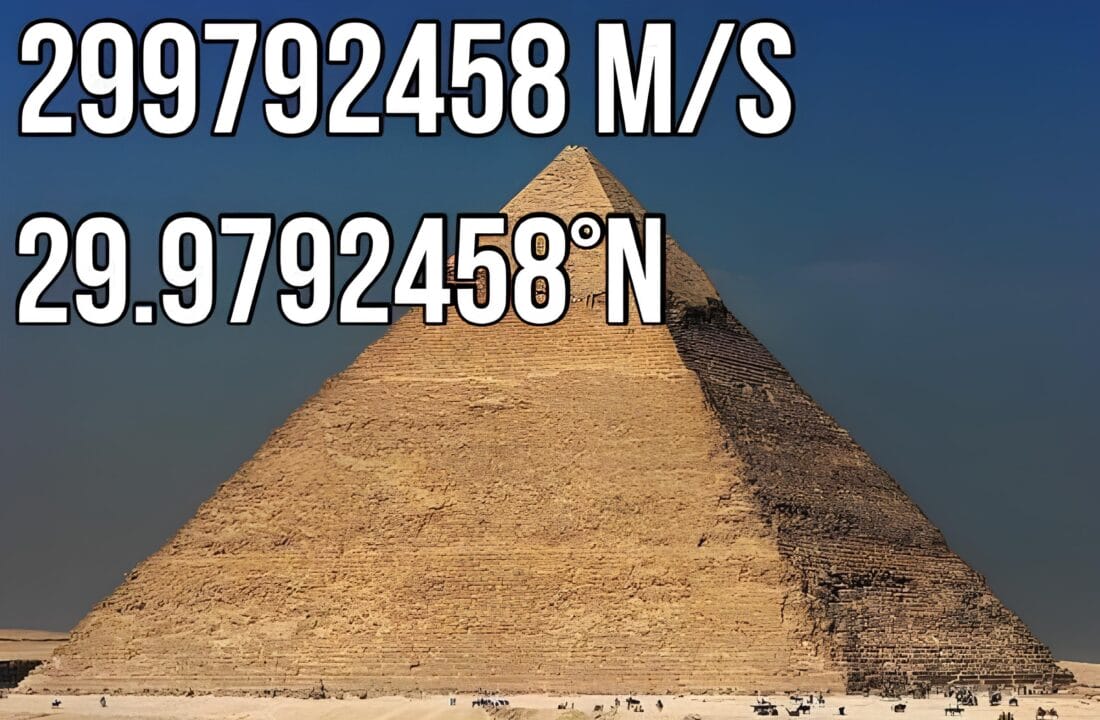
Huge Coincidence or Everything Planned? Understand What the Speed of Light and the Great Pyramid of Egypt Have in Common Even After Thousands of Years.
On November 21, 1676, about 347 years ago, the speed of light was discovered, almost by accident. About three millennia before that, an enormous monument 137 meters tall, which involved the work of 100,000 men over two decades, was erected in Egypt. This is the Great Pyramid of Giza. But what is the connection between these two things? Keep reading and find out!
Check Out the Coincidences Between the Great Pyramid of Egypt and the Speed of Light


For those wondering what the two pieces of information have in common, in fact, absolutely nothing. Except for a major numerical curiosity: the speed of light is 299,792,458 meters per second in a vacuum, and the latitude of the pyramid is exactly 29.9792458ºN.
This information occasionally appears on social media, followed by the classic question: “Coincidence?”. According to what the fact-checking site E-farsas.com explains, when used in decimal format, geographical coordinates are commonly expressed up to four decimal places.
-
Motorola launched the Signature with a gold seal from DxOMark, tying with the iPhone 17 Pro in camera performance, Snapdragon 8 Gen 5 that surpassed 3 million in benchmarks, and a zoom that impresses even at night.

-
Satellites reveal beneath the Sahara a giant river buried for thousands of kilometers: study shows that the largest hot desert on the planet was once traversed by a river system comparable to the largest on Earth.

-
Scientists have captured something never seen in space: newly born stars are creating gigantic rings of light a thousand times larger than the distance between the Earth and the Sun, and this changes everything we knew about stellar birth.

-
Geologists find traces of a continent that disappeared 155 million years ago after separating from Australia and reveal that it did not sink, but broke into fragments scattered across Southeast Asia.

After that, the location varies only a few meters or millimeters, so it’s practically redundant. Therefore, it would be possible to take the value of 29.9792 from the latitude of the Great Pyramid of Giza and add any number sequences we wanted after the fourth place (between 001 and 999), which wouldn’t make practically any difference.
This means that the claim that the geographical coordinates of the Great Pyramid of Egypt are exactly the same as the speed of light is completely arbitrary, that is, it depends on the choice made by a particular person regarding which numbers to use after the main sequence.
Does the Speed of Light and the Great Pyramid of Egypt Have Any Relationship?
Even if the two numbers were exactly the same. Would that establish any relationship between the speed of light and the Great Pyramid of Egypt?
To begin with, even if they had discovered the speed of light centuries before its measurement by the Danish astronomer Ole Roemer, and for some reason chose to remain silent about it, the ancient Egyptians did not think in meters, especially since this unit of measurement was defined only in 1791.

They used cubits, with the speed of light, thus being about 571,033,253 cubits per second. If memes had existed back then, there surely would have been one about some random object in Western Russia at 57.1033253 latitude with the caption “Coincidence?”, for example.
The ancient Egyptians did not measure the speed of light, nor did they navigate using global lines of longitude and latitude – only if they had “predicted” it.
However, if they had done so, there would probably be a bit more evidence than positioning the Great Pyramid of Giza at a mark that corresponds to the latitude line when expressed in a measurement system centuries removed from its invention.
Other Curiosities About the Great Pyramid of Giza
The pyramids of Giza are the oldest of the Seven Wonders of the Ancient World, and also the only one that remains standing today.
These wonders previously included the Colossus of Rhodes, the Lighthouse of Alexandria, the Hanging Gardens of Babylon, and the Statue of Zeus at Olympia. Although the pyramids of Giza are very famous, they are not the only ones to visit in Egypt: There are over 130 other pyramids to explore in the country.
In fact, only on the Giza Plateau, it is possible to find a total of nine pyramids. Other sites include the Bent Pyramid, the Red Pyramid, and the Pyramid of Unas, and so on.








-

-

4 pessoas reagiram a isso.