





 Portuguese
  English
  Spanish
  7 min of reading
  0 comments


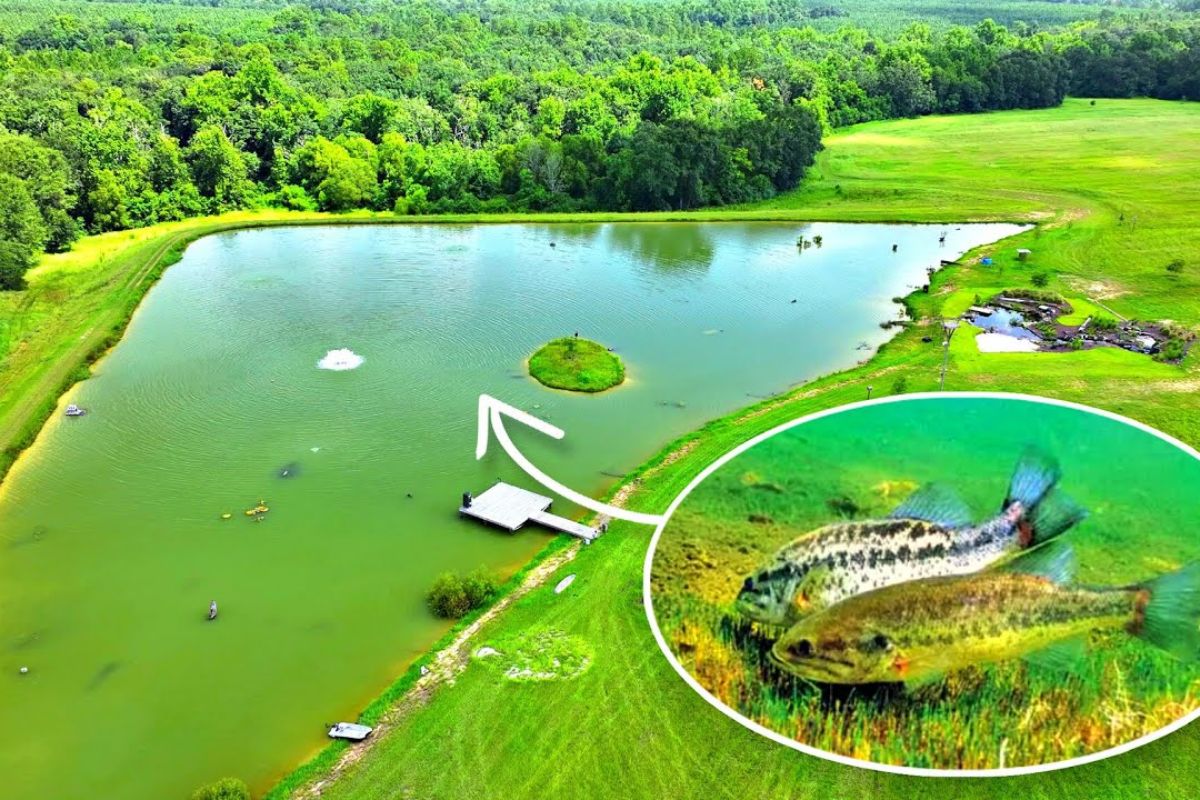
In a Two-Hectare Lake, An Off-Season Winter Spawn Led Largemouth Bass and Other Predators to Reproduce Early, Filled the Water Column with Fry, Pressured Forage Fish, and Forced Researchers and Managers to Rethink Quick and Preventive Management Strategies Before the System Collapsed.
Field records show something that, at first glance, seems like a dream for any sport fishing: healthy bass of all sizes, intense activity along the shores, and schools of juveniles crossing the shallow water. But, behind the attractive images, the scenario is one of ecological alert. The combination of an abnormally mild winter, successive spawns, and a restricted area created a kind of biological time bomb in a two-hectare lake, with a real risk of largemouth bass overpopulation and collapse of the local food chain.
More than a curious case, the episode exposes how small changes in climate and the thermal dynamics of water can rewrite the entire functioning of a closed aquatic ecosystem, shortening the time between equilibrium and imbalance in artificial or managed environments. The challenge now is to contain the explosion of juvenile bass without destroying what has made the lake a productive and stable system in recent years.
A Tiny Lake, Many Bass, and An Unusual Winter

The scenario is a private lake of approximately two hectares, integrated into a farm with other smaller bodies of water, such as Cedar Falls pond.
-
Friends have been building a small “town” for 30 years to grow old together, with compact houses, a common area, nature surrounding it, and a collective life project designed for friendship, coexistence, and simplicity.

-
This small town in Germany created its own currency 24 years ago, today it circulates millions per year, is accepted in over 300 stores, and the German government allowed all of this to happen under one condition.

-
Curitiba is shrinking and is expected to lose 97,000 residents by 2050, while inland cities in Paraná such as Sarandi, Araucária, and Toledo are experiencing accelerated growth that is changing the entire state’s map.

-
Tourists were poisoned on Everest in a million-dollar fraud scheme involving helicopters that diverted over $19 million and shocked international authorities.


For years, the main lake maintained a relatively predictable pattern: adult bass spawning in spring, abundant forage fish, consistent growth of marked individuals, and biomass compatible with the carrying capacity of that body of water.
Everything began to change when winter stopped looking like winter. The previous year, the area recorded about 28 centimeters of snow, with enough cooling to keep the water column at typical seasonal patterns.
This season, the record was almost the opposite: few cold fronts, water temperatures stabilized in the range of 65 to 70 degrees Fahrenheit at the turn of the year, and a sequence of mild days that effectively erased the division between autumn, winter, and early spring in the thermal behavior of the lake.
In this context, largemouth bass and other top individuals, accustomed to reading temperature and water stability signals to decide when to reproduce, began to treat December and January as if they were April.
Instead of a single concentrated reproductive pulse, the lake began to record multiple spawning waves, including signs of late autumn spawning and full spawning in mid-winter.
How Winter Spawning Resets the Ecological Clock of Largemouth Bass

In managed systems, it is expected that bass concentrate spawning during the period when water temperature gradually rises, ensuring that fry find enough food and escape extreme cold events.
When the temperature remains high for long periods out of season, the biological clock of the bass stops following the calendar and starts following the water. This is exactly what the two-hectare lake began to record.
Field observations show bass using lily pads in the shallowest areas as preferred nurseries, repeating a behavior already seen in previous spawns, but now shifted to mid-winter.
The clear sandy edges and dark patches on the bottom, typical of newly opened nests, began to multiply at a time when, under normal climatic conditions, the lake should be in a phase of low reproductive activity.
The most sensitive data, however, came a few weeks later.
The presence of juvenile bass measuring 2 to 3 inches in length, distributed in shallow areas and trying to blend in with the bright bluegills and other smaller forage fish, indicates that part of this bass spawning may have occurred as early as late autumn, continuing into winter.
Ecologically, this means the creation of multiple cohorts of bass in the same annual cycle, compressing the interval between generations in a limited area environment.
Accelerated Overpopulation and Risk of Food Chain Collapse

In a two-hectare lake, there is not infinite space for bass, nor for the species that sustain these predators. A single adult bass can release between 5,000 and 10,000 eggs in a season.
When this potential is multiplied by hundreds of spawns, and not just in a single spring pulse, the curve shifts from replacement to overproduction.
In practice, thousands of new bass fry are released into a system with limited volume, food, and oxygen, immediately pressuring forage fish populations such as bluegills, sunfish, and other smaller species present in the lake and associated ponds.
The risk is not just having too many bass; the risk is having too many skinny bass, competing for the same reduced stock of prey, with stunted growth and cascading mortality in the lower layers of the food chain.
The first signs of this pressure were already showing in tagging and monitoring fishing campaigns. In other seasons, some bass from the main lake exhibited good body condition, with marked individuals being recaptured in different locations, gaining weight over the years, and exploring areas close to fish feeders.
With the explosion of juveniles, the balance between established predators and incoming juveniles tends to quickly shift to intense internal competition. When this happens, forage species have less time for replacement, and the food chain starts to operate on the edge.
Intensive Management in a Two-Hectare Lake
In light of the winter spawning findings and the massive presence of 2- to 3-inch bass, the team responsible for the lake had to abandon the logic that the system regulates itself.
In small environments, the margin between high productivity and management collapse is narrow, necessitating invasive and constant decisions.
One of the main measures underway is the active removal of juvenile bass. The capture of smaller specimens, in the range of 2 to 3 inches, is seen as a critical step to reduce the density of emerging predators and relieve pressure on forage fish.
Some of these juveniles may be transferred to other controlled systems or designated for use in specific projects, avoiding simply discarding them and at the same time decompressing the two-hectare lake population.
In parallel, electronic tagging data and identification of larger bass remain essential.
The recapture database allows identifying individual patterns: there are bass that concentrate near feeders, others that roam the entire lake, and some that have already grown well even under high competition.
This information helps determine which individuals have priority for retention, which can be removed, and how to adjust the control fishing effort throughout the year.
Natural Predators, Climate, and Infrastructure as Allies of Balance
Despite the need for human management, the two-hectare lake is not isolated from the web of natural predators that operate on the farm. Great blue herons, kingfishers, diving birds, and raptors utilize the margins and structures as observation towers to capture smaller fish in shallow areas and around channels and bays.
In recent records, birds were even seen capturing juvenile bass, exactly in the size range that is of most concern from an overpopulation perspective.
In the surrounding environment, aquatic snakes also take advantage of logs and submerged structures as shelters and attack points, while additional predator fish, such as alligator gars kept in aquariums and auxiliary systems, show how different species can be used in a planned manner to consume fry or smaller fish when integrated thoughtfully into management projects.
In small systems, every predator that removes some juvenile bass from the circuit helps relieve the load on the food chain.
Another relevant structural component is the difference in behavior between bodies of water on the same property.
The two-hectare lake, more fertile and managed for high productivity, contrasts with a backyard pond with clearer water and greater turnover, fed by a wider watershed, where water is constantly exchanged through overflow pipes after heavy rains.
This comparison shows that the hydraulic design and water renewal directly interfere with a lake’s ability to support multiple bass spawns without collapsing.
Small Lakes, Big Lessons About Bass and Adaptive Management
The case of winter spawning in a two-hectare lake exposes, on a smaller scale, dilemmas that arise in much larger systems: climate variations that alter the biological calendar, top species responding quickly to these changes, compressed food chains, and managers forced to make decisions based on continuous observation, not just on theoretical models.
At the same time, the situation offers a rare opportunity. A small, meticulously monitored lake acts as a living laboratory where it is possible to observe, in real-time, what happens when bass reproduce out of season, how many young the system can support, and which management strategies truly work.
The responses attempted there, from selective removal of juveniles to leveraging natural predators, may inform policies and best practices for other private lakes, fishing clubs, and rural reservoirs.
The line between a lake filled with trophy bass and a lake saturated with stunted bass lies, at this moment, in the decisions that will be made over the upcoming cycles. Each cold front that doesn’t arrive, each mild winter, and each new wave of fry repositions this line.
The episode makes it clear that, in small environments, waiting for nature to correct an imbalance caused by out-of-season spawning on its own can be the quickest path to food chain collapse.
In your place, facing a two-hectare lake overwhelmed by juvenile bass after a winter spawn, would you prioritize the active removal of young fish, the enhancement of the role of natural predators, or structural changes in the lake to reduce pressure on the local food chain?










-

-

4 pessoas reagiram a isso.