





 Portuguese
  English
  Spanish
  4 min of reading
  0 comments


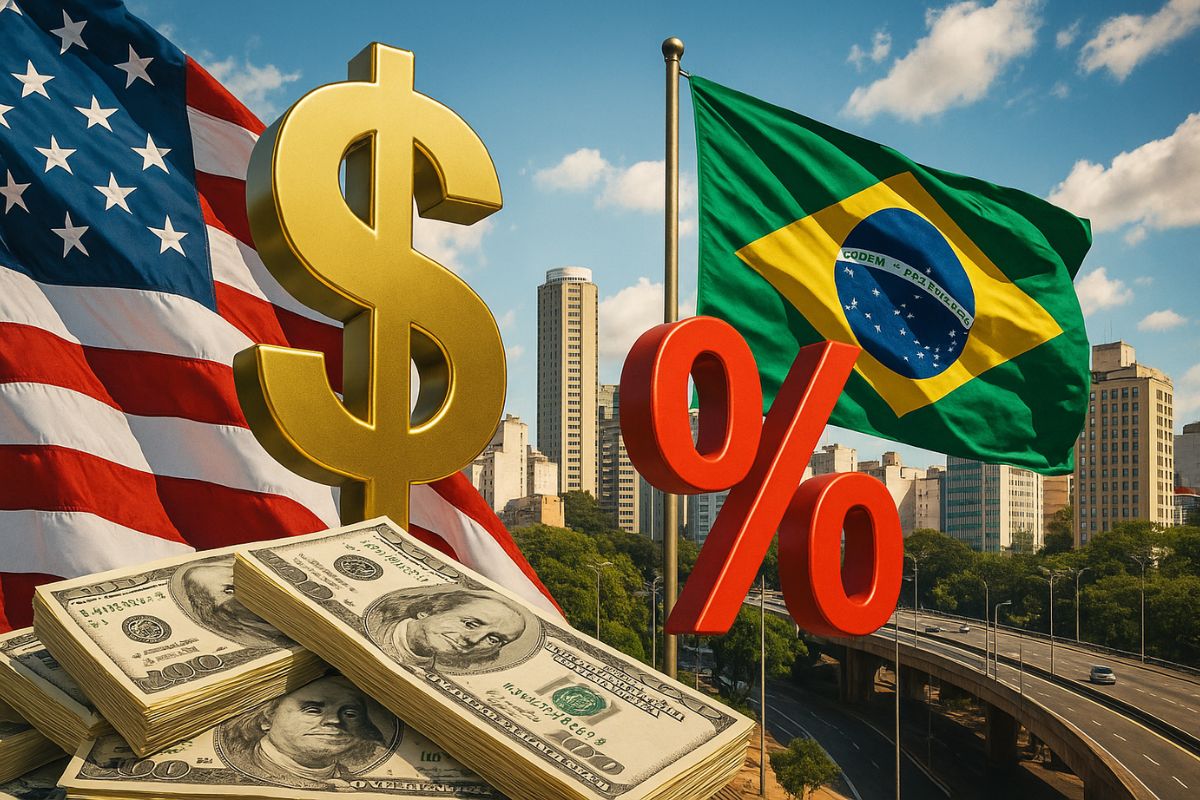
The Power of the American Economy Continues to Determine the Rhythm of Exchange Rates and Interest Rates in Brazil, Influencing Everything from the Dollar and Inflation to the Central Bank’s Decisions and the Cost of Credit in the Country
The rhythm of exchange rates and interest rates in Brazil continues to be dictated by the behavior of the American economy. When the Federal Reserve, the central bank of the United States, raises interest rates or maintains a tougher stance, investors migrate to the dollar and reduce exposure to emerging markets, causing the U.S. currency to rise and putting pressure on the real.
This movement directly impacts inflation and forces the Central Bank of Brazil to react, often keeping the Selic high for a longer period. According to Estadão, the result is an increase in the cost of credit, a slowdown in consumption, and an economy that becomes dependent on decisions made in Washington.
Why the USA Still Dictates the Rhythm of the Brazilian Economy
The price of money in the world is defined by the United States, as explained by Valor Investe.
-
Larger than entire cities in Brazil: BYD is building a 4.6 km² complex in Bahia with a capacity for 600,000 vehicles per year, but the discovery of 163 workers in conditions analogous to slavery has shaken the entire project.

-
With an investment of R$ 612 million, a capacity to process 1.2 million liters of milk per day, Piracanjuba inaugurates a mega cheese factory that increases national production, reduces dependence on imports, and repositions Brazil on the global dairy map.

-
Brazilian city gains industrial hub for 85 companies that is equivalent to 55 football fields.

-
Peugeot and Citroën factory in Argentina cuts production by half and opens a layoff program for more than 2,000 employees after Brazil drastically reduced purchases of Argentine vehicles.


When U.S. interest rates rise, U.S. Treasury bonds start offering more attractive and low-risk returns.
International investors withdraw funds from emerging economies and strengthen demand for the dollar.
The result is the appreciation of the American currency and the depreciation of the real.
This effect has immediate consequences. With a more expensive dollar, the prices of imported products and industrial inputs rise, increasing production costs and putting pressure on inflation.
To avoid a further escalation in prices, the Brazilian Central Bank keeps the Selic high, which makes credit more expensive and limits economic growth.
The Exchange Rate as a Thermometer of Monetary Policy
The exchange rate variation is the most sensitive link between the two economies.
Every time the dollar strengthens globally, the prices of fuels, electronics, and imported food rise in Brazil, affecting the Broad Consumer Price Index (IPCA).
Even if the pass-through takes a few months, inflation expectations adjust almost automatically.
This causes the financial market to demand higher interest rates to compensate for exchange rate risk, and the Central Bank needs to respond quickly to preserve the credibility of its monetary policy.
The Impact of American Data on Brazil
Employment reports, inflation, and retail sales from the United States have a direct effect on the Brazilian market.
As explained by TraderMap, if the numbers indicate a heated American economy, the probability of higher interest rates for a longer period increases. This raises the value of the dollar and makes financing more expensive in Brazil.
When the data points to a slowdown, the movement reverses.
The dollar tends to fall, the real gains strength, and the local market starts pricing in cuts to the Selic.
This is why the calendar for the release of American data is closely followed by Brazilian analysts and investors, treating it almost like a domestic agenda.
The Influence of China and Commodities
Although the United States remains the largest global reference, China also influences exchange rate behavior in Brazil.
When the Chinese economy accelerates and increases demand for commodities, prices of products like soybeans and iron ore rise, favoring Brazilian exports and strengthening the real.
But if commodity prices fall and the dollar appreciates at the same time, Brazil feels a double impact: lower dollar inflow and increased pressure on inflation.
In these moments, the Central Bank needs to act firmly to contain the depreciation of the real and protect the purchasing power of the population.
How the Central Bank Tries to Balance External Effects
The Central Bank’s main tool is credibility. Clear and firm communication reduces volatility and prevents external shocks from turning into inflationary outbursts.
Additionally, the use of exchange instruments, such as swap auctions and dollar sales in the futures market, helps to smooth abrupt movements in the exchange rate.
When the market believes that the monetary authority will do what is necessary to maintain stability, pressures from outside tend to lose strength.
It is a delicate balance, where the Central Bank needs to act without seeming submissive to the rhythm of the United States, but also without ignoring the global impact of the Fed’s decisions.
What This Represents for Companies and Investors
Companies that import or export need to constantly adjust their hedge strategies, contract timelines, and fundraising efforts.
A fluctuation of a few cents in the exchange rate can mean large gains or losses.
For investors, tracking signals coming from the U.S. is essential. High interest rates abroad make dollar-denominated investments safer and put pressure on risk assets in Brazil.
A scenario of falling American interest rates opens space for equity appreciation and strengthening of the real.
The dependence of Brazil on American economic decisions shows how the global financial system still revolves around the dollar.
Even with the commercial diversification and the rise of new economic poles, the rhythm of exchange rates and interest rates in Brazil remains tied to the choices of the Federal Reserve.
And you, do you think the Central Bank should react more independently of U.S. decisions or continue adjusting internal rhythms to American movements? Share your opinion in the comments, we want to hear from those who feel the impact of these decisions in their pockets.










Seja o primeiro a reagir!