





 Portuguese
  English
  Spanish
  3 min of reading
  0 comments


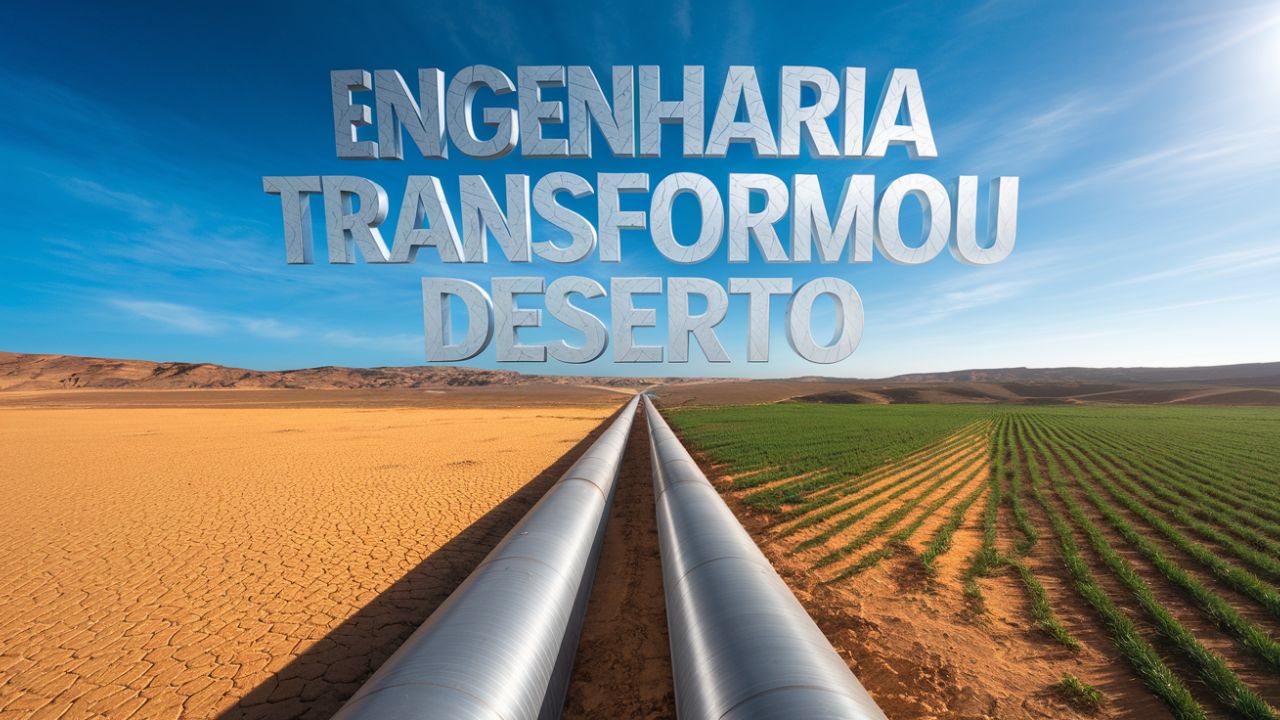
With 130 km in length, pioneering technology, and the capacity to transport millions of cubic meters of water per day, the National Water Carrier is an engineering feat that has not only changed Israel but also revolutionized the way the world combats water scarcity.
Have you ever stopped to think about the power of engineering to transform seemingly impossible realities? Israel’s National Water Carrier, also known as the National Water Transporter, is a living proof that great ideas, combined with determination, can change the course of an entire nation. In the midst of the desert, Israel built a solution so grand that the entire world learned from it.
The Historical Context and the Water Challenge
When Israel was officially established in 1948, the country faced a colossal challenge: how to sustain a growing population in a territory with such unequal water resources? In less than three years, the population doubled, from 800 thousand to 1.6 million people. The pressure to accommodate so many lives in an environment where half the territory was desert was immense. It was not just a challenge; it was a race against time.
In the north, areas like the Sea of Galilee and the Jordan River Basin were blessed with abundant rainfall. But in the south, the vast Negev Desert was virtually dry, receiving less than 10 cm of rain per year. How to solve this puzzle? The answer was a system that would redistribute water from the fertile north to the thirsty south.
-
Florianópolis will receive a million-dollar BRT that will begin construction in 2026 with nearly 400 million in funding from the federal government and the Inter-American Development Bank, and the map already shows the routes for the exclusive bus corridors.

-
Without a blueprint, without an engineer, and using scrap from the dump, a father spends 15 years building an 18-room castle for his daughter, featuring tram tracks, 13 fireplaces, and over 700 m², which may now be demolished.

-
A megaproject worth R$ 89 billion is advancing in Iraq and promises to change the game in global trade by creating a new corridor between Asia and Europe, reducing traditional routes and repositioning the country as a logistics powerhouse.
-
Goodbye bedside table: floating shelves become a trend in 2026 by freeing up space in the bedroom, improving circulation, bringing visual lightness, and integrating technology without taking up floor space.


Building the Solution: The Engineering of the National Water Carrier

The vision for the National Water Carrier began in the 1950s, led by Tahal, a state-owned company specializing in water resources. In just eight years, from 1958 to 1964, Israel built a 130-kilometer system, including tunnels, pipelines, and gigantic reservoirs. The initial cost, 420 million dollars, seems colossal, but today that amount would be around 4 billion, a crucial investment for the country’s future.
Transporting water from the Sea of Galilee to higher regions of the country was an unprecedented engineering challenge. With pumping stations like Sapir, which lifts water by 250 meters, and Tzalmon, which ascends another 115 meters, Israel turned the impossible into reality. The modular system allowed expansions over time, ensuring its efficiency to this day.
Impacts and Legacy of the National Water Carrier
With water available in the desert, Israel saw the Negev flourish. Agriculture, industries, and cities grew. The National Water Carrier not only supplied the basic needs of the population but also paved the way for Israel to become a technological and agricultural powerhouse.
According to Interesting Engineering, this engineering masterpiece has inspired projects like the California Water System in the U.S. and the South-North Water Transfer Project in China. Israel proved that with creativity and courage, it is possible to overcome even the greatest environmental challenges.
The Future of the National Water Carrier and Sustainability
In the 21st century, desalination has revolutionized water supply in Israel. Today, 70-80% of the country’s drinking water comes from this process, integrated into the National Water Carrier system. This ensures that Israel remains resilient in the face of climate change.
Israel shows us that even in a world increasingly affected by water scarcity, it is possible to innovate and prosper. The combination of technology, planning, and boldness is a valuable lesson for any nation.








Seja o primeiro a reagir!