





 Portuguese
  English
  Spanish
  5 min of reading
  23 comments


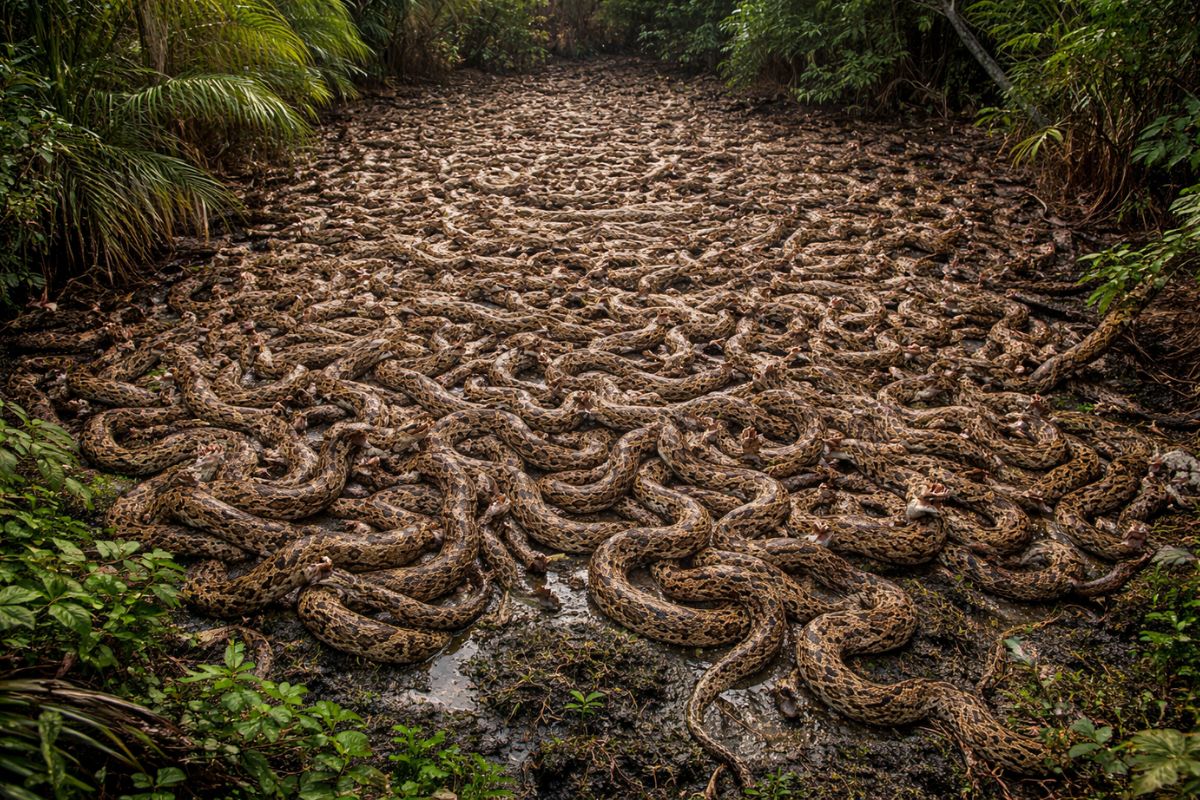


To Contain Burmese Pythons, Florida Bets on Native Giant Snakes, the Eastern Indigo Snake, and Is Already Seeing Concrete Signs of Balance Returning with Hunting of Python Hatchlings and Reproduction in Nature.
Florida tried to save the Everglades with giant snakes and, for a time, the world treated it as environmental madness. The idea seemed absurd: to combat invasive snakes by bringing more snakes into a place already overrun by them.
But the plan was not to “throw snakes into the swamp.” It was to reintroduce a native predator that had disappeared from the landscape and historically kept other snakes under control. What seemed like desperation began to turn into a restoration strategy.
The Silent Invasion That Transformed the Swamp Into an Empty Place
At the end of the 20th century, Burmese pythons, brought from Southeast Asia as exotic pets, escaped or were abandoned and found a perfect refuge in the Everglades. With a favorable climate, endless wetlands, and plenty of prey, the invasion grew in silence.
-
A “silent skill” is allowing Brazilians to earn up to R$ 22,000 per month without a degree and become indispensable for companies that rely on millions of data to survive.

-
Researchers at the Toyota Research Institute found that if a human uses robotic arms to flip a pancake 300 times in an afternoon, the robot learns to do it on its own the next morning, and this is currently the most promising method to solve the biggest bottleneck in modern robotics.

-
Goodbye iron: a common item in households is starting to lose space to technology that smooths clothes in minutes without an ironing board and with less energy consumption.

-
Antarctica reveals an unusual clue high in the Hudson Mountains, and what appeared to be just an isolated rock began to expose a secret hidden under the ice for ages.

The impact turned into ecological collapse. Studies between 2003 and 2011 indicated extreme declines in mammals in areas dominated by pythons: raccoons down more than 99%, opossums nearly extinct, bobcats down nearly 90%, in addition to the disappearance of swamp rabbits and foxes. The python didn’t just consume animals; it consumed the balance.
When “Eliminating Snakes” Doesn’t Work, Florida Seeks Another Answer

Traps, trackers, rewards, and even thermal drones made it onto the list of attempts. The problem is that the python can stay still for days and hide where almost no one can find it.
That’s when the state’s most unpopular bet emerged. Instead of trying to defeat the invader solely with brute force, Florida started working with the logic of the ecosystem and bet on native giant snakes as a biological counterbalance.
The Idea That Became a Meme: Combat Snakes with Snakes
When conservation agencies announced the reintroduction of the Eastern Indigo Snake, the world laughed. Headlines and presenters repeated the same phrase: “Florida fights snakes with snakes.” It seemed like yet another bizarre experiment destined for failure.
But there was one point that almost no one accounted for. The Eastern Indigo Snake was no longer an invader. It was Florida’s forgotten guardian, a large, strong native species known for hunting other snakes, including venomous ones.
Who Are the Chosen Giant Snakes: The Eastern Indigo Snake
The Eastern Indigo Snake can exceed 2.5 meters, with a dark blue appearance and a striking sheen. It does not rely on venom: it hunts using strength, is immune to toxins, and can prey on rattlesnakes, moccasins, and corals.
And there is a decisive detail for public acceptance: despite being one of the region’s giant snakes, it is not described as a threat to humans.
Shy and elusive, it avoids conflict and acts as a silent regulator of the environment.
Why This Species Had Disappeared and Why the Return Took So Long
The decline of the indigo was not sudden. Deforestation eliminated much of the longleaf pine habitat, highways fragmented the remaining areas, and capture for trade and collectors accelerated the decline.
By the end of the 1970s, the species was declared threatened. Without the native predator, the system became more vulnerable. And the invasion of pythons encountered a scenario without natural defense.
The Real Plan Behind the Giant Snakes: Breeding, Release, and Monitoring
The return was planned years in advance. Organizations and biologists began breeding indigo snakes in captivity, not for display, but for release, monitoring their health, strength, and hunting behavior.
In 2017, the project took shape with releases in the Apalachicola Bluffs and Ravines Preserve, a rare and protected area.
The snakes were bred for about two years before returning to the wild, with registration and tracking to increase their chances of survival. This was not a spectacle; it was precision and patience.
What Changed After the Release: Hunting, Control, and Signs of Recovery

When the giant snakes indigo started to circulate again, they began hunting venomous snakes and also rodents, such as cotton rats, associated with crop damage and disease spread in overcrowded scenarios.
But the most significant turnaround came with a discovery that surprised researchers: the indigos began hunting Burmese python hatchlings.
Small and vulnerable hatchlings, which previously faced no natural predator in Florida, became prey. It was as if nature applied a brake where humans had failed.
Local reports also began to change. Farmers noticed fewer venomous snakes in field areas, and hikers and rangers observed the return of small mammals in places once considered empty.
The Proof That Every Reintroduction Project Needs: To Be Born in Nature
In projects like this, mere survival is not enough. The milestone is reproducing in nature.
This proof appeared in 2023 when researchers found two hatchlings born in the wild, descendants of the reintroduced snakes.
It was the first confirmed natural birth in over 40 years, a sign that giant snakes indigo not only returned but resumed their ecological role.
In 2024, the program recorded the release of 41 indigo snakes, 22 females and 19 males, with expectations of more than 200 to follow. And the effect began to inspire other areas: in Alabama, releases also advanced, and in 2019, a hatchling was found in the state for the first time in 60 years.
Why the “Unlikely Plan” May Restore Balance, and Where the Risk Lies


The logic is powerful: reintroducing a native predator to reduce pressures that were destroying the food chain. It’s restoration with ecology, not with improvisation.
Still, it is not an automatic miracle. Reintroduction requires suitable habitat, monitoring, continuity of resources, and time. And the impact on the pythons needs to be monitored carefully because the challenge is enormous and the ecosystem is complex.
In the end, Florida did not “release snakes out of desperation.” It bet on native giant snakes to return a piece that had been removed from the swamp equation, and now it begins to see the type of response that only appears when nature finally gets a second chance.
Do you think using native giant snakes to control invaders is a model that should be replicated elsewhere, or is it too risky to become an official strategy?






Sensacional,provar na prática é o melhor remédio, parabéns
Muito interessante essa matéria.
Como diz o velho ditado
É cobra comendo cobra
Eu acho que isso funcionaria muito bem em todos os lugares que tem espécies invasoras. Menos no Brasil pois a própria Mata Atlântica já faz o papel direitinho com onças.
Também tinha que fazer uma pra comer o humanos malvados
Que faz tanto mal as pessoas inocente tudo que seja inocente
Faz um **** assim também