





 Portuguese
  English
  Spanish
  6 min of reading
  0 comments


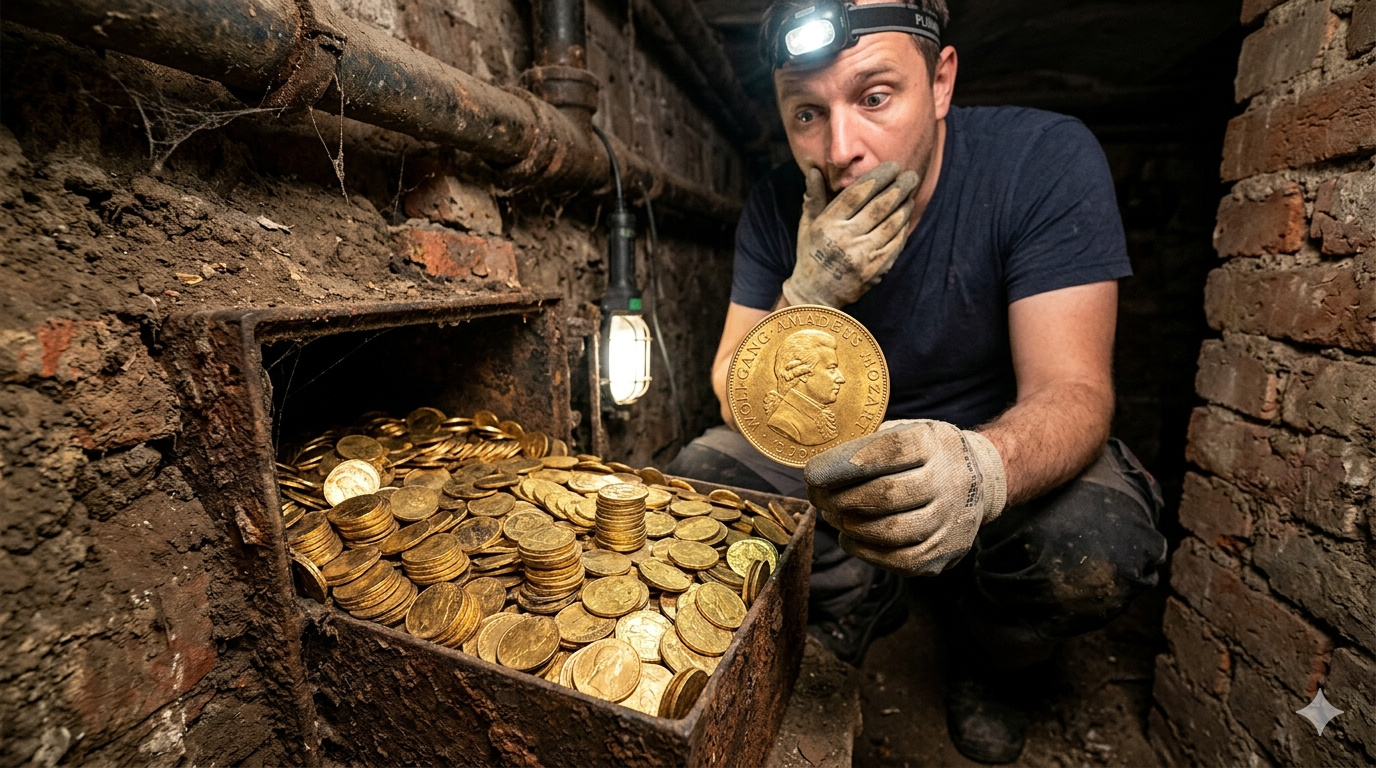
Plumber finds 30 kg of gold coins with Mozart’s face in a Vienna basement; hidden treasure buried before World War II worth millions
In November 2024, during the renovation of a basement in a villa in the Penzing district of Vienna, a 66-year-old plumber discovered about 30 kilograms of gold coins hidden under the concrete. According to a report from The Jerusalem Post, the find includes pieces stamped with the face of Wolfgang Amadeus Mozart and was valued at approximately 2.3 million euros. The case quickly gained international attention for involving a treasure buried before World War II and never recovered by the original owners.
The discovery occurred after the professional noticed an unusual cord protruding from the floor. Upon investigating the spot, he revealed a metal box buried for decades. The episode has become one of the most emblematic recent cases of historical treasures found accidentally in Europe, combining historical context, financial value, and legal implications.
Discovery in the basement in Vienna: plumber finds gold coins hidden under concrete
During the structural renovation of the property, the plumber noticed a partially exposed cord in the basement’s concrete. When he tried to pull it, he encountered resistance. He then used tools to break the floor around it.
-
A couple buys an old chalet, breaks the kitchen floor for renovation, and finds over a thousand coins of gold and silver hidden since the English Civil War over 4 centuries ago.

-
Rigid bags with their days numbered: new trend prioritizes comfort in 2026.

-
YouTuber creates an excavator equipped with a giant 4.5-meter sword to challenge his brother to a rematch, and the invention quickly goes viral on social media.

-
The U.S. Army surprises the world by presenting the UH-60MX Black Hawk helicopter capable of flying without pilots, controlled by a tablet, featuring the MATRIX system, smart sensors, and full autonomy in real combat and rescue missions.


Under the layer of concrete, a rusty metal box emerged containing approximately 30 kilograms of gold coins. Each unit bore the image of Mozart, a central figure in Austrian culture.
The volume of the find impresses not only for its weight but also for the historical and numismatic value of the pieces, which exceeds the value of the raw gold due to their rarity and origin.
Worker ignored the cord a day before and lost million-dollar fortune
A detail that amplified the case’s repercussions was the report that a mason had seen the same cord the day before but chose to ignore it.
Other workers also passed by the site without investigating. None of them realized they were just a few centimeters away from a treasure valued at millions of euros.
The plumber, with over 50 years of experience in construction, interpreted the irregularity differently. The accumulated experience and attention to small details were decisive in transforming an apparently trivial element into a million-dollar discovery.
Box with Mozart coins: origin of the gold buried before the war
The box found in the basement contained pure gold coins dated before World War II. Experts point out that the treasure was buried by a family living in the villa to avoid confiscation or looting during the period of instability in Europe.

In the 1930s, Austria faced profound transformations, including annexation by Nazi Germany in 1938. In this context, hiding wealth in physical gold was a common practice among families fearing the loss of their possessions.
The fact that the treasure was never recovered suggests that the original owners did not return to the property after the conflict, a scenario consistent with the fate of thousands of displaced or persecuted families during the war.
Historical mystery: family that buried the gold never returned to recover
So far, there is no official confirmation about the identity of the family that buried the gold. The property has changed owners over the decades and has undergone various superficial renovations.
No previous intervention was deep enough to reach the area where the box was buried. Only the recent structural renovation allowed for the discovery.
The absence of return over nearly 80 years has raised questions in the European press and on social media. The case raises hypotheses directly linked to the context of the Holocaust and forced migrations in Central Europe, although there is no official confirmation about the exact origin of the family.
Austrian law on found treasures defines division of million-dollar value
In Austria, discoveries of this kind follow specific rules. Any find must be reported to the authorities, who notify the agency responsible for historical heritage.
The legislation establishes that the value of the treasure is to be divided between the discoverer and the property owner. In the case of the plumber from Vienna, this means he could receive between one-third and half of the 2.3 million euros.
The mason who ignored the cord the day before has no legal rights over the find. This type of legislation seeks to balance property rights with incentives for reporting archaeological discoveries, preventing the concealment of historical assets.
50 years of experience in construction was decisive in finding the treasure
The plumber stated in an interview with the Austrian magazine Heute that he has been working in construction since he was 15 years old. Throughout his career, he has found common objects, such as isolated coins, but never anything of this magnitude.
The statement reinforces an important technical aspect: experienced professionals develop a keen perception to identify irregularities in structures.
In the case of Vienna, the difference between ignoring and investigating an apparently irrelevant detail resulted in a million-dollar discovery, highlighting the role of practical experience in construction environments.
Gold coins with Mozart: historical and numismatic value of the found pieces
The coins found are part of the Austrian tradition of minting precious metals, with a focus on commemorative series related to Mozart.
Austria has one of the oldest mints in the world, active since 1194. Coins featuring the composer’s likeness are widely recognized in the international market.
With about 30 kilograms of gold, the intrinsic value of the metal already exceeds 2 million euros. However, the numismatic value could be even higher, depending on the rarity and condition of the pieces.
This transforms the find into a simultaneously relevant historical and financial asset, increasing interest from collectors and institutions.
Hidden treasures in Europe: historical pattern of discoveries during renovations
The case in Vienna follows a recurring pattern in Europe. Various treasures have been found during renovations of old properties.
In England, a couple found over a thousand coins in a 17th-century cottage. In Germany, a worker discovered medieval coins while installing piping. In Poland, a family found 16th-century coins during home renovations.
In all cases, the context is similar: wealth hidden during periods of conflict and forgotten over generations.
These discoveries reinforce the lasting impact of historical events on European material heritage, often preserved involuntarily.
Why families buried gold at home during wars and crises
Burial of gold in one’s own property was a rational strategy in the face of extreme instability scenarios. Banks could be confiscated, safes broken into, and properties taken by military forces.
In Austria during the 1930s and 1940s, physical gold represented one of the few secure ways to preserve wealth.
The choice to hide the treasure in the basement ensured immediate access in case of flight, as long as the owners could return later, which did not always happen.
Plumber could receive up to 1 million euros with discovery in Vienna
Considering the division stipulated in Austrian legislation, the plumber could receive between 770,000 and 1.15 million euros, equivalent to about 6.7 million reais at the 2024 exchange rate.
After more than five decades of work in construction, the discovery represents a significant change in financial reality. The irony of the case is that the largest find of his life occurred during a routine activity, without any prior planning.
The mason who ignored the cord the day before remains anonymous. However, his decision has become one of the most discussed points of the story. The difference between finding millions in gold and continuing with daily routine was determined by a choice made in a few seconds.
The episode highlights how seemingly simple decisions can lead to large-scale consequences, especially in unpredictable environments like construction and renovations.
Vienna and Mozart: cultural context reinforces symbolism of the treasure found
Vienna is one of the cities most associated with the figure of Mozart. His image is present in tourist products, museums, and cultural events. However, in the case of the basement, Mozart ceased to be merely a cultural symbol to represent concrete financial value.
The coins transformed a cultural element into a tangible asset of high value, reinforcing the symbolic impact of the discovery.
More than the financial value, the find reveals the story of a family that lived, accumulated wealth, and disappeared without recovering their belongings. The gold remained intact for decades, protected by concrete. The family, however, never returned.
The contrast between the preservation of material heritage and human disappearance makes the case a silent portrait of the lasting effects of World War II.










Seja o primeiro a reagir!