





 Portuguese
  English
  Spanish
  7 min of reading
  2 comments


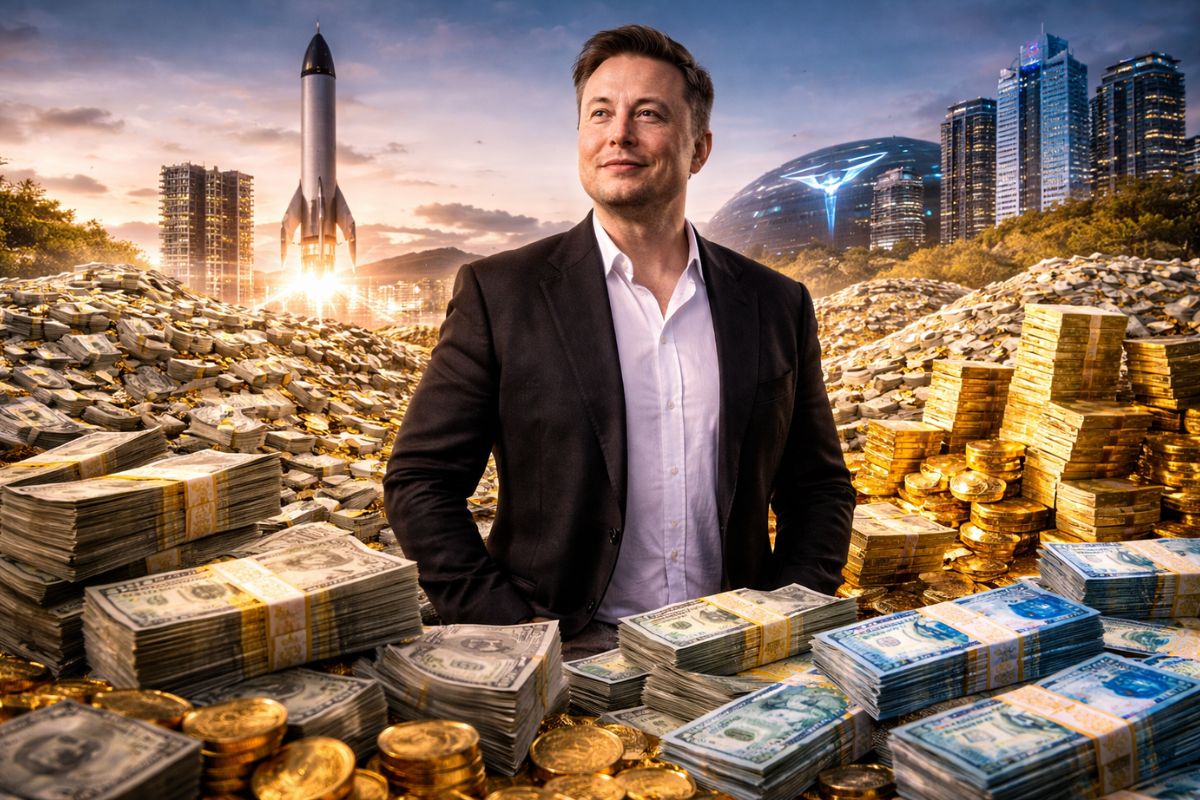


With R$ 2.5 Trillion, Elon Musk’s Fortune Could Allow R$11,715 Per Person Among 213.4 Million in Brazil. The Calculation Exposes Global Concentration, Surpasses the GDP of Uruguay, Bolivia and Paraguay, and Shows How Technology Multiplies Wealth While the Common Salary Would Take Millions of Years to Reach Similar Values Today
Elon Musk’s fortune has been put into perspective in Brazil by a direct and brutal calculation: with an estimated net worth of R$ 2.5 trillion, a hypothetical division among 213.4 million inhabitants would result in R$11,715 for each Brazilian. This exercise does not describe a real policy, but serves as a measure to gauge economic scale, income, and purchasing power.
In Brazil and in comparison with neighbors in Latin America, Elon Musk’s fortune also appears as a mirror of global concentration: when an individual wealth is compared with the GDP of countries, the reference of magnitude shifts. The discussion moves from being merely “a lot of money” to becoming a phenomenon of national proportion, with theoretical effects on consumption, inflation, credit and the perception of inequality.
The Calculation of R$11,715 Per Brazilian and What It Really Measures in Brazil
The division of R$ 2.5 trillion by 213.4 million creates a number that is easy to visualize, but what it measures is not “how much each one would actually receive.” It measures the size of the disparity between an extreme concentration of wealth and everyday economic life in Brazil, where most financial decisions occur at the scale of household budgets, installments, debts, and salaries.
-
A forgotten cord on the floor of a basement in Vienna leads a plumber to a box containing 30 kilograms of gold with Mozart’s face, hidden before World War II. The treasure, worth 2.3 million euros, was just centimeters away from a worker who ignored the sign a day earlier.

-
A couple buys an old chalet, breaks the kitchen floor for renovation, and finds over a thousand coins of gold and silver hidden since the English Civil War over 4 centuries ago.

-
Rigid bags with their days numbered: new trend prioritizes comfort in 2026.

-
YouTuber creates an excavator equipped with a giant 4.5-meter sword to challenge his brother to a rematch, and the invention quickly goes viral on social media.


This type of calculation has a technical role: it translates an abstract figure into something comparable to daily life. In Brazil, R$11,715 could mean paying off overdue bills, replenishing savings, paying installments, replacing an essential item, regularizing one’s name, or simply gaining breathing space for a few months. The central point is that Elon Musk’s fortune is large enough to transform, in this simulation, into a relevant unitary value when diluted across an entire country.
The Hypothetical Impact on Consumption, Retail, and Credit in Brazil
If R$11,715 reached the accounts of 213.4 million people in Brazil simultaneously, the first wave would tend to be practical and immediate: paying off debts and normalizing credit. Thousands of families would use the amount to settle outstanding issues and regularize their situation in the market, altering the dynamics of delinquency and freeing access to financing and installment purchases.
The second wave would be consumption: an instant boost in retail. Even without detailing specific sectors, the mechanism is known: when many people increase spending at the same time, the demand for goods and services rises rapidly, and companies begin to deal with queues, deadlines, stocks, and replenishment. In Brazil, this would likely be felt in essential purchases and pent-up expenses, especially where the salary is usually spent almost entirely month to month.
The third wave would be the adjustment of the financial system. More liquidity in people’s pockets means changes in demand for credit, renegotiations, early payments, and rearrangements in cash flow. In simple terms, money circulating en masse accelerates the economy, but also amplifies tensions that arise when supply does not keep up.
Why Inflationary Pressure Would Enter the Conversation Quickly
The report points to a plausible and recurring effect: temporary inflationary pressure. The reason is technical and straightforward: when demand suddenly rises, the supply does not reorganize at the same speed. The result tends to be price increases, especially for items with slower supply chains or limited production capacity in the short term.
In Brazil, this could happen even if part of the population used the money for debts. Still, the portion that would convert the amount into consumption would cause demand to grow rapidly. In practice, such a demand shock often appears first where purchases are immediate, repeated, and sensitive to the wallet. This is why, even as a simulation, the calculation of Elon Musk’s fortune becomes a trigger to discuss price stability and market responsiveness.
GDP of Neighbors: When an Individual Fortune Exceeds National References
The comparison with the GDP of neighboring countries in Latin America highlights the discrepancy between the annual production of an economy and the wealth accumulated by an individual. In the presented cut, Musk’s wealth exceeds the market value of several nations combined, and when confronting smaller countries, the contrast becomes even more visible.
The very cited list points to the meaning of the disparity:
The GDP of Uruguay represents only a small fraction of the total capital held by the businessman. Bolivia’s economy would need decades to generate the value accumulated by the investor. Paraguay’s production underscores the concentration of income at unprecedented global levels.
This type of comparison is important because the GDP is not “cash in hand,” but rather a measure of production over a period. Still, the scale shock is real: Elon Musk’s fortune approaches magnitudes that are typically associated with countries, public policies, and macroeconomic planning.
What Changes When Wealth Becomes “Power of Scale” in the Real World
When an individual wealth reaches a trillion-dollar level in local currency, it is not just a number. It transforms into financing capacity, decision-making power, and international reach. Even without detailing external mechanisms, the central argument is clear: capital of this scale allows for global initiatives and ambitious projects, often comparable to the financial power of states.
In practice, the consequence is a displacement of reference: the debate moves from the personal sphere to the arena of global wealth concentration, where the distance between extreme fortunes and common income becomes an economic, social, and political issue. In Brazil, this contrast becomes even more sensitive because labor income, salary, and the cost of living are already recurring themes in daily life.
Salary and Time: Why “Working to Get There” Becomes a Mathematical Impossibility
The most compelling part of the comparison appears in the time necessary to reach the fortune based on known annual incomes. The idea is not to suggest that someone “should” reach trillions, but to highlight that the distance between salary and extreme wealth is not just large. It is temporally absurd.
The table presented details the estimated time to reach Musk’s fortune based on known salaries in the Brazilian market:
Profession: Minimum Wage. Estimated annual income: R$ 21,000. Time needed: 119 million years.
Profession: Specialist Doctor. Estimated annual income: R$ 360,000. Time needed: 6.9 million years.
Profession: Senior Developer. Estimated annual income: R$ 200,000. Time needed: 12.5 million years.
Profession: Executive Director. Estimated annual income: R$ 1,500,000. Time needed: 1.6 million years.
Even at the top of the mentioned salaries, the number remains outside human scale. This is the technical point: when salary becomes the measure, Elon Musk’s fortune appears as something that cannot be reached through the accumulation of conventional work, because the timeline explodes into millions of years.
Technology and Market in 2026: The Gear That Accelerates Trillions
Musk’s wealth in 2026 is associated with the technological advancement of companies like Tesla and SpaceX, described as the foundation of his financial empire. The logic presented is that of capital markets: constant innovation in strategic sectors is rewarded with appreciation, and this appreciation is reflected in net worth.
Here, the key word is speed. The report emphasizes that Elon Musk’s fortune can experience billion-dollar fluctuations within hours due to financial volatility. This means that it is not just about “revenue” or “high salaries,” but about assets whose pricing changes rapidly according to expectations, performance, and market mood.
In summary, technology acts as the engine and the market as the accelerator. When both align, the formation of trillions can occur in short appreciation cycles, something that traditional salaries cannot keep up with because they depend on time and monthly repetition.
Volatility: Why Billions Can Appear and Disappear in Hours
Net worth, when based on market assets, is not a static figure. It varies with evaluations and pricing. This is why the report describes billion-dollar changes in a matter of hours: the market reacts to expectations, results, and projections, and the value associated with wealth follows suit.
This element is crucial to understanding the narrative. Elon Musk’s fortune is not presented as a pile of stagnant money but as a set of shares and values subject to fluctuations. In Brazil, where labor income tends to be more predictable and linear, this contrast reinforces the idea that the world of the largest fortunes operates on a different logic than that of salary.
Financial Education: What to Observe to Understand the Leap Between Salary and Trillions
The final block connects the theme to economic understanding. Following the trajectories of large investors and market dynamics offers a lens to interpret why wealth moves and concentrates. Three points are highlighted as reasons to delve deeper into the topic:
Understanding the capital market opens doors to new forms of profitability and asset protection.
Asset management aids in building a solid and resilient financial foundation over time.
Exploring applied innovation reveals which sectors will receive the largest investments in the coming years.
In Brazil, this debate tends to gain traction because it touches on two ends at once: on one side, salary and cost of living; on the other, technology and appreciation, capable of creating and evaporating billions quickly. Elon Musk’s fortune, expressed in reais and distributed in a per capita calculation, transforms a distant number into a concrete measure of scale inequality.
Do you think that, in Brazil, the discussion about Elon Musk’s fortune should focus more on the technology that creates trillions or on the contrast with the salaries that would never reach that level?









Que texto ridículo. “Tamanho do desnível da concentração de riqueza”. O Bruno que escreveu isso sabe que ele não tem esse dinheiro na conta do banco? Que os valores representam o percentual de equity que ele possui e nãode dinheiro líquido?
Recomendo à página que invista mais em instrução de seus funcionários.
E dá pra viver quantos meses com isso? Vai acabar com a miséria no mundo se distribuir a riqueza dele? É bom você mostrar pra gente que nem assim ia adiantar alguma coisa.
O bostileiro padrão ia pegar os 11k e comprar Iphone, e continuar passando fome.