





 Portuguese
  English
  Spanish
  4 min of reading
  0 comments


Nuclear Fusion: Overcoming Greenwald’s Limit and Paving the Way for Clean and Sustainable Nuclear Energy. Discover More!
At CPG, we have often discussed the challenges that those researching in the field of nuclear fusion must overcome for the first commercial reactors to succeed. We talked about the need to develop new types of steel capable of minimally activating in response to the impact of high-energy neutrons; about the importance of stabilizing the plasma and controlling turbulence, etc.
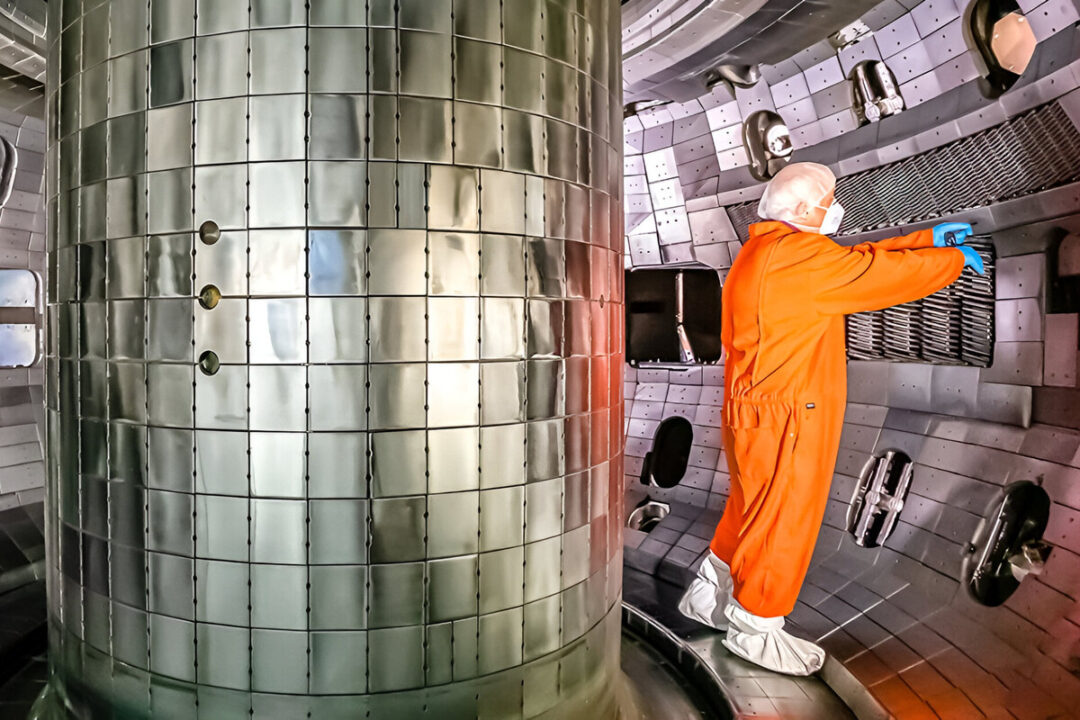
However, until now, we have only briefly addressed the reason why each new experimental nuclear fusion reactor is larger than the previous one. In fact, when the assembly of ITER (International Thermonuclear Experimental Reactor) is completed, the fusion machine being built by an international consortium led by Europe in the French locality of Cadarache, it will be the largest experimental reactor on the face of the Earth. And it will not be, of course, by mere chance.

Nuclear Fusion and Greenwald’s Limit
In experimental nuclear fusion reactors, such as ITER, scientists confine the nuclei of deuterium and tritium using a magnetic field. What happens is that, no matter how powerful this field is, it always has a limit of intensity, and the particles, when produced, acquire very varied energies. Some have a lot of energy, while others acquire little energy. The engineers of the reactors are able to contain the average energy, but those particles that exceed this energy value have the capability to escape from the magnetic field.
-
Fukushima Marks A Turning Point In Japan’s Energy Policy: After The Disaster, The Country Shut Down Its 54 Nuclear Reactors And, 15 Years Later, Only A Small Portion Have Returned To Operation
-
How Japan Overcame The Nuclear Bomb And Now Houses Millions In Hiroshima, While Ukraine Lost Chernobyl?

-
Bill Gates Receives Historic Approval to Build Giant 345 MW Nuclear Plant in the U.S. and Promises to Generate Up to 500 MW of Energy with Innovative Technology

-
India Opens Nuclear Energy to Private Capital to Accelerate Projects and Attract Billions, While Brazil Remains Stalled at Angra 3 and Discusses Who Will Foot the Bill for Completion

The problem is that if too many particles escape, a lot of energy is lost, and it is not possible to sustain the fusion reaction over time. Fortunately, this challenge can be solved by modulating the magnetic fields and increasing the size of the plasma. This is the reason why each experimental reactor is larger than the previous one. Scientists believe that ITER is the appropriate size because the more particles there are around one that wants to escape, the more likely it is that it will collide with another on its escape path and change direction or transfer its energy.
In Search of Stability in the Fusion Reaction
Ultimately, what scientists working with fusion seek is for the energy that escapes to be small enough so that a declining energy level does not occur within the reaction. This has already been achieved in JET, but it was achieved for a short time, as it is not possible to maintain the effort for a prolonged period due to the lack of size, viewed very simplistically. In any case, good news has just emerged. A research group from the American company General Atomics published a paper in Nature that makes a significant contribution in this area.
The Greenwald limit establishes the maximum density value that the fuel can reach within the vacuum chamber of a nuclear fusion reactor. In theory, exceeding this value within a tokamak reactor can lead to a disruption, which is an event where the plasma destabilizes, the magnetic confinement is interrupted, and the fusion reaction ceases. A disruption can cause serious damage to the inner walls of the vacuum chamber, depending on the energy of the particles that escape confinement and collide with them.
Exceeding the Greenwald limit does not guarantee that a disruption will occur, but the physicists and engineers working with tokamak reactors had so far considered this parameter a barrier they could not ignore. The contribution that the scientists from General Atomics made is very relevant because they managed to empirically prove some working conditions that allowed them to sustain plasma stability with a density 20% above the Greenwald limit for 2.2 seconds.
In their experiment, they used a tokamak reactor with a radius of 1.6 meters (ITER will have a radius of no less than 6.2 meters) and a gas containing deuterium nuclei (the ITER fuel will incorporate both deuterium and tritium nuclei). As we have seen, it is very important that the plasma density is sufficiently high to minimize the probability of significant energy losses caused by particles that manage to escape from magnetic confinement. And now, researchers working with tokamak reactors know that it is possible to exceed the Greenwald limit to work with the density required to sustain the fusion reaction. There is no doubt that this is great news.
Image: General Atomics
Source: Nature









-

Uma pessoa reagiu a isso.