





 Portuguese
  English
  Spanish
  5 min of reading
  0 comments


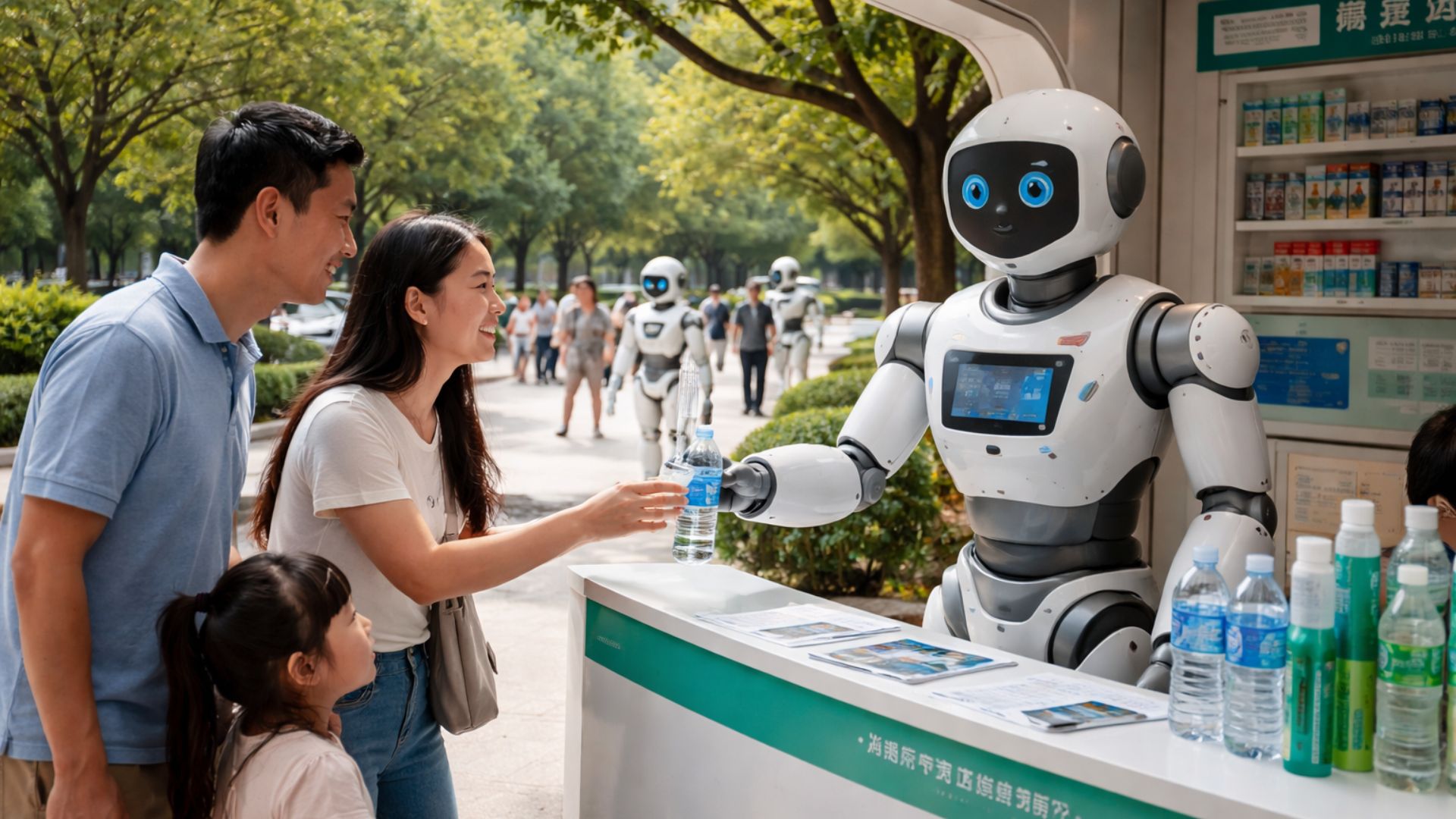
Urban experiment in Shenzhen deploys robots to guide visitors, patrol areas, and interact with the public in real-time, combining service, technological testing, and entertainment in an open park as part of a broader strategy to integrate artificial intelligence into the daily life of cities.
China launched, on March 20, what local authorities and state-run Chinese media presented as the first volunteer robot station in the country in a public park.
The structure was installed at Qianhai Stone Park in Shenzhen, in the south of the country, with machines focused on service, guidance, patrolling, educational actions, and presentations for visitors.
The initiative brings together robots developed by local companies and is part of a broader strategy in Shenzhen to expand the everyday use of artificial intelligence and automation technologies in urban spaces.
-
Millions of people have been eating yam for centuries without knowing that this humble tuber contains a compound called diosgenin, which scientists have now discovered can improve memory and help control blood sugar levels.

-
Scientists from an international project drill 1,800 meters of ice in Antarctica using hot water and discover details about one of the most intriguing places on planet Earth.

-
Seen from space, a colossal volcano nearly 5,000 meters high in Russia has released 1,600 km of smoke over the Pacific, forming “devil’s horns” of lava and revealing the brutal force of the Ring of Fire.

-
Expedition 501: Scientists drill into the ocean floor and discover a giant reserve of fresh water hidden beneath the sea, extracting nearly 50,000 liters and revealing an invisible system that could reshape the map of water scarcity.


In practice, the station functions as a public showcase and, at the same time, as a testing environment for services that depend on direct interaction with residents and tourists.
Images distributed by China News Service and reproduced by international media show robots positioned at a fixed service point, delivering drinks and insect repellent, answering questions, and circulating around the park.
Some of the equipment also performs choreographed movements, in a combination of service, technological demonstration, and entertainment that caught the attention of passersby.
How the robot station in Shenzhen works

According to coverage published in the Chinese press, five “volunteer robots” began operating simultaneously in the park, within a model that associates machines with tasks traditionally performed by attendants at public support points.
The project was built in partnership between the Qianhai Authority in Shenzhen and the local Communist Youth League.
The functions assigned to the equipment go beyond simple reception.
The robots were presented as capable of offering daily consultations, convenience support, patrol reminders, knowledge dissemination actions, explanations about policies, emergency support, public interaction, and entertainment performances, totaling eight service fronts described by local authorities.
In this format, the station does not operate merely as an automated counter.
It distributes tasks among machines with distinct profiles, some more suited for conversing with visitors, others designed for circulation and monitoring of the space.
The stated goal is to observe, in a real situation, how these systems react to a public environment subject to varied flow, noise, and unpredictable demands.
One of the machines mentioned in the coverage is the robot Oli, described by Cheng Peng, a volunteer at the park station, as responsible for providing general information, conducting guided tours, interacting with the public, and performing presentations.

In the same material, Cheng Peng stated that another robot, from Xingchen General Robot Co., was primarily designed to patrol the park, issue safety and etiquette reminders, and respond to visitors’ questions along the way.
The description reinforces the division between robots focused on welcoming and equipment aimed at circulation, observation, and practical guidance.
Robotics testing in real public environments
The reading made by those responsible for the initiative is that the station should not be seen merely as a technological attraction.
The constant presence of robots in a public park allows for measuring, with real and moving people, factors such as communication clarity, response time, navigation ability, and social acceptance of the equipment, items that are difficult to fully replicate in closed laboratory environments.
This type of test interests developers because the use of robots in open areas requires permanent adaptation.
In a park, the equipment needs to deal with children, the elderly, large groups, changes in paths, and spontaneous requests, without losing operational stability.
Therefore, the station was presented as a practical step to improve the coexistence between machines and users in real urban scenarios.
At the same time, the experience serves to evaluate to what extent service and support tasks can be partially absorbed by automated systems in public services.
The proposal released by the authorities in Shenzhen is to observe everyday uses, not just industrial applications, expanding the field of robotics to routines related to information, hospitality, prevention, and basic assistance.
Shenzhen bets on artificial intelligence and urban automation

The inauguration of the station comes at a time when Shenzhen is intensifying policies and projects related to artificial intelligence and robotics.
A report from Xinhua agency describes the city as an urban laboratory for these technologies, with initiatives that include robots in subway screening, patrolling, digital public services, and programs to stimulate the local industry.
According to the same report, the Longgang district created, in March 2025, the first administration dedicated to artificial intelligence and robotics in China, while the municipality advances with funds, vouchers, and plans aimed at the adoption of intelligent systems.
In this context, the Qianhai Stone Park station appears less as an isolated episode and more as a piece within an expanding urban policy.
The choice of Shenzhen also helps explain the symbolic dimension of the project.
The city is one of China’s main hubs for technology and advanced manufacturing, in addition to concentrating companies related to hardware, software, and automation.
When an experiment of this kind migrates to a public park, the institutional message is that robotics has ceased to be a topic restricted to factories and specialized fairs.
Robots between public service and entertainment
The material released about the station shows a deliberate combination of utility and visual appeal.
While some robots answer questions about the park and offer basic items to visitors, others dance and interact playfully, a strategy that increases public curiosity and facilitates initial contact with technology, especially in a leisure space frequented by families.
Still, the spectacle dimension does not eliminate the operational function announced for the machines.
The coverage by the Chinese press highlights that the robots can guide movements, reinforce coexistence rules, give safety warnings, and provide support in emergency situations, indicating that the station’s proposal is to combine hospitality, urban pedagogy, and technological demonstration in a single service point.
In practice, the experiment observes a theme that several cities are following with interest.
For now, the case of Shenzhen serves as a limited-scale test but already anticipates a trend where robots leave the controlled environment of exhibitions and begin to compete for a place in the everyday landscape.







Seja o primeiro a reagir!