





 Português
  Inglês
  Espanhol
  4 min de leitura
  9 comentários


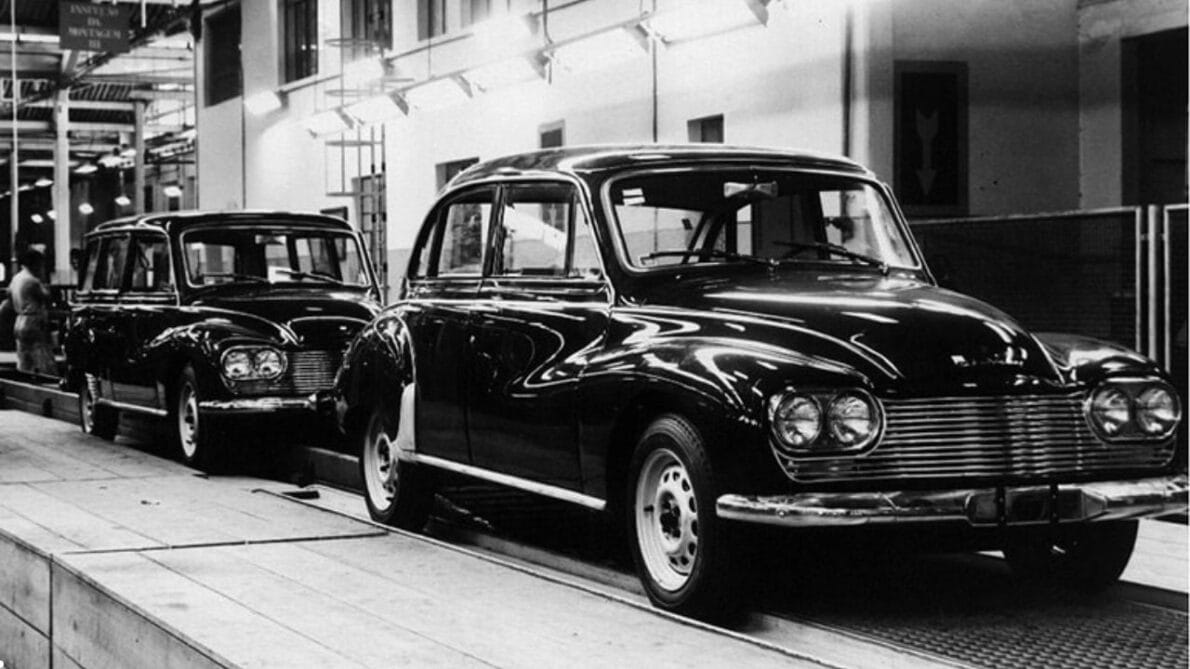


With Noisy Engines, Suicide Doors, and Innovative Ideas, DKW Vemag Marked an Era. The History of DKW Vemag in Brazil Involves Pioneering, Boldness, and an Ending That Surprised Even the Most Faithful Fans.
The history of DKW Vemag in Brazil begins at a time when the country was still crawling in the automotive sector. It was in the Ipiranga neighborhood of São Paulo that Studebaker do Brasil was established in 1945, responsible for assembling imported vehicles in disassembled form. But it was only in 1952, after the merger with Elite, that Vemag – Veículos e Máquinas Agrícolas S.A. was officially born. Initially, the new company focused on assembling trucks and tractors.
It was only in 1956, during the government of Juscelino Kubitschek and the incentives of GEIA (Executive Group of the Automotive Industry), that Vemag decided to bet on the production of passenger cars. And they did so boldly: forming a partnership with the German DKW to produce their vehicles under license. From then on, DKW Vemag was officially born, a name that would become iconic among Brazilian enthusiasts.
The Line of Models That Conquered (and Intrigued) Brazilians
The first truly national car was from DKW Vemag. On November 19, 1956, the Universal, the first station wagon manufactured in Brazil, was launched. With rounded lines, circular headlights, doors that opened the opposite way (the famous “suicide doors”), and a simple but functional finish, it was practical and displayed a unique charm.
-
OMODA & JAECOO grows in Europe in 2026 with an integrated strategy of sales, innovation, local production, and technological advancement in the United Kingdom, Italy, and Spain.
-
OMODA & JAECOO expands after-sales service in Brazil with competitive maintenance, a 7-year warranty, and high availability of parts for technological SUVs.
-
OMODA & JAECOO appoints Alessandra Souza as executive marketing director in Brazil and accelerates brand expansion with a focus on innovation, networking, and hybrid portfolio.

-
Jaecoo 7 with super hybrid SHS system exceeds 1,200 km of combined range with a 1.5 turbo engine, high-density battery, and intelligent energy management.

Next came the Candango jeep, launched in 1958. With all-wheel drive, robust approach angles, and a fearless off-road behavior, it was a favorite among adventurers despite having a short life, being discontinued in 1963.
Then came the Belcar sedan, also in 1958, with a more urban look and capacity for six occupants. It was comfortable, spacious, and maintained the brand’s signature: three-cylinder, two-stroke engine, and column-mounted transmission. In 1964, refinement came with the 1000 series: improvements in finishing, conventionally opening doors, and an upholstered dashboard.
You can’t talk about the history of DKW Vemag in Brazil without mentioning the elegant Fissore (1964), the sporty GT Malzoni (1965), and the bold Carcará, developed exclusively to break the national speed record. On June 29, 1966, it reached 212.9 km/h on a straight stretch of Barra da Tijuca, a remarkable feat for a national vehicle of the time.
The Peak of Innovation with the Two-Stroke Engine and Its Peculiarities


The beating heart of DKW Vemag was under the hood. Its vehicles used a three-cylinder, two-stroke engine, with solutions well ahead of their time and others that caused headaches. One such example was the need to manually mix two-stroke oil with gasoline at each refuel, which generated a lot of smoke and often an imbalanced mix.
The freewheel system, activated by a lever on the dashboard, allowed the car to keep moving as if it were in neutral, even with a gear engaged, which compromised engine braking but promised savings and smoothness. It was curious, different, and very “à la DKW”.
The peak of engineering came with the Lubrimat system, introduced in 1964 in the Fissore, which automated the mixing of oil and gasoline, making life easier for the driver and reducing smoke emissions. And, despite all the challenges, these engines were durable and delivered honest performance for the time.
The End of DKW Vemag in Brazil: The Silent Blow from Volkswagen
Everything was relatively fine until, in 1965, news from Germany changed the course of DKW Vemag’s history in Brazil. Volkswagen acquired control of Auto Union, the parent company of DKW, and with that began to dictate production directions in Brazil. In 1967, Volkswagen do Brasil bought Vemag.
And that’s when the end began. DKW models were already struggling with declining sales and fierce competition from new cars with more modern and economical engines. VW, eager to expand its lineup with the Beetle and its variations, did not allow DKW models to evolve. Gradually, production was interrupted until, by the end of 1967, the DKW brand disappeared from Brazilian assembly lines.
It was a farewell without ceremony, but not without significance. DKW Vemag was a pioneer in many aspects and left a technical and historical legacy that is hard to ignore. Its vehicles still roam at classic car gatherings and spark curiosity among those who see a noisy engine, emitting bluish smoke, with a charm that has crossed decades.
A Noisy, Smoky, but Unforgettable Legacy
Even though the end was discreet, the history of DKW Vemag in Brazil remains alive in the memories of classic car enthusiasts. Its models innovated in design, technology, and were the first to pave the way for the national automotive industry.
With their simple yet ingenious engines and peculiar designs, DKW Vemag showed that Brazil could indeed manufacture cars. And more than that: that these cars could be unique, different, and remarkable. The brand is gone, but the unmistakable sound of its two-stroke engine still echoes in the streets of those who preserve this special part of Brazilian automotive history.
Source: Automotive Relic









Eu tenho uma dúvida, é sobre o Candango. Eu não lembro dele 4×4 e sim 4×2 com tração dianteira como todos DKW.
Meu pai tinha um com diferencial traseiro. Apenas estava sem o cardam para ser mais economico pois o uso era urbano.
Eu dirigia uma dessas peruas que era do meu pai. Não fazia muita fumaça mas tinha um cheiro de óleo que eu adorava quando criança. Saudades, vontade de ter um hoje.
Meu pai teve uma Vemaguete Bordô com assento branco…perto dos anos 60….