





 Portuguese
  English
  Spanish
  7 min of reading
  1 comment


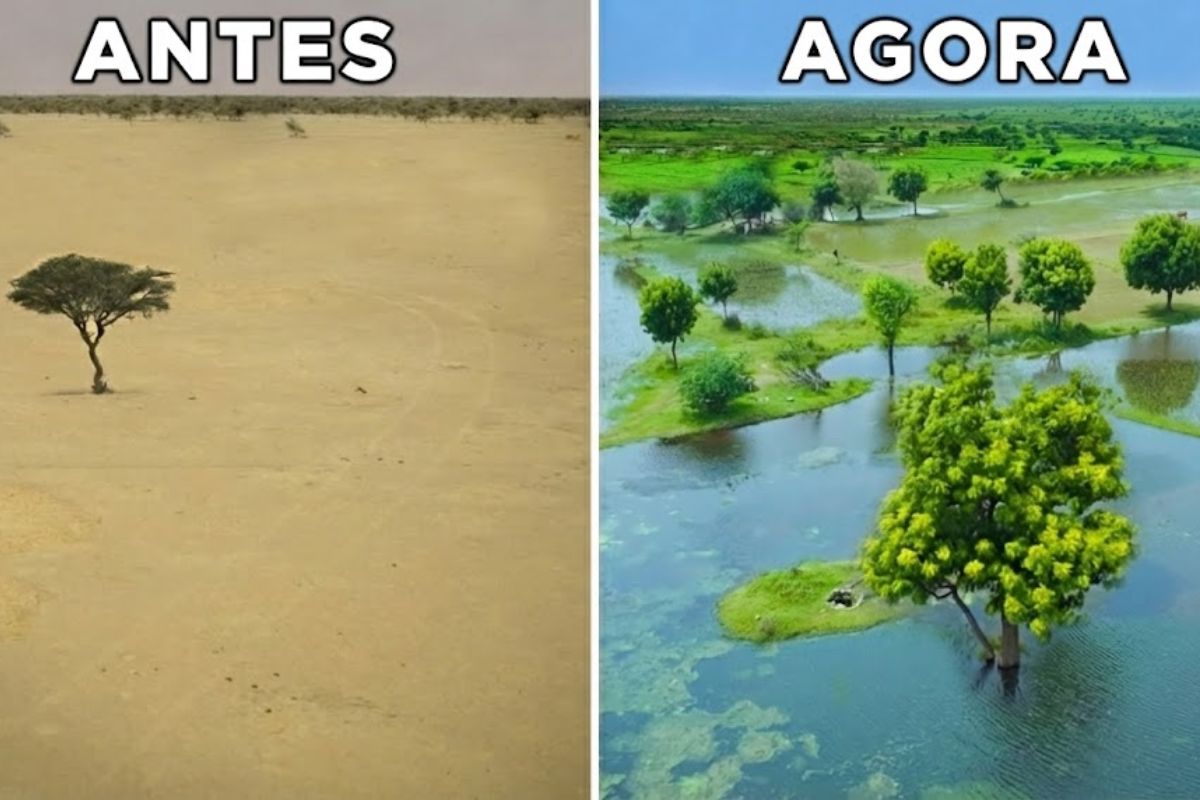


After 40 Years of Water Collection, GRAVIS Shows in Rajasthan That the Thar Desert Can Support Crops with Rainwater: Well-Placed Surface Lakes, Fields That Become Catchment Basins, and 20,000-Litre Underground Domestic Tanks Reduce Chronic Shortage and Elevate Productivity.
In the northwest of India, the Thar Desert is described as the most densely populated desert in the world, where 25 million people live under extreme heat and with rare rainfall, often just one, two, or three times a year. In this scenario, water collection ceases to be a point technique and becomes the axis that separates permanent scarcity from stable agriculture.
What appears to be a “miracle” in Rajasthan is the sum of local organization and three solutions replicated on a large scale: surface lakes in the right place, fields designed to capture rainwater, and underground domestic tanks for drinking water. GRAVIS has been working in this logic for about 40 years and argues that the method can redesign agriculture in arid regions in the coming years.
The Thar Desert and the Size of the Water Challenge

The Thar Desert is presented as one of the hottest regions in the world and, at the same time, a territory where life depends on taking advantage of rare rainfall windows.
-
They said no to 26 million dollars and would do it all over again: mother and daughter from Kentucky reject a million-dollar offer from a mysterious company that wants to build the largest data center in the state on more than 2,000 acres of rural land.

-
While corn requires rain and is expensive, sorghum produces almost the same volume per hectare at a cost up to 80% lower and uses less water, and it is revolutionizing dairy farming in the Triângulo Mineiro, where producers save hundreds of reais per hectare.
-
A rural producer from Urubici cries as he shows 50 tons of plums thrown on the ground because no one wanted to buy them, and in desperation, he records a video asking anyone to come to the property to pick the fruits before they rot.
-
Unable to pass through Hormuz, Brazil activated a plan B that uses Turkey as a gateway to the Middle East: the route through Gibraltar and the Mediterranean is longer and more expensive but ensures that chicken, beef, and corn continue to reach Arab markets.


The monsoon rains are described as short and intense, falling in a short time and causing water to flow everywhere during a very brief interval. This is the water that needs to last the whole year.
The geological limitation is treated as an objective barrier.
In the cited areas, no well works because the groundwater is saline, which pushes the strategy to the surface: capturing rainwater at the exact moment it falls and redistributing it with minimal loss possible.
Why Surface Lakes Became the Basis of Water Collection

In hot deserts, large volumes of open water face high evaporation, which would normally be an argument against surface reservoirs.
Still, in the Thar Desert, “large surface lakes” appear as a practical solution because the underground alternative via wells is unviable due to salinity.
The goal is to combine accessible storage and controlled infiltration, without relying on usable groundwater.
In this design, water collection is, above all, a choice of location.
The large lakes need to be in the right place within the landscape to maximize collection even with little rain, and the resource requires precise management so that overflow and agricultural use do not waste the collected volume.
The Perfect Lake: Large Basin, Permanent Water, and Domestic Use

A highlighted technical point is the size of the watershed that feeds the lake.
When the catchment area is large, the lake “will be filled” and may “never really dry up,” which transforms a short rain event into a stock that sustains months of use.
The construction is also described as communal: the lake was dug alongside the village residents, creating a permanent water source where previously the nearest large source was 10 kilometers away.
When water is needed for homes, a tanker truck arrives at the lake, takes the volume, and distributes it for local domestic needs, integrating human supply and productive planning.
When Overflow Becomes Connected Crops
The agricultural system is presented as a direct extension of the lake.
When the reservoir fills, the water overflows and floods connected fields, and the land is shaped with embankments to hold the volume long enough to infiltrate and store moisture in the soil.
The agriculture described does not depend on continuous irrigation, but rather on accumulated moisture after the rain event.
The operational detail is the connection between areas: spillways carry water to another series of fields, and in heavy rains, agricultural reservoirs overflow from one to the other.
The logic is simple and repeatable: each unit stores a bit, transfers excess, and reduces loss due to uncontrolled runoff.
Each Field as a Shallow Lake for Rainwater Collection
The second essential technique is explicit: “every farm” can function as a shallow lake for rainwater collection, and “each field” can be a catchment basin.
This matters because the farmer has only one opportunity to sow, and the catchment allows even a single precipitation to be sufficient to start the crop cycle, which grows with the moisture stored in the soil.
In practice, water collection becomes a landscape design: instead of relying on chance, the field turns into infrastructure, with forms, edges, and outlets calculated to hold and distribute rainwater.
Trees on the Crests: Soil Stability and Discreet Agroforestry
The described management is not limited to the reservoir.
Khejri trees are mentioned as being planted above the stakes, aligned to ground level, and there are plantings along the crests that help keep the dams in place when the water level rises.
The effect is direct: the soil remains stable, and erosion is reduced.
The integration between agricultural and tree crops is described as a discreet agroforestry system, with functional benefits.
Besides food, these trees provide fodder, wind protection, erosion control, firewood, and shade, sustained by the management of surface runoff and surface ponds.
GRAVIS: 1983, Lake in 2003, and 40 Years in the Thar Desert
GRAVIS is described as founded in 1983 and associated with the principles of Mahatma Gandhi, focusing on serving and supporting the poorest and most marginalized for a just and non-violent society.
An operational milestone cited is the construction of a lake by GRAVIS in 2003, within the set of conservation and natural resource management works in the Thar Desert.
In the economic design, the organization encourages rain-fed agriculture: when there are no means to store water for irrigation and for a second crop, crops are grown during the monsoon season.
The risk is described without softening: if it does not rain and the harvest is destroyed, the farmer is left without income.
Water Collection as a Turnaround for Productivity in Extreme Environment
The turning point appears when techniques manage to “collect almost every drop” of rain.
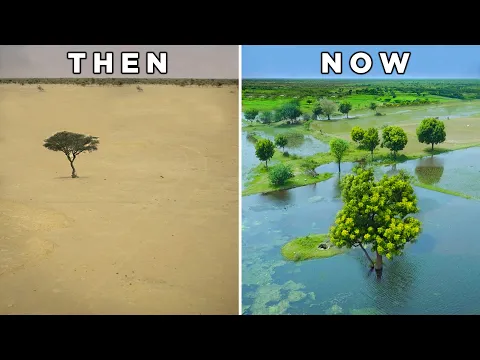
The text describes that, with this, fields become flooded and the landscape changes, with lush vegetation and a sense of moisture where dryness once dominated.
Water collection, in this framing, becomes a lever of productivity instead of just being an emergency response to scarcity.
GRAVIS is also described as a diffusion agent: teaching techniques to farmers who did not know them and supporting local adoption as part of the method.
The simplicity lies less in the absence of engineering and more in the repetition of understandable structures, maintained by village-level institutions.
The Third Technology: Water Collection at Home for Drinking Water
The third technique is domestic rainwater harvesting.
The argument is social: when there is no access to drinking water, women walk long distances every day to fetch water, and this affects the education of young women because travel time consumes the day.
In this context, underground rainwater harvesting tanks are described as crucial for everyday life in the Thar Desert.
These tanks are underground, made of ferrocement, and serve as a source of drinking water for many people, with collection from roofs and also from water flowing from the soil surface.
A Tank of 20,000 Liters, Sediments in Zigzag, and Stock for Five and a Half Months
An example describes an underground tank of 20,000 liters, linked to a small catchment area.
Water flows down from the hill, passes through diversion channels, and a zigzag sediment network to separate sediment from water before flowing into the reservoir.
The last mentioned rain kept a lake full for about five and a half months, and when necessary, the supply is supplemented by tanker trucks.
In the Village of the Goats, with a population estimated between 3,000 and 5,000, rainwater flowing from the roof is dumped into the reservoir, and a simple pump fills a bucket.
The account includes a change in routine: a family used to walk four kilometers to fetch water.
The irregularity of rainfall appears in measurements: in a bad year, 5 to 7 centimeters; in a good year, 38 centimeters, with the expectation of filling the tank and having water for half a year.
The domestic system also incorporates quality control: after previous issues with mineral-rich water, a sand filter was put in place to filter the water before it enters the tank when it arrives by tanker.
Ancient Technology and Large Scale: 300,000 Liters, 60 Years, and Silt Trap
Another structure is described as a tank dug into rock, which does not reach the groundwater but stores surface water in a deep underground reservoir.
The account attributes the construction to the grandfather and claims that the structure has been there for 60 years, with 300,000 liters stored, providing water for two families throughout the year.
The cited improvement is direct: GRAVIS installed a silt trap, making the structure more complete, as an example of successful ancient technology strengthened by technical adjustment and maintenance.
In Rajasthan, the transformation of sand into crops in the Thar Desert is narrated as the accumulated result of 40 years of water collection with three components that reinforce each other: surface lakes, fields as catchment basins, and underground domestic tanks.
The method appears simple because it is repeatable, but it depends on correct location, overflow management, sediment control, and local organization to keep each structure functioning.
As a practical action, the case suggests looking at rainwater as an annual asset and structuring water collection at community, agricultural, and domestic levels, with maintenance routines and local institutions capable of managing distribution, cleaning, and sediments, without relying on wells in areas with saline groundwater.
Do you think that water collection efforts, like in the Thar Desert, would work in Brazilian rural communities with short and intense rains?










Esse método funciona em qualquer lugar e só querer no deserto e mais complicado, no nordeste isso pode ser usado com maís facilidade ainda basta querer mais os desgoverno nordestino quer o povo dependente de carro Pipa