





 Portuguese
  English
  Spanish
  3 min of reading
  0 comments


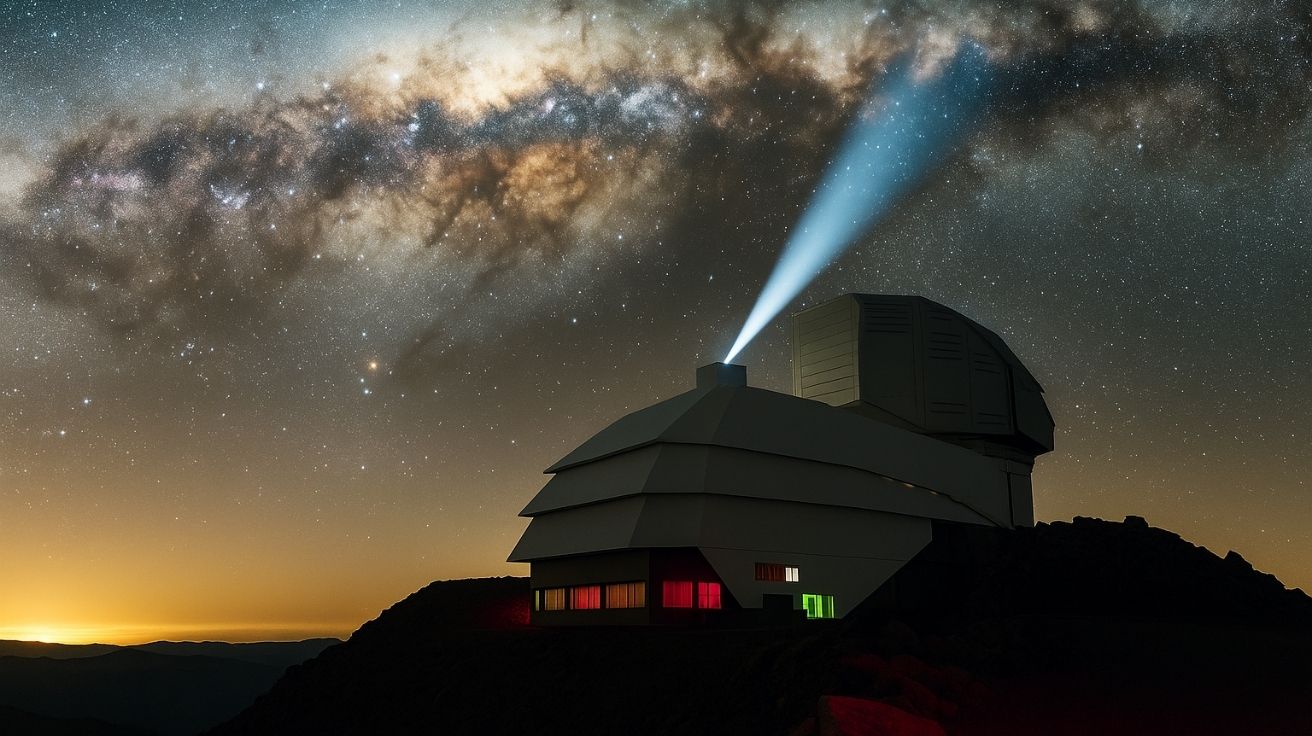
With Unprecedented Resolution Installed on the Vera C. Rubin Super Telescope, the Revolutionary Technology of the Largest Camera in the World Has Begun Testing in Chile and Will Be Able to Capture Stellar Explosions, Black Holes, and Asteroid Movements in Real Time
The Vera C. Rubin Observatory, located at the top of Cerro Pachón in Chile, began its first tests in June 2025 with the largest camera in the world, equipped with 3.2 gigapixels, promising to map 20 billion galaxies over the next decade through comprehensive sky surveys of the southern hemisphere every three nights.
Designed to capture ultra-high-definition images of the visible universe, the camera at the Rubin Observatory is the main instrument of the Legacy Survey of Space and Time (LSST) project, a ten-year scientific initiative supported by the U.S. National Science Foundation (NSF) and the Department of Energy (DOE).
-
Motorola launched the Signature with a gold seal from DxOMark, tying with the iPhone 17 Pro in camera performance, Snapdragon 8 Gen 5 that surpassed 3 million in benchmarks, and a zoom that impresses even at night.

-
Satellites reveal beneath the Sahara a giant river buried for thousands of kilometers: study shows that the largest hot desert on the planet was once traversed by a river system comparable to the largest on Earth.

-
Scientists have captured something never seen in space: newly born stars are creating gigantic rings of light a thousand times larger than the distance between the Earth and the Sun, and this changes everything we knew about stellar birth.

-
Geologists find traces of a continent that disappeared 155 million years ago after separating from Australia and reveal that it did not sink, but broke into fragments scattered across Southeast Asia.
The camera, which measures 1.6 meters wide and weighs about 2,800 kg, features 189 CCD sensors arranged in a matrix of 64 centimeters in diameter. Together, these units capture images of 3,200 megapixels in exposures of just 15 seconds, capable of recording both extremely distant objects and celestial bodies in motion, such as asteroids and comets.

In addition to its size and resolution, the differentiator of this equipment is its ability to continuously update a massive digital map of the universe. This will be done with the help of an 8.4-meter telescope installed in the same observatory, which will direct the camera to different sections of the sky every few seconds.
Unprecedented Astronomical Catalog
During full operation, expected to begin at the end of 2025, the largest camera in the world will allow scientists to identify and track phenomena such as supernovae, distant galaxies, black holes, and changes in the light of stars. It is estimated that the system will process over 10 million alerts per night about objects that change brightness or position.
The telescope housing the camera uses an innovative optical system, with three mirrors and three corrector lenses, as well as automated filters that capture six different spectral bands, from ultraviolet to near-infrared. The entire operation will be conducted by artificial intelligence algorithms and supercomputing centers in the United States and France.
The LSST aims to map the structure of the Milky Way, identify near-Earth objects, and assist in the search for answers about the nature of dark matter and dark energy, components that are still poorly understood in the cosmos.
Infrastructure and Global Impact
To enable the transport of data generated by the largest camera in the world, a high-speed fiber optic network was built connecting the observatory in Chile to processing centers in the United States. It is estimated that the volume of data will exceed 20 terabytes per night, with alerts issued in under a minute after each capture.
As reported by the official website of the Rubin Observatory and the NSF, the first tests conducted with the camera and telescope took place between April and June 2025, with initial images already revealed from regions such as the Trifid and Lagoon Nebulae, and the Virgo Cluster, where there are thousands of galaxies.
These records were received with enthusiasm by scientific communities in over 28 countries participating in the project. The expectation is that the LSST will revolutionize astronomy by generating the largest catalog ever made of celestial bodies, with over 37 billion objects by the end of the decade.








-

-

-

-

-

13 pessoas reagiram a isso.