





 English
  Francês
  Alemão
  Italiano
  Japonês
  Norueguês
  Portuguese
  Spanish
  4 min of reading
  15 comments





Founded in 1944, Cobrasma Led the Brazilian Railway Industry, Produced Iconic Trains and Collapsed After Crisis in the 90s.
Founded in 1944 in the municipality of Osasco, in São Paulo, the Brazilian Railway Material Company, known as Cobrasma, became one of the main manufacturers of freight cars, subway cars, and railway equipment in the country. Historical data available in business records and encyclopedic sources indicate that, at its peak, the company employed around 6,900 workers and recorded annual revenues exceeding US$ 200 million. For decades, Cobrasma was a central piece of Brazilian heavy industrialization, providing rolling stock for national railway and subway systems. However, after facing prolonged financial crises, it entered bankruptcy in the early 1990s and definitively ceased its manufacturing activities in May 1998.
Even after production ended, some of the equipment manufactured by the company continued to operate in urban systems until approximately 2020, evidencing the technical robustness of its designs. Cobrasma’s trajectory illustrates a classic cycle of industrial rise, ambitious diversification, and collapse amid the country’s economic restructuring.
Industrial Rise and Consolidation in the Brazilian Railway Sector
Cobrasma emerged in a context of import substitution and strengthening of the national industry. Brazil sought to reduce external dependence in the production of capital goods and railway equipment. The company specialized in manufacturing freight cars, passenger cars, and later metropolitan trains.
-
In A European City, The Country’s Largest Railway Junction Was Modernized Without Closing Its Doors, Kept Trains Running During Years Of Construction, Now Serves Up To 60,000 Passengers Per Day, And Installed Solar Panels That Generate About 30% Of Its Energy
-
Famous Brazilian Railway May Become a Parking Lot
-
The Country of “Punctual As a Train” Admits It Has Lost Control: High-Speed Trains Delay, Stop, Disappear from the Map and Turn 6-Hour Trips into 10, While Deutsche Bahn Promises Restructuring in 2026 But Faces 19th Century Infrastructure, Staff Shortages and Sections Closed for Months
-
With an Investment of R$ 700 Million in One of the Country’s Main Rail Networks, VLI Reinforces Infrastructure, Receives 8 New Locomotives, and Expands the Corridor Connecting 7 States, Boosting Jobs and the Transportation of Grains, Ore, and Oil Products to the Port of Santos



Throughout the 1950s, 1960s, and 1970s, the company expanded its production capacity, integrating heavy casting, large-scale machining, and metal structure assembly. Vertical integration allowed control over critical components, reducing the need for imports.
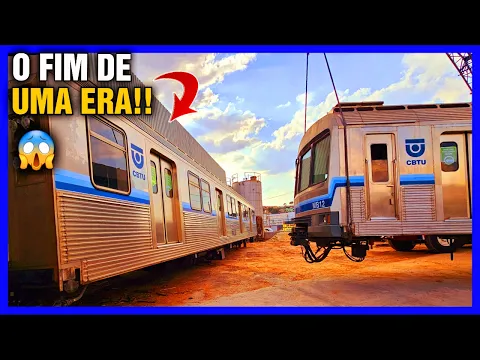
The consolidation occurred when the company began supplying materials for large urban systems, including compositions for the São Paulo Metro. The Series 900, delivered starting in 1982, became one of the best-known examples of national railway engineering. Some of these compositions remained in operation for decades.
The structural robustness and manufacturing standards reflected the industrial logic of the time, based on strong metal structures and planned maintenance for long life cycles.
Technological Innovation and Diversification in the 80s
During the 1980s, Cobrasma attempted to expand its operations beyond the railway sector. The company launched urban bus projects using stainless steel for the body, a technology considered advanced for the period. The use of stainless steel promised greater durability and corrosion resistance.
Diversification also included trolleybuses and special metal structures. This expansion sought to leverage the accumulated metallurgical expertise and reduce exclusive dependence on the railway sector.
However, the bus market faced consolidated competition and narrow margins. The production in stainless steel implied higher costs compared to conventional models. The strategy, although technically bold, faced commercial difficulties.
In the railway sector, the company maintained relevant contracts but began to face structural changes in the Brazilian economic environment.
Economic Crisis and Structural Impacts in the 90s
The 1990s marked a profound transformation in the Brazilian economy. Trade liberalization, reduced state investments, and the restructuring of the railway sector drastically altered the demand for national rolling stock.
With fewer orders and increased external competition, Cobrasma saw its order book shrink. Dependence on public contracts became a critical vulnerability.
The company accumulated significant debts and entered bankruptcy in the early decade. The industrial model based on large integrated plants and high fixed costs proved unsustainable in a retraction environment.
Furthermore, the Brazilian railway sector underwent concessions and privatizations, reducing the predictability of government purchases. Foreign companies began competing for contracts with imported technology.
Without international scale and facing financial restrictions, Cobrasma lost competitiveness.
Closure of Activities and Industrial Legacy
In May 1998, Cobrasma definitively ceased its manufacturing activities. The closure represented the end of an industrial cycle that had profoundly marked the city of Osasco and the Brazilian railway sector.
Despite the business collapse, the technical legacy remained visible for years. Trains produced by the company continued operating in urban systems, some even until approximately 2020, evidencing structural quality and durability.
The story of Cobrasma became a symbol of a period when Brazil sought to develop an autonomous heavy industry. The collapse also reflects the difficulties faced by national companies in the face of rapid macroeconomic transformations.
Deindustrialization and Technological Dependence
The disappearance of Cobrasma is part of a broader debate on deindustrialization and loss of national productive capacity in strategic sectors.
Brazil became more dependent on foreign manufacturers for railway and subway materials. The transfer of technology became limited, and local productive chains shrank.

While countries like China and South Korea strengthened their industrial conglomerates, part of Brazilian heavy industry faced retraction.
Cobrasma represented a vertically integrated industrial model, with its own foundry and integrated engineering. The dissolution of this structure implied a loss of accumulated knowledge.
The End of the Largest Manufacturer of Trains and Subways
The largest manufacturer of trains and subways in Brazil disappeared after more than five decades of intense operation in the heavy industry. Cobrasma was a leader in the production of freight cars, subway cars, and innovative projects in stainless steel, leaving lasting marks on national urban transport.
The collapse did not result from an isolated technological failure, but from a combination of economic crisis, reduced public investments, international competition, and rigid industrial model in the face of structural changes.
The trajectory of Cobrasma reveals how robust engineering and industrial tradition are not enough to ensure survival in volatile economic environments. The end of the company represents an emblematic chapter in Brazilian industrial history, marked by technological ambition, rapid expansion, and abrupt closure amid profound transformations in the country’s economic scenario.









Das três empresas capacitadas a construir trens na época (Mafersa, Cobrasma e Santa Matilde) a única remanescente ainda em atividade no Brasil é a Mafersa que foi comprada pela Bombardier e posteriormente pela Alston francesa que luta muito para fornecer no mercado interno e tambem para exportar talves pelo fato de que não se consegue exportar impostos
Infelizmente um PAÍS AONDE A CORRUPÇÃO, é usada nas três esferas, no judiciário, legislação e executivo, com toda potência e legalizada, e um povo fraco e covarde Infelizmente tudo de bom não dar CERTO não, Vergonha de ser BRASILEIRO
Verdade inclusive ela foi à falência em 2020 na corrupção do governo do Bolsonaro
Faliu porque só vendia no mercado interno protegida pelos impostos de importações, nunca teve capacidade para exportar seus produtos, no seu auge não competiu lá fora, quando os lá de fora vieram competir aqui ela perdeu
Isso mesmo. Dev eria ser mais agressiva.
Ter um olhar promissor.
Acomodação da indústria é mortal.
Faliu porque as politicas públicas da época favoreceram o transporte terrestre por caminhões, uma total aberração se considerarmos o tamanho de nosso território, e, ainda não aprendemos porque continuamos a priorizar o transporte rodoviário e descartamos o ferroviário, assim como o marítimo e fluvial com toda essa imensidão de costa marítima e rios.
Foi uma senhora empresa que valorizou muito os quinze anos que trabalhei na engenharia de carros de passageiros e engenharia de pesquisa e desenvolvimento.