





 Português
  Inglês
  Espanhol
  4 min de leitura
  0 comentários


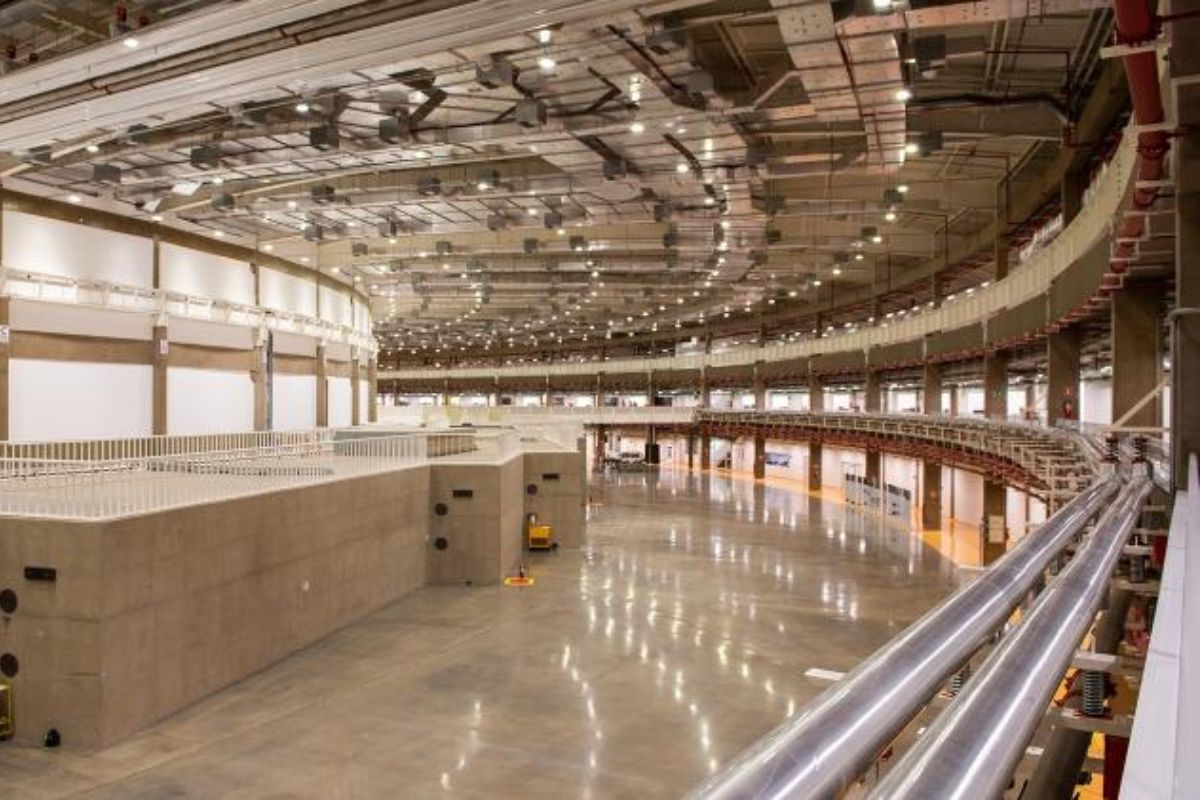
In Campinas, The Most Sophisticated Scientific Tool in the Southern Hemisphere Is Operating at Full Steam. Discover Sirius and Learn How It Is Enabling Advances in New Drugs, Batteries, and Even Agriculture.
In April 2025, Brazilian petroleum engineering gained an ally of unprecedented power. Researchers from Petrobras, in collaboration with the National Center for Energy and Materials Research (CNPEM), announced the success of the first tests at an experimental station dedicated to analyzing pre-salt rocks with an unprecedented level of detail. The tool that made this possible was Sirius.
But what is this monumental machine, considered the largest and most complex scientific infrastructure ever built in Brazil? Far from being just an experiment in theoretical physics, the Sirius Particle Accelerator is a cutting-edge tool that is, at this very moment, paving the way for innovations that will impact the industry, health, and energy of the country.
What Is Sirius? Unraveling the ‘Super Microscope’ of Light
Forget the image of scientists colliding particles to recreate the Big Bang. Sirius operates on a different and much more practical principle. The best analogy is to think of it as a “super microscope” that, instead of lenses, uses a special type of light to reveal the intimate structure of materials.
-
Found in one of the most radioactive places on Earth, this Chernobyl fungus may be doing something with radiation that no one has been able to explain to this day.
-
A bright yellow mushroom imported from Asia escaped from a cultivation farm in the United States in 2010 and is now aggressively spreading across 25 states, destroying entire communities of native fungi in American forests.

-
Buried under China, a colossal machine weighing 20,000 tons began operating as the largest neutrino detector on the planet and, in just 59 days, surpassed results that science took half a century to achieve.

-
Iran enters the center of a climate alert after the war emitted 5.6 million tons of CO2 in two weeks, surpassing the annual pollution of entire countries.


This light, called synchrotron light, is extremely bright – brighter than the Sun – and focused. It works like a “super X-ray” flashlight, capable of penetrating matter and generating detailed images of its molecules, atoms, and the bonds between them. It is the ultimate tool for understanding what things are made of at their most fundamental level.
The Engineering of Light: How Does the Most Complex Machine in the Country Work?

Built at a cost of R$ 1.8 billion, Sirius is an engineering marvel. Its operation, while complex, can be understood in three main stages:
Acceleration: it all starts with a gun that fires electrons. These particles go through two initial accelerators that elevate them to a speed close to that of light (99.999999% of the speed of light).
Light Generation: the high-speed electrons are injected into a main storage ring, which has a circumference of 518 meters. Inside that ring, over a thousand super-powerful magnets force the electrons to make tight turns. As they make these turns, the electrons lose energy, emitting it in the form of extremely bright synchrotron light.
Analysis: this light is then deflected from the main ring and channeled through long tunnels called “light lines.” At the end of each line, there is a research station where scientists place their samples (of rocks, proteins, metal alloys, etc.) to be bombarded by the light and analyzed by high-precision detectors.
From Atom to Agriculture: What Is Sirius Used for in Practice?
This is where cutting-edge science meets the real world. Understanding the atomic structure of materials allows for revolutionary innovations. The discoveries from the Sirius project are already impacting various fields:
Health: by deciphering the 3D structure of proteins from viruses and bacteria, scientists can design drugs that “fit” perfectly with them to deactivate them, accelerating the creation of new medications.
Energy: researchers analyze materials to create more durable and efficient batteries, develop catalysts for producing green hydrogen, and study the porosity of pre-salt rocks to optimize oil extraction.
Agriculture: it is possible to understand how nutrient fertilizers interact with plant roots at the molecular level, enabling the creation of more effective and sustainable products.
Industry: Sirius enables the development of new materials, such as lighter and more resistant metal alloys for aviation, more durable polymers, and special glasses.
The Future Is Bright: The Impact of Sirius on Brazilian Industry

The CNPEM in Campinas operates Sirius as an open facility. This means that companies and universities from all over Brazil can submit projects to use its light lines. Before Sirius, a Brazilian researcher had to wait months or years in line at a synchrotron abroad.
By democratizing access to this cutting-edge technology, Sirius acts as a national innovation hub. It accelerates the research and development cycle, allowing Brazil not only to participate in global science but also to create its own patents, products, and technologies, generating a virtuous cycle of technological advancement and industrial competitiveness for the coming decades.
In your opinion, which area of Brazilian industry stands to gain the most from the discoveries of Sirius? And what should be the next major scientific project that Brazil should tackle?







-

-

6 pessoas reagiram a isso.