





 Portuguese
  English
  Spanish
  4 min of reading
  1 comment


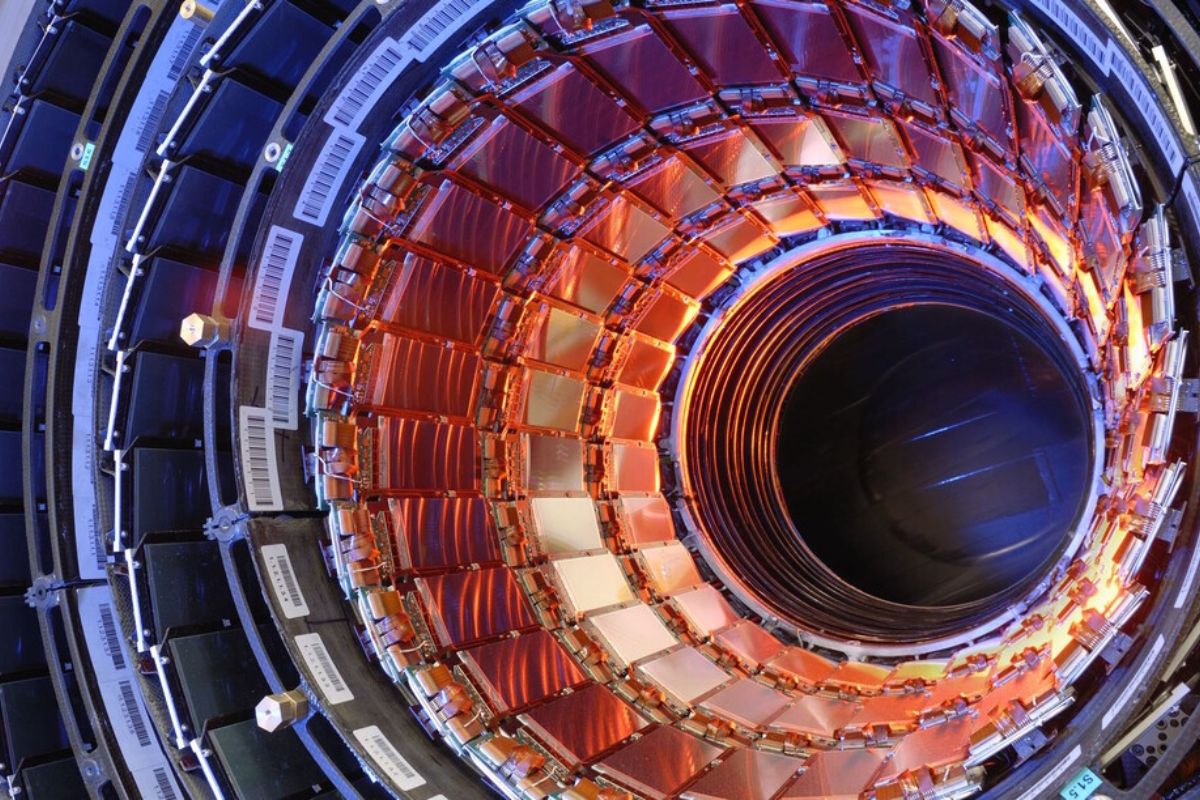


Get To Know The LHC, The 27km Ring On The Franco-Swiss Border. This Giant Machine Investigates The Mysteries Of The Universe, From The Higgs Boson To The Safety Of Its Operations.
The Large Hadron Collider (LHC) captures public imagination, being dubbed “The World’s End Machine?” and questioned for its billions in costs to “hunt for invisible particles.” Indeed, this is the largest and most powerful particle accelerator in the world, designed to probe the fundamental structure of matter and recreate conditions similar to the Big Bang.
This article aims to demystify the LHC, addressing its goals, functioning, and the rigorous studies on its safety. With a 27km circumference and operated by CERN near Geneva, this machine is a monument to science and international collaboration.
Unraveling The Monumental Scientific Machine
The Large Hadron Collider (LHC) is a colossal structure located on the Franco-Swiss border near Geneva. It consists of a 27-kilometer circumference ring, housed in an underground tunnel at depths of 50 to 175 meters. This impressive machine is operated by CERN (European Organization for Nuclear Research), the largest particle physics laboratory in the world.
-
A “silent skill” is allowing Brazilians to earn up to R$ 22,000 per month without a degree and become indispensable for companies that rely on millions of data to survive.

-
Researchers at the Toyota Research Institute found that if a human uses robotic arms to flip a pancake 300 times in an afternoon, the robot learns to do it on its own the next morning, and this is currently the most promising method to solve the biggest bottleneck in modern robotics.

-
Goodbye iron: a common item in households is starting to lose space to technology that smooths clothes in minutes without an ironing board and with less energy consumption.

-
Antarctica reveals an unusual clue high in the Hudson Mountains, and what appeared to be just an isolated rock began to expose a secret hidden under the ice for ages.

Its name describes its function: “Large” for size, “Hadron” for accelerating protons or heavy ions (hadrons), and “Collider” for colliding two beams of these particles in opposite directions. The LHC represents the pinnacle of decades of research and development in particle physics.
How The 27km Ring, The Powerful Machine of CERN Works
The operation of the LHC is a feat of engineering. Two beams of particles, usually protons, travel in opposite directions in ultra-high vacuum tubes, accelerated to nearly 99.9999990% the speed of light. Thousands of superconducting magnets, including 1,232 15-meter dipoles, guide and focus these beams.
These magnets, made of a niobium-titanium alloy, operate at -271.3°C (1.9 Kelvin), a temperature colder than outer space, thanks to a vast system of liquid helium. This superconductivity allows magnetic fields of up to 7.7 Teslas, essential for keeping the protons on their path. Collisions occur at four specific points, where the gigantic detectors are located: ATLAS, CMS, ALICE, and LHCb.
Scientific Goals And Key Discoveries Of The Machine
The LHC was conceived to test the Standard Model of particle physics and investigate the origins of the universe. A central goal is to recreate the conditions of the universe moments after the Big Bang, allowing the study of fundamental forces and cosmic evolution. The discovery of the Higgs boson in 2012, crucial for explaining the origin of particle mass, was a milestone of this machine.
Besides Higgs, this machine enabled the study of quark-gluon plasma (a state of matter from the early universe), the discovery of new hadrons (such as tetraquarks and pentaquarks), and precision measurements of rare processes. The LHC is also searching for physics beyond the Standard Model, investigating dark matter, supersymmetry, and the asymmetry between matter and antimatter.
The Scientific Truth About The Safety Of The LHC
The prospect of high-energy collisions at the LHC has generated fears about the creation of micro black holes, strangelets, or other apocalyptic scenarios, fueling the nickname “World’s End Machine?” CERN took these concerns seriously, commissioning safety studies by independent scientist groups, such as the LHC Safety Assessment Group (LSAG).
The reports, reviewed and endorsed by external committees and published in scientific journals, unequivocally concluded that “LHC collisions pose no danger.” The main argument is that cosmic rays hit the Earth with energies far exceeding those of the LHC for billions of years, without catastrophic consequences. Established physics and speculative theories also indicate that any hypothetical dangerous formations would be impossible or would decay instantly.
Costs, Funding, And The Future


The construction of the LHC cost around €7.5 billion (approximately $9 billion in 2010), a monumental investment. Operational costs, covering maintenance, electricity (around 120 MW for the LHC and detectors), and personnel, represent about 80% of CERN’s annual budget, which is approximately €1.2 billion, funded by contributions from its 24 member states.
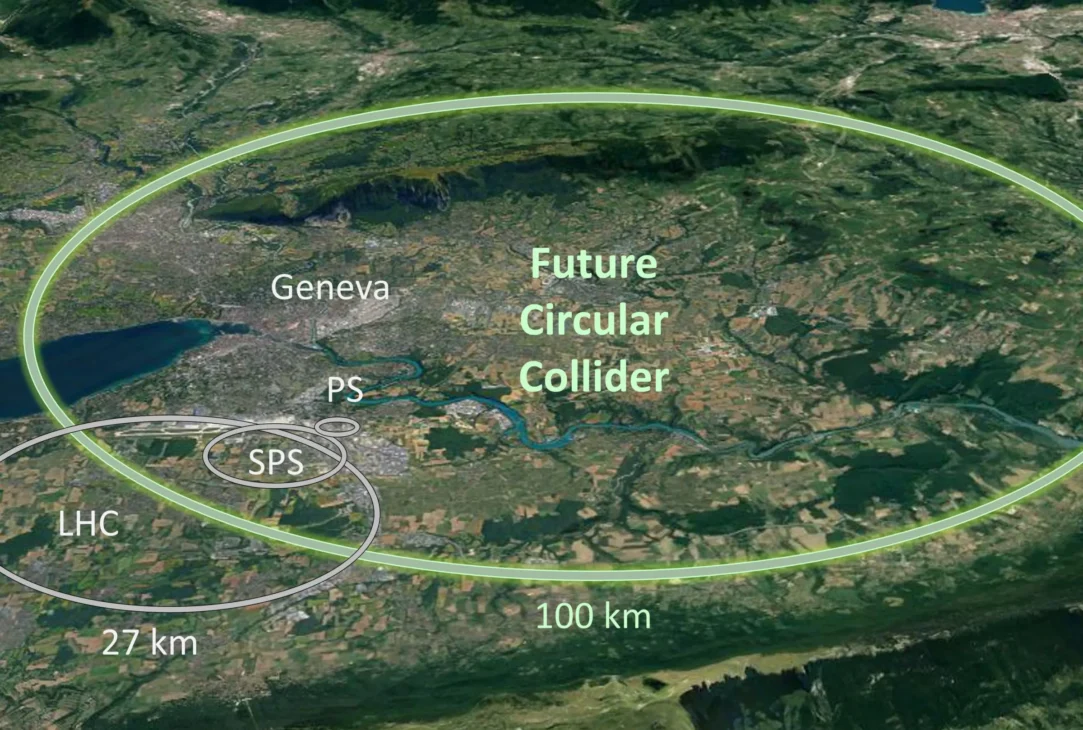
The future of this great machine includes the High-Luminosity LHC (HL-LHC) project, an upgrade to drastically increase the number of collisions from 2030, allowing for more precise studies. Looking even further ahead, CERN is studying the Future Circular Collider (FCC), a possible successor with a 91km ring and collision energies of up to 100 TeV, whose feasibility study was released in 2025, with estimated costs of CHF 15 billion for its first phase.







Se essa máquina descomunal é carésima, investigando desde o bóson de Higgs, com algumas imperfeições precisas de cálculos, que futuramente, poderá ser constatado, até o Universo (e nãomultiverso possível), então, na minha vã ignorantia,essa máquina é bem limitada, tipo século XIX. Quem Viver, verá!