





 Portuguese
  English
  Spanish
  4 min of reading
  0 comments


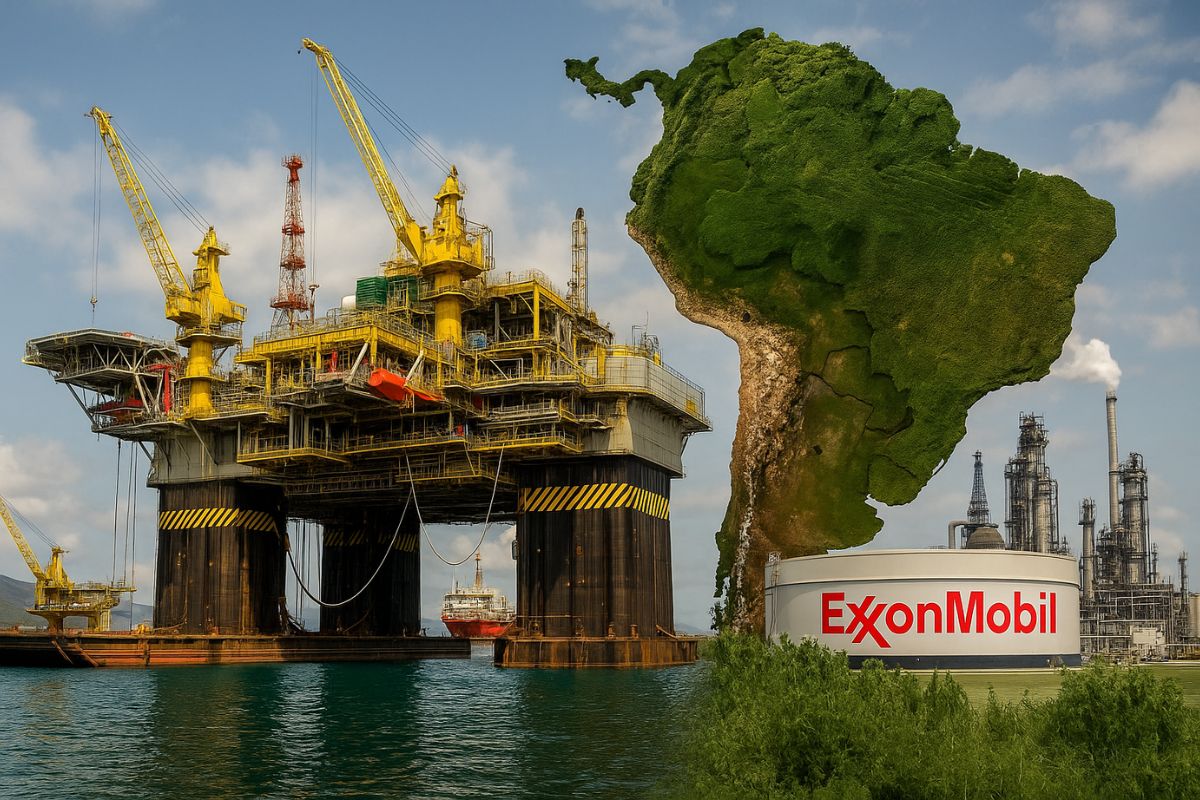
With An Economic Growth That Exceeded 43% In 2024, The Small South American Nation Became An Oil Giant With The Discovery Of 11 Billion Barrels Of Oil, But The Newly Discovered Wealth Rekindled A Territorial Dispute That Threatens The Stability Of The Northern Border Of Brazil.
Guyana, a small nation on the northeastern coast of South America, has become the center of attention in the global energy landscape. The discovery of 11 billion barrels of oil in its waters, mainly in the Stabroek Block, is transforming the country’s economy at an unprecedented pace. Led by American giant ExxonMobil, the exploration has turned Guyana into the fastest-growing country in the world.
However, this new wealth has brought to light an ancient and dangerous territorial dispute. Neighboring Venezuela has intensified its claim over the Essequibo region, an area that corresponds to two-thirds of Guyana’s territory and where rich oil fields are located. The escalation of military tension along the border has raised concerns and prompted a direct response from Brazil, which seeks to ensure stability in the region.
The Treasure Of The Stabroek Block: How ExxonMobil Found The Reserves Of 11 Billion Barrels Since 2015
The story of Guyana’s rise as an oil powerhouse began in May 2015, with the first major discovery by ExxonMobil, in consortium with Hess and CNOOC, at the Liza-1 well. Since then, the exploratory successes in the Stabroek Block, an offshore area of 26,800 km², have not stopped.
-
Son of a seamstress from the rural area of Ceará who did not speak English wins a scholarship of over 2 million reais at Williams College, one of the top 10 universities in the United States, covering everything including dormitory, meals, and annual trips to Brazil.

-
Bill Gates revealed that the true secret behind every great achievement is not a brilliant leap but rather small improvements repeated over the years, and the data from his own career and the fight against climate change prove that he is right.
-
With 22 thousand tons of steel, a height nearly three times greater than the Eiffel Tower, and a cost of R$ 1.6 billion, China is building the highest bridge on the planet over a colossal canyon, reducing a crossing time of over 2 hours to just over 2 minutes.
-
With more than 635,000 doctors, Brazil sees competition increasing in large cities, and recent graduates are competing for shifts at an accelerated pace while the countryside still faces shortages.


As of March 2024, there have been more than 30 confirmed oil discoveries in the block, including the Payara fields (January 2017), Turbot (October 2017), and Hammerhead (August 2018). The total recoverable reserves in the country have already exceeded 11 billion barrels of oil equivalent, a volume that has firmly placed Guyana on the global energy map.
The Surge In Production: The 668,000 Barrels Per Day In April 2025 And The Arrival Of The ONE GUYANA Ship

The oil production in Guyana, which was zero before 2019, is growing at an impressive pace. In April 2025, the daily production averaged 668,000 barrels per day, distributed among the Liza Phase 1, Liza Phase 2, and Payara projects.
The expansion continues to accelerate. Also in April 2025, the floating production storage and offloading unit (FPSO) ONE GUYANA arrived in the country, intended for the Yellowtail project. The
expectation is that this new project will begin production in the third quarter of 2025, adding another 250,000 barrels per day to the country’s capacity and increasing total production to nearly 900,000 barrels daily.
The Economic Boom: The 43.6% GDP Growth In 2024 And The US$ 3.3 Billion Fund
The impact of the discovery of 11 billion barrels of oil on Guyana’s economy has been extraordinary. According to data from the International Monetary Fund (IMF), the country had the highest growth rate in the world in recent years. In 2024, the country’s real GDP grew by 43.6%.
Oil revenues are managed by the country’s Natural Resource Fund (NRF). By the end of 2024, the fund had already accumulated US$ 3.1 billion.
By March 2025, the balance had risen to US$ 3.3 billion. This sudden wealth, however, brings the challenge of avoiding the so-called “resource curse” and ensuring that the benefits reach the entire population.
The Dispute Over Essequibo: The Military Crisis That Began In 2023 And Brazil’s Response
The wealth beneath the ground has reignited the century-old territorial dispute with Venezuela over the Essequibo region. In December 2023, the Venezuelan government held a referendum to annex the area and has since increased its military presence along the border. In March 2025, a Venezuelan warship even approached an ExxonMobil platform in Guyanese waters.
The situation prompted a firm response from Brazil. Since the end of 2023, the Brazilian Army has reinforced its presence along the northern border in Roraima, deploying armored vehicles and increasing troop levels in the region to about 600 soldiers.
The aim is to prevent the conflict from spilling over into national territory and to ensure stability in South America. The International Court of Justice (ICJ) ruled in May 2025 that Venezuela must refrain from any actions that change the status of the region, but tensions remain.
Guyana On The Oil Map: The Discovery Of 11 Billion Barrels Of Oil And What It Means For The Global Market


The rise of Guyana is changing the energy landscape. With a population of only 800,000 inhabitants, the country has one of the largest oil reserves per capita in the world, surpassing nations like Saudi Arabia in this regard. It is estimated that by 2027, Guyana will produce more oil per capita than Kuwait.
As a non-OPEC producer, Guyana adds a new source of supply to the market, contributing to diversification and global energy security.
The United States, for example, has already become a major customer: in March 2025, Guyana exported 148,000 barrels per day to the American market. The discovery of 11 billion barrels of oil has not only transformed Guyana but has also created a new and important player in the complex geopolitical energy landscape.






-

-

3 pessoas reagiram a isso.