





 Portuguese
  English
  Spanish
  5 min of reading
  0 comments


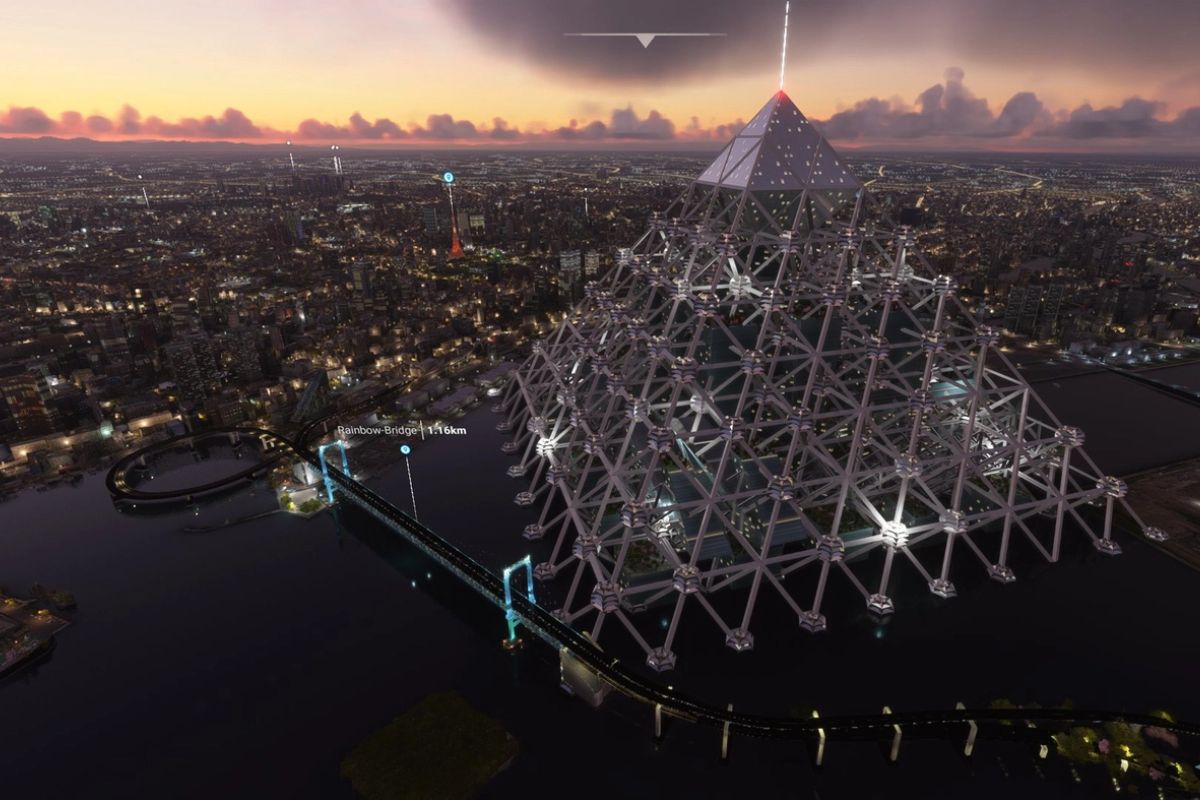
Discover The Details Of The Visionary Shimizu Mega-City Pyramid, An Audacious Project For Tokyo Bay, And The Challenges For Its Completion.
Inspired by cinema and formalized in the 90s, this self-sustaining arcology promises to house up to one million people. Discover the conception, technological challenges, and expert opinions on the Shimizu Mega-City Pyramid, one of the most ambitious urban concepts ever proposed.
The Shimizu Mega-City Pyramid, a monumental project by Shimizu Corporation, aims to redefine urban life in Tokyo Bay. This colossal structure seeks to address space scarcity and overpopulation in the Japanese capital, issues intensified by internal migration.
What Is The Shimizu Mega-City Pyramid And Its Futuristic Vision?
The Shimizu Mega-City Pyramid, officially known as TRY 2004 Mega-City Pyramid, is an audacious architectural proposal. Conceived by Shimizu Corporation, a renowned Japanese construction firm, the idea emerged in 1982. An engineer from the company, inspired by the pyramidal buildings from the movie “Blade Runner”, envisioned a pyramidal mega-city. This vision combined urban problem-solving with science fiction, culminating in a patent registration in 1992.
-
A megaproject worth R$ 89 billion is advancing in Iraq and promises to change the game in global trade by creating a new corridor between Asia and Europe, reducing traditional routes and repositioning the country as a logistics powerhouse.
-
Goodbye bedside table: floating shelves become a trend in 2026 by freeing up space in the bedroom, improving circulation, bringing visual lightness, and integrating technology without taking up floor space.

-
Israel, Greece, and Cyprus signed an agreement in 2020 to transport gas from the Mediterranean to Europe via a 1,872 km pipeline, but Turkey claimed sovereignty over part of the maritime route, and the project never materialized.
-
Israel, Greece, and Cyprus signed an agreement in 2020 to transport gas from the Mediterranean to Europe via a 1,872 km pipeline, but Turkey claimed sovereignty over part of the maritime route, and the project never materialized.

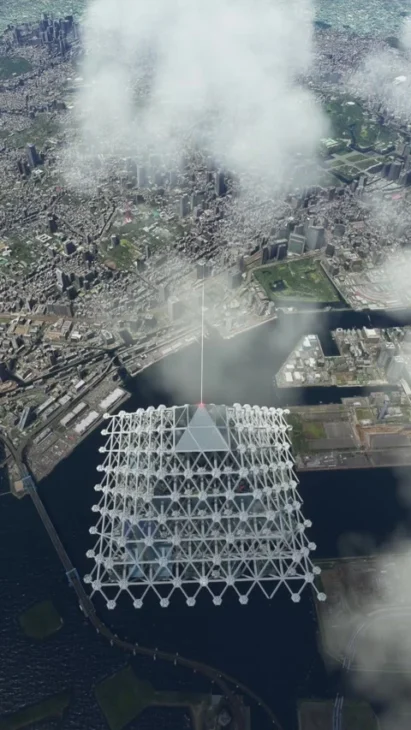
The project aims to be a self-sustaining arcology, capable of housing approximately 1 million inhabitants. If built, the Shimizu Mega-City Pyramid would become the largest structure ever created by man. Its planned height is 2,004 meters, possibly a symbolic milestone. The structure would consist of five overlapping trusses, each with dimensions comparable to the Great Pyramid of Giza, or, according to other descriptions, composed of 55 to 204 smaller pyramids stacked. The project was conceived by architects Dante Bini and David Dimitric.
The footprint of the pyramid is estimated at 8 km², with a gross construction area of 88 km², located over Tokyo Bay. The proposed timeline is extensive: construction start in 2030 and completion in 2110. Despite the lack of concrete actions by 2030, Shimizu Corporation remains determined to complete the project by 2110. The Shimizu Mega-City Pyramid is, above all, a visionary statement.
Shimizu Mega-City Pyramid – Central Project Specifications
| Parameter | Description |
| Official Name | Shimizu TRY 2004 Mega-City Pyramid |
| Promoter | Shimizu Corporation |
| Architects | Dante Bini, David Dimitric |
| Location | Tokyo Bay, Japan |
| Type | Self-Sustaining Pyramid Arcology |
| Proposed Height | 2,004 meters (6,575 feet) |
| Base Area | Approximately 8 km² (3.1 mi²) |
| Gross Construction Area | Approximately 88 km² (34 mi²) |
| Estimated Capacity | 1,000,000 people |
| Key Structural Concept | Open network of mega trusses supporting suspended skyscrapers |
| Primary Material Dependency | Carbon Nanotubes (CNTs) And Graphene |
| Proposed Construction Start | 2030 (no action taken) |
| Proposed Completion | 2110 (80 years of construction) |
| Current Status | Conceptual, visionary project |
The Essential Base Of The Shimizu Mega-City Pyramid
The realization of the Shimizu Mega-City Pyramid crucially depends on the development of advanced materials. Carbon nanotubes (CNTs) and graphene are essential, as the monumental scale of the structure makes it impossible to build with conventional materials due to excessive weight. The design calls for ultra-strong and lightweight materials.
CNTs, hollow cylinders of graphene, have exceptional mechanical properties. Their tensile strength can reach about 100 GPa, with predictions of up to 126.2 GPa. The density of CNTs is low, resulting in a specific strength far superior to steel. Graphene shares these properties, with a tensile strength of 130 GPa. These materials are crucial for the mega trusses and supporting braces of the pyramid, which need to withstand immense loads and natural forces while minimizing weight. Nanotube cables would also suspend the internal skyscrapers.
However, the mass production of CNTs and graphene faces challenges. Issues of purity, uniformity, dispersion in composites, and, above all, scalability and cost persist. The viability of the Shimizu Mega-City Pyramid is defined by the maturation of these materials. The 80-year timeline reflects the expected evolution of materials science.
Main Challenges Of The Shimizu Mega-City Pyramid
The construction of the Shimizu Mega-City Pyramid presents formidable engineering challenges. Its location in Tokyo Bay, a seismically active zone in the Pacific Ring of Fire, requires robust solutions. The base would be formed by 36 giant pillars of special concrete, anchored in the seabed. To resist earthquakes, tsunamis, and strong winds, the outer structure would be an open network of mega trusses made of carbon nanotubes. Internal skyscrapers would be suspended by nanotube cables.
The logistics of construction over 80 years would be Herculean. Robotic systems would play a major role in assembly and maintenance. Architect Dante Bini suggests innovative methods, such as robotic “factories” weaving trusses on-site. Maintaining a million people would require complex life support systems. Energy would come from photovoltaic films on the trusses, algae biofuel, and wind power. Advanced desalination and water recycling systems would be essential, as would waste management for self-sufficiency.
Internal transportation within the Shimizu Mega-City Pyramid would include moving walkways, inclined elevators, and a personal rapid transit (PRT) system. Automated capsules would travel inside the hollow trusses, which would also house electrical and communication networks. Safety against structural failures, fires, and mass evacuation are critical concerns.
Experts’ Opinions On The Shimizu Mega-City Pyramid
The Shimizu Mega-City Pyramid evokes a mix of admiration and skepticism among experts. Many consider the project unfeasible with current and near-future technology and materials. Some describe the pyramid as a “paper concept car”, an exercise in vision more than a constructive plan. Dr. Toshiaki Fujimori, for instance, although affiliated with Shimizu, suggested it would take a decade just to have more news, which seems optimistic for large-scale implementation.
Common criticisms point to the potential waste of resources. The pyramidal shape, with its “huge gaps” in the structure, is questioned regarding the efficiency in material use relative to the useful space generated. The maintenance of such a vast and complex structure is described as a potential “nightmare”.
Safety is another major concern. The risk of a catastrophic failure in one of the trusses, which could lead to the collapse of the entire structure and endanger its 750,000 to 1 million inhabitants, is a frequently raised point. Some criticize the potential negative impact of the Shimizu Mega-City Pyramid on the soul and aesthetics of Tokyo’s urban landscape. Despite the criticisms, the project persists as a test of the limits of what is possible.







Seja o primeiro a reagir!