





 Portuguese
  English
  Spanish
  4 min of reading
  0 comments



Did You See a Round Blue Sign with a Bicycle and Are Wondering What to Do? We Clarify the Meaning of Official Signage for Cyclists in Brazil, the Correct Use of Sidewalks, and How to Proceed at the End of Exclusive Sections.
Many drivers and cyclists come across a sign they describe as a round blue sign with a white bicycle and question: Can I ride on the sidewalk here? Has the bike lane ended? Correct interpretation of traffic signage is vital for everyone’s safety.
This guide details the rules for bicycle circulation. Although the sign that regulates the “Exclusive Bicycle Circulation” is the R-34 (white with red border and black pictogram), we will clarify common doubts about different types of signage and explain your rights and duties as a cyclist.
The “Blue Sign” and the Official R-34
It is common to confuse cycling signage. The popular description of a “round blue sign with a white bicycle” does not correspond to the main sign that regulates exclusive use by bicycles. This sign, coded R-34, is actually circular, has a white background, a red border, and a black bicycle pictogram. Its official meaning is “Exclusive Bicycle Circulation”.
-
A couple buys an old chalet, breaks the kitchen floor for renovation, and finds over a thousand coins of gold and silver hidden since the English Civil War over 4 centuries ago.

-
Rigid bags with their days numbered: new trend prioritizes comfort in 2026.

-
YouTuber creates an excavator equipped with a giant 4.5-meter sword to challenge his brother to a rematch, and the invention quickly goes viral on social media.

-
The U.S. Army surprises the world by presenting the UH-60MX Black Hawk helicopter capable of flying without pilots, controlled by a tablet, featuring the MATRIX system, smart sensors, and full autonomy in real combat and rescue missions.


Signs that are actually blue and contain bicycle pictograms generally belong to other categories: they may be auxiliary service signs (like S-10 “Bicycle Traffic”, which is rectangular and informs about the presence or traffic of cyclists on the road or in a specific section), educational signs, or bicycle route indication signs. These do not impose a rule of exclusive use like the R-34. The goal of the R-34 sign is clear: to designate an area, roadway, lane, or track specifically for bicycle traffic, protecting that space. It can be found on bike lanes, cycle paths, or, as we will see, on sections of sidewalks.
Can a Cyclist Use the Sidewalk? What Does the Law and the R-34 Sign Say
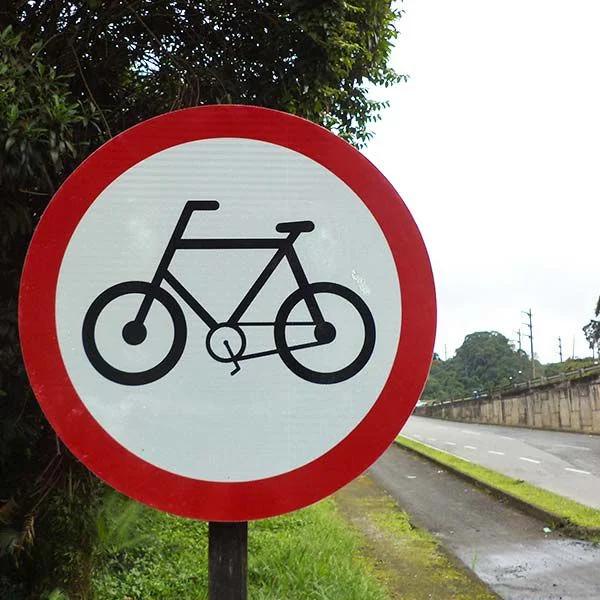
The general rule, established by Article 59 of the Brazilian Traffic Code (CTB), is that bicycle traffic on sidewalks is only permitted in exceptional cases. That is, the sidewalk is primarily for pedestrians.
For this exception to occur, two conditions are indispensable: the traffic authority responsible for the road must authorize it in advance, and this authorization must be communicated through specific signage. The signs that authorize bike traffic on sidewalks include R-34 (for exclusive use of a section), R-35a/b (indicating the side for cyclists to travel), or R-36a/b (for sharing with pedestrians).
When the R-34 sign is installed on part of the sidewalk, that segment becomes a bike lane, and pedestrians should not travel there. Riding a bicycle on a sidewalk where there is no signal indicating permission is a medium traffic violation, subject to fines and removal of the bicycle, according to Article 255 of the CTB.
End of the Bike Lane or Section with R-34: What Is the Correct Procedure?
The end of an area exclusive to bicycles, such as a bike lane or a section of sidewalk marked with R-34, requires the cyclist’s attention. It is necessary to identify the signage that indicates the end of exclusivity. This can be done by the R-34 sign itself accompanied by the word “END”, the specific R-34t sign, or by evident physical changes in the roadway signaling the end of the restriction.
At the end of the exclusive section, if there is no other marked cycling infrastructure (such as a new bike lane or shared sidewalk), the cyclist should, as a general rule, integrate into the flow of vehicles on the roadway. Article 58 of the CTB advises that, in the absence of a bike lane, cycle path, or shoulder, bicycle traffic should occur at the edges of the roadway, in the same direction as other vehicles, and with preference over motor vehicles. It is crucial not to ride on sidewalks that are not properly marked for bicycle traffic, as this constitutes a violation and may lead to conflicts.
Understanding Signs R-36a and R-36b
In many situations, wide sidewalks or central medians can be designated for shared use between cyclists and pedestrians. For this, R-36a signs (“Cyclists to the Left, Pedestrians to the Right”) and R-36b signs (“Pedestrians to the Left, Cyclists to the Right”) are used.
The fundamental difference between the R-34 sign and the R-36a/b signs is that R-34 indicates exclusive use for bicycles, while R-36a/b allows both cyclists and pedestrians to use the same space, but in an organized manner, each in their designated lane. For safe sharing, it is ideal to have clear visual markings separating the spaces. Disregarding the spatial organization imposed by these signs may also constitute a violation.
Cyclist Duties and Tips for a Safe Ride
In addition to knowing the signage, cyclists have general duties established by the CTB. Among them: prefer to cycle on the street, dismount when crossing pedestrian crosswalks (pushing the bicycle), signal all maneuvers, and use mandatory equipment (bell, front, rear, side, and pedal nighttime signals, and left rearview mirror).
It is important to note that CONTRAN Resolution No. 996/2023 equates electric bicycles with regular bicycles for traffic rule purposes. Therefore, all guidance on signage and circulation also applies to them. For a safer ride, remember to see and be seen (use lights and light-colored clothing), communicate your intentions in traffic, maintain a predictable trajectory, and always show mutual respect with other road users.







Seja o primeiro a reagir!