





 Portuguese
  English
  Spanish
  6 min of reading


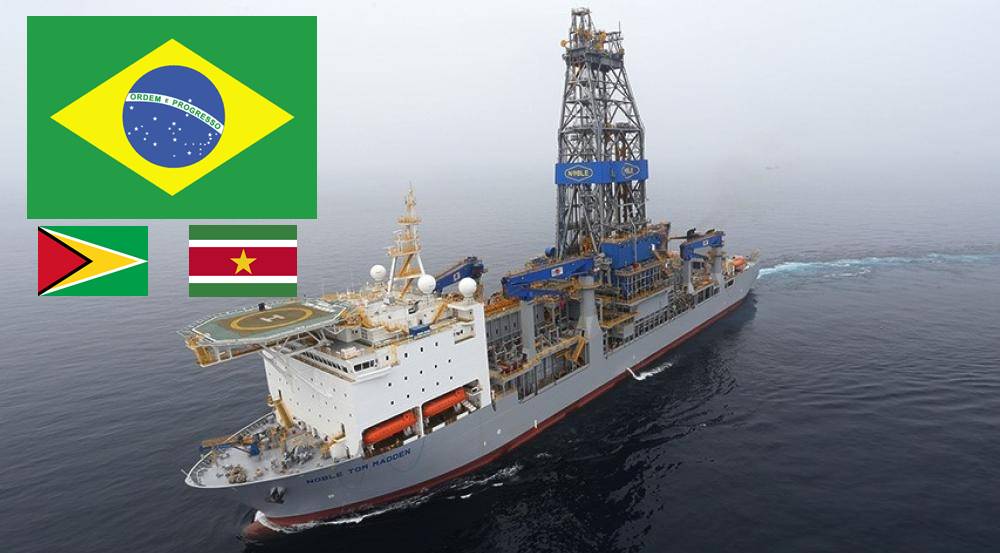
Major Discoveries And Reduced Costs Generate Interest From Many Global Oil Companies, Particularly In Brazil, Guyana, And Suriname
The development of offshore oil and gas in South America is entering a new era as a result of massive new discoveries, particularly off the coast of Brazil, Suriname, and Guyana, including falling breakeven costs (When calculations indicate that companies have reached the break-even point) that make large-scale ventures more financially attractive. The combination of these three has made offshore development in South America one of the world’s most attractive pieces.
According to a recent report by GlobalData, the average selling price of oil for the top 10 deepwater and ultra-deepwater projects in South America is US$ 50 / bbl and US$ 40 / bbl, respectively. GlobalData reported that more than US$ 81 billion in investments will be spent over the lifespan of the top 10 offshore projects in South America, which the analyst predicted would eventually produce 8.4 Bboe.
-
Government unlocks R$ 554 million for a highway that has been requested for decades and accelerates the duplication of BR.
-
Without bricks, without cement, and without endless construction: the cardboard house that is assembled in modules and can be moved.

-
Billions of barrels on the equatorial margin could lead Amapá to double its oil production in Brazil — the state aims to enter the route of companies in the Campos Basin, attract investments, and boost jobs and businesses in the oil and gas sector.
-
Without bricks, without cement, and without endless construction: the cardboard house that is assembled in modules and can be moved.

Guyana
At the forefront of the emergence of South America’s offshore industry is Guyana, where Exxon Mobil and its partner, Hess Corp., announced 12 discoveries in the massive Stabroek Block. On February 7, the two companies announced their latest discoveries in Tilapia-1 and Haimara-1, in the southeast portion of Stabroek.
“These two discoveries demonstrate the ongoing exploration potential of the prolific Stabroek block and increase the already announced estimated recoverable gross resources of over 5 billion barrels of oil equivalent”, said John Hess, CEO of Hess, in a statement announcing the discoveries.
According to Hess, the 10 previous discoveries in the Stabroek Block established the potential for at least FPSOs to produce over 750,000 bbl / d by 2025.
Liza Phase 1 opened the piece and was sanctioned in 2017. Liza Phase 1 is expected to go online in early 2020 and produce up to 120,000 bbl / d from the FPSO Liza Destiny. Liza Phase 2 will use a second FPSO and is expected to produce up to 220,000 bbl / d after its startup in 2022, according to Hess.
Liza Phase 1 comes with breakeven costs of US$ 35 / bbl (Brent) and Liza Phase 2 has a breakeven point of US$ 25 / bbl, according to the company. In its 2018 investor presentation, Hess cited low equipment rates and an improved standardization approach to reduce costs and improve schedules. It also noted that the use of FPSOs would accelerate first oil for Liza Phase 1 by up to 12 months.
Wood Mackenzie reported in September 2018 that Guyana’s Liza Complex is responsible for 15% of all conventional oil found globally since 2015.
Meanwhile, Payara, located 19 km (12 miles) northwest of Liza, may receive sanctioning later this year with production starting in 2022.
Other developments in the Stabroek Block include Snoek, Turbot, Pluma, Ranger, Hammerhead, Longtail, and Pacora.
Barbara Lowery-Yilmas, Senior Vice President of Exploration at Hess, said during the company’s investor day in 2018 that the company plans to continue exploration and appraisal activities this year, particularly southeast of the Turbot area. According to Hess, the Turbot areas include the Tilapia, Turtle, Longtail, and Pluma discoveries.
Hess stated in its announcement of Tilapia-1 and Haimara-1 that the expanding Turbot area is expected to progress to a major development hub with ongoing 4-D seismic data acquisition.
Located north of Stabroek is the emerging Kaieteur Block, situated 250 km off the coast of Guyana. Hess and Exxon Mobil have acquired blocks there or initiated seismic surveys in some areas. In April 2018, Hess announced it acquired a 15% interest in the block. Its 2018 work program included processing and interpreting about 5,700 km2 of 3-D seismic data and assessing a future drilling program. According to Hess, the Kaieteur Block is in the same geological basin as the Stabroek Block.
Suriname
Adjacent to the prolific Guyana Basin is the Suriname Basin, and the two combined are estimated to hold 13.6 Bbbl of oil and 906.1 Bcm (32 Tcf) of natural gas, making it the second most promising offshore oil basin in the world, according to the US Geological Survey.
Among the companies leading exploration efforts in the Suriname Basin are Exxon Mobil, Kosmos Energy, Chevron, Tullow Oil, and national oil companies Repsol and Equinor.
Speaking during the company’s investor meeting in the third quarter of 2018, Apache CEO John Christmann said the company identified several high-quality prospects in the region and plans to drill at least one well there this year.
“We will initiate a drilling program [in 2019] in Block 58, where Apache currently has 100%,” he said. “This block has not been tested and is adjacent to Exxon Mobil’s Stabroek Block in neighboring Guyana.”
Some early results in the basin, however, have not been favorable. Kosmos Energy began two wells last year, Pontoenoe-1 in Block 42 and Anapai-1A in Block 45. However, Kosmos saw enough to continue its exploration efforts in the future.
“We are in the early stages of exploration of the emerging Suriname-Guyana Basin, and given the indications of a mature source, quality Cretaceous reservoir, and
From the perspective, we believe there is significant remaining potential in Block 42,” said Andrew Inglis, chairman and CEO of Kosmos, in October. “Our current plan is to test the next prospect in 2020.”
Brazil
Much of the famous Campos Basin in Brazil is approaching the end of its economic life — Wood Mackenzie estimated in September 2018 that 32 platforms would reach their economic cutoff by 2025 — the Santos Basin has emerged as its next major producer. The rise of the Santos Basin can be partially attributed to Brazil’s government approval legislation in 2016, which allows greater private and foreign investment in the country’s offshore areas. The new legislation resulted in offshore licensing activity in Brazil peaking in 2017 and 2018, according to a Wood Mackenzie report.
In a September 2018 auction, the Brazilian government awarded blocks in the pre-salt layer to Royal Dutch Shell, Exxon Mobil, Chevron, and Petrobras.
According to Petrobras, pre-salt production has steadily increased in the Santos Basin since 2010, reaching over 1 million barrels / day in 2016 and accounting for over 50% of Brazil’s oil and gas production. The pre-salt formation contains about 16.4 billion barrels of gross reserves in Brazil’s ultra-deep waters.
“The main challenges that pre-salt field development faces include adverse oceanographic conditions in the Santos and Campos basins — an ultra-deep aquatic environment without pre-installed production infrastructure, located 300 km from the coast at water depths deeper than 2 km [1 mile] and an oil reservoir nestled 5 km [3 miles] below the seabed with a salt layer 2 km thick,” reported Stratas Advisors in a 2018 report on offshore production in Brazil.
Among the solutions for the challenges that Stratas pointed out were the development of pipeline infrastructure to take oil and gas from the seabed to the platform, new solutions for well construction, and the design of CO2 separation and reinjection systems that allow for oil production in the most extreme pre-salt reservoirs.
Also supporting increased development, breakeven prices are falling, dropping to about US$ 35 / bbl and US$ 40 / bbl for new pre-salt projects, according to BP.
The latest projects in Brazil include Búzios 1, where Petrobras began production in April 2018. Búzios 2 began production in November from the P-75 platform. According to Petrobras, the P-75 was the fourth platform to begin production in 2018, following the FPSO Cidade Campos dos Goytacazes in the Turtle Field, the P-69 in the Lula Field, and the P-74 in the Búzios Field.
Although the Campos Basin may need up to US$ 8 billion for decommissioning and related infrastructure for the 32 aging platforms, Wood Mackenzie suggested that the same amount could be invested in redeveloping these mature fields, further extending the life and production of the field.
“We estimate that redevelopment could add 230,000 barrels / day by 2025 and delay 60% of decommissioning costs to post-2030”, the company reported.









Seja o primeiro a reagir!