





 Portuguese
  English
  Spanish
  5 min of reading
  0 comments


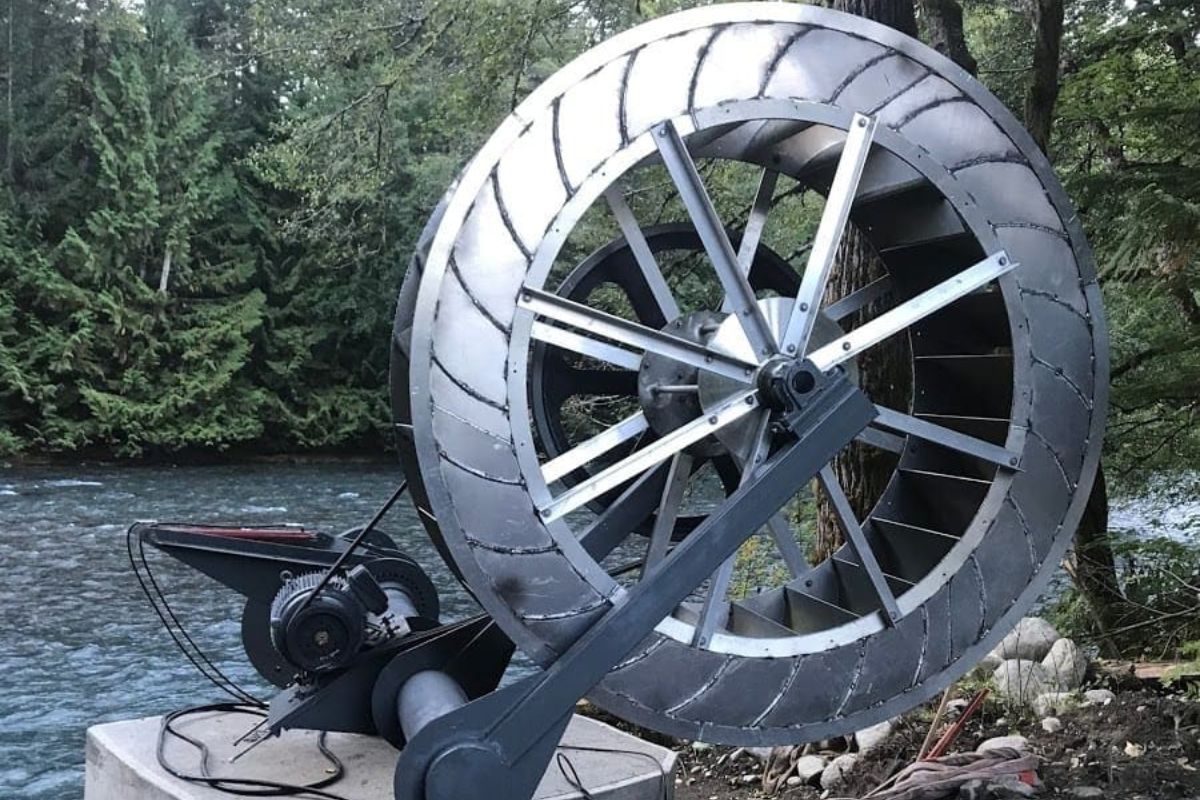
Retired engineer Marc Nering built a water wheel in British Columbia that generates up to 36 kWh per day using only the natural current of the river, without a dam, and is already exporting the surplus energy to the power grid.
The idea of generating your own energy at home using the force of a river seems like something from another century. But that is exactly what a retired Canadian engineer has managed to turn into a functional reality in British Columbia, Canada. Marc Nering, founder of Nering Industries, built a water wheel on the riverbank next to his property that produces up to 36 kWh of electricity per day under stable conditions. The system provides about 1,500 watts of continuous power, enough to supply a significant portion of the consumption of an average household.
What makes the project especially relevant is that the water wheel operates without any conventional dam, according to Daily Galaxy. It directly harnesses the speed of the river’s current to spin and drive a generator. The retired engineer himself summarized the advantage straightforwardly: “You don’t need to dam a river to use it.” Furthermore, the surplus energy that he does not consume is exported to the power grid through a converter connected to the system. Nering confirmed without hesitation: “I use it to power my home.”
How the water wheel built by the retired engineer works

The principle behind the system is straightforward. The flowing water of the river turns a large wheel installed on the bank, which in turn drives an electricity generator. There is no damming or diversion of the natural watercourse.
-
A huge Maya city has been detected beneath the Mexican jungle with the help of LiDAR, a system that shoots laser pulses from above to map the ground beneath the vegetation, revealing 6,764 structures.

-
About 6,000 residents live concentrated along a single street nearly 9 km long in the interior of Poland, with houses forming a continuous row and narrow agricultural strips emerging behind them, creating one of the most unusual rural patterns in Europe.

-
Millionaires flee to Florida and create chaos at the marinas: megayachts of Bezos, Brin, and Zuckerberg don’t fit, spots disappear, cost up to $500,000 a year, and it has already turned into a legal battle for space.

-
A Globo actor lives on a farm the size of 300 football fields in Teresópolis, where he produces cheese, honey, and organic chocolate, and has already planted 20,000 native trees.


The wheel relies solely on the speed of the current to function. Nering explained that the river needs to have a minimum flow rate of three meters per second for the system to operate efficiently.
This mechanical simplicity is precisely what sets the water wheel apart from a traditional hydroelectric plant. The retired engineer eliminated the need for heavy infrastructure, such as dams, diversion channels, and large civil works.
The result is a system that takes up little space, minimally interferes with the river’s ecosystem, and produces energy continuously, 24 hours a day, as long as the current remains stable. It is this uninterrupted operation that makes the project stand out compared to alternatives like solar panels and wind turbines, which depend on weather and daylight.
The real numbers of generation: 36 kWh per day and up to 3 kilowatts peak

Power values vary according to river conditions, but consistency is the system’s strong point. Under stable operation, the water wheel generates between 800 and 900 watts, reaching 1,500 watts continuously and peaking close to 2 kilowatts.
Over 24 hours, this performance results in approximately 36 kWh per day, a volume that meets a large part of residential electricity consumption.
The retired engineer also revealed the maximum he managed to extract from the system: “The most I managed to generate was about 3 kilowatts.” This difference between peak and continuous production is crucial for those considering home energy planning.
The number that really matters for daily life is not the maximum power, but the sustained generation over 24 hours. And in this regard, the water wheel delivers a result that few renewable sources can match in consistency.
The real problems the retired engineer faced in practice
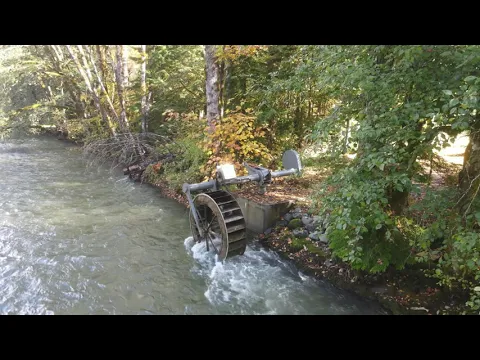

Despite the impressive results, the path to stable operation of the water wheel involved concrete engineering challenges. One of the biggest problems was the high torque at low rotational speeds, which caused belt slippage, especially when the equipment got wet. Nering tested different solutions, including chain drive, gearbox, and direct drive generator.
Another obstacle was the accelerated wear of mechanical parts. The constant influx of water rapidly deteriorated the bearings, even when using high-quality components with reinforced seals.
The solution came from an unexpected material: lignum vitae wood bearings, a species known for its durability in contact with water.
The retired engineer’s verdict on the swap was simple: “It’s been great.” These practical details elevate the project beyond a mere viral curiosity. It is a real installation that required maintenance, redesign, and adaptations over time.
The bureaucracy that almost prevented the project from getting off the ground
Even being a small-scale installation, the retired engineer’s river energy system faced a difficult licensing process that involved municipal, provincial, and federal agencies in Canada.
Consultations related to fish protection and assessments regarding the impact on other river users were necessary. Regulatory bodies initially analyzed the project as if it were a hydroelectric plant with a dam, even though the water wheel does not retain water in the same way.
This bureaucratic burden helps explain why solutions like this are still rare, even in regions with strong currents. The regulatory process was designed for large hydroelectric projects with dams and applies the same requirements to residential projects that occupy a fraction of the space and cause incomparably less environmental impact.
For the retired engineer, the solution makes more sense in remote communities, areas without reliable power grids, and places that rely on diesel generation or intermittent renewable sources.
For whom the water wheel really makes sense as an energy source
The system created by Marc Nering is not a universal solution for all households. It depends on specific conditions: a river with a minimum current of three meters per second, proximity of the property to the bank, and compatible environmental licensing.
Without these requirements, the water wheel simply does not deliver the necessary power to justify the installation.
Where the project truly shines is in rural contexts and outside the conventional power grid. Communities that currently depend on diesel generators, regions with unstable electricity supply, and isolated properties with access to strong-flowing rivers are the ideal scenarios for this type of micro-hydroelectric system.
The fact that the system produces energy 24 hours a day, without relying on sun or wind, eliminates the need for large battery banks for storage.
For the retired engineer who built it, the water wheel is proof that clean and constant energy can arise from a mechanical principle as old as civilization itself.
What do you think of the idea of generating energy at home using the current of a river? Do you believe that projects like this retired engineer’s can inspire similar solutions in Brazil, where rivers abound? Leave your comment. This is the kind of discussion that connects practical innovation with the future of renewable energy.








Seja o primeiro a reagir!