





 Português
  Inglês
  Espanhol
 6 min de leitura
  0 comentários


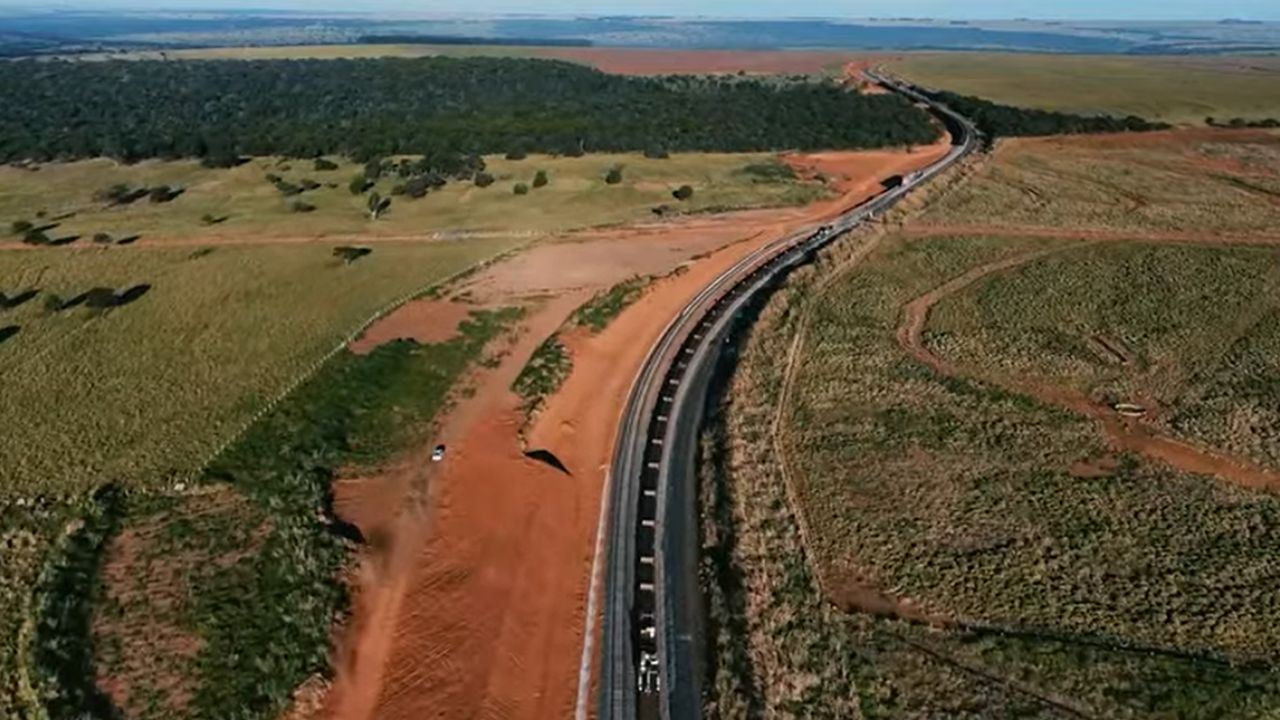
With the Agribusiness Suffocated by Poor Highways and High Costs, the State Bets on the Construction of Brazil’s First State Railway to Revolutionize Its Logistics and Boost the Economy.
For decades, Mato Grosso faced a dilemma: high production versus poor drainage, generating high costs and slowing down agribusiness. Now, an unprecedented initiative emerges: the construction of Brazil’s first state railway. Spanning over 700 km, funded by private initiative, it promises to reduce costs and transform the logistics of the Midwest. But how did this become a reality and what impacts are expected? Canal EngeZone points out that it is necessary to analyze history to understand this shift in direction.
Huge Production, Limited Drainage
The development of Mato Grosso has long been tied to a logistical paradox: the state established itself as a global agricultural powerhouse, but its ability to drain this immense wealth was severely limited. The main reason for this bottleneck lies in its transportation infrastructure. The road network, responsible for almost 98% of local transportation, although extensive, proved chronically inefficient. An alarming statistic from 2023 revealed that more than 75% of state highways were classified as regular, poor, or terrible. The direct consequence of this precariousness is a high logistical cost, which burdens producers – the freight to transport soy from Sorriso (MT) to the port of Santos, for example, exceeded R$ 440 per ton, undermining the competitiveness of local agribusiness.
This historical dependence on road transport did not arise by chance. For decades, public investments in transportation focused almost exclusively on roads. To put it into perspective, in 2010, Mato Grosso received R$ 3.87 billion in federal resources for transportation infrastructure; twelve years later, in 2022, this amount plummeted to just R$ 110 million, and even then, more than 97% of this amount was still directed to the road sector. In light of this scenario, some railway alternatives began to emerge, such as Ferronorte, which connects Rondonópolis to the Port of Santos and has become an important route for grain drainage. Other initiatives, such as the construction of the Midwest Integration Railway (FICO) and the Ferrogrão (still under study), also gained traction. However, the reality is that the railway network in Mato Grosso remained insignificant: only 366 km, equivalent to a mere 1.16% of the state’s transportation network.
-
A megaproject worth R$ 89 billion is advancing in Iraq and promises to change the game in global trade by creating a new corridor between Asia and Europe, reducing traditional routes and repositioning the country as a logistics powerhouse.
-
Goodbye bedside table: floating shelves become a trend in 2026 by freeing up space in the bedroom, improving circulation, bringing visual lightness, and integrating technology without taking up floor space.

-
Israel, Greece, and Cyprus signed an agreement in 2020 to transport gas from the Mediterranean to Europe via a 1,872 km pipeline, but Turkey claimed sovereignty over part of the maritime route, and the project never materialized.
-
Israel, Greece, and Cyprus signed an agreement in 2020 to transport gas from the Mediterranean to Europe via a 1,872 km pipeline, but Turkey claimed sovereignty over part of the maritime route, and the project never materialized.

This disparity became even more critical in the face of continuous agricultural expansion. In 2023, the state not only led the national production of soy, corn, and cotton, but also accounted for over 35% of Brazil’s agricultural exports. With an economy increasingly dependent on agribusiness, a sector that represents over 34% of the state GDP, the need for a robust and lasting logistical solution became urgent, hence the construction of the first state railway.
The Construction of the First State Railway
It was in this context of urgency that the idea of creating the first state railway in Brazil emerged, an ambitious construction proposal driven both by pressing need and by the opportunity to reconfigure regional logistics. Thus began the Senator Vicente Emílio Vuolo State Railway, a project that transcends mere transportation to represent a new logic of development for Mato Grosso. With 743 kilometers in length and an estimated budget between R$ 12 and R$ 15 billion, the railway will be 100% funded by private initiative, marking the first major step for the state towards protagonism in managing its own logistical infrastructure. Strategically, it will link Rondonópolis – already connected to the Port of Santos by Ferronorte – to vital agricultural hubs like Lucas do Rio Verde, Nova Mutum, and Campo Verde, as well as include a branch to the capital, Cuiabá.
The work has already begun to come to fruition, with significant milestones such as the 107-meter-long railway viaduct over BR-163 in Rondonópolis, symbolizing the kickoff for this transformation. The construction of the tracks is also progressing: in February 2024, Rumo completed the first three kilometers of railway line, essential for receiving materials that will accelerate the entire project. The plan also includes the construction of four cargo terminals. Among them, the BR 070 Terminal, located between Campo Verde, Dom Aquino, and Primavera do Leste, is already under construction in an area of 2 million square meters and will have the capacity to handle 10 million tons per year, promising to significantly reduce freight costs for producers in the region.
Transformative Impacts of the Construction of the New Railway


The expected benefits from the new railway are, in fact, vast, radiating positive impacts from the economic sphere to the environmental one. In the socioeconomic field, the numbers are remarkable: the concessionaire Rumo projects the creation of 186,000 new jobs – among direct, indirect, and induced – while the Federation of Industries of Mato Grosso (FIEMT) estimates a total of 165,000 jobs. Alongside the significant job creation, a concrete reduction in logistical costs is anticipated. Projections from SINFRA MT indicate that freight costs could decrease by up to 30%, a relief that will directly impact the competitiveness of Mato Grosso’s production in the markets.
In addition to the economic advantages, the construction of the railway presents itself as a more sustainable alternative to road transport. Substituting a significant portion of truck traffic with railway compositions has the potential to promote a drastic reduction in carbon dioxide (CO₂) emissions. This change will also result in lower flows of heavy vehicles on state and federal roads, translating into greater road safety and less pavement wear, which are key elements for a more efficient and cleaner logistics. Another point of great relevance is the promotion of intermodality. By connecting the State Railway to the already existing Ferronorte and consequently to the Port of Santos, the project establishes a continuous drainage line for agricultural production. For this integration to be fully realized, however, complementary works such as transshipment terminals and coordination with other railways, such as FICO and the future Ferrogrão, are considered essential.
Challenges, Supports, and the Future of Regional Logistics
Despite its enormous potential, the Senator Vicente Emílio Vuolo State Railway faces significant challenges and carries a strong symbolism. Among the obstacles, the environmental licensing stands out, a complex process, since the railway line will cross urban and rural areas. The construction will need, therefore, to reconcile the desired development with environmental preservation and respect for local communities. The concessionaire Rumo states that the project will contribute to the conservation of fauna and flora, promoting low-impact logistics. However, concerns remain regarding the impact on indigenous areas and sensitive territories, a point that, although the documents are still under review, requires maximum transparency.
Alongside the challenges, the project is imbued with deep significance. The very name of the railway honors Senator Vicente Emílio Vuolo, a historical defender of railway transport in the Midwest. More than a tribute, the railway symbolizes the revival of an ideal and repositions Mato Grosso as a protagonist of national logistics. As Canal EngeZone points out, this initiative represents a strategic turnaround. In a state where almost 98% of transport depends on roads, often precarious ones, the choice of rail transport is a direct response to current needs and a solid investment in the future. With its more than 700 kilometers of tracks and direct connection to the country’s main port, the railway has the potential to transform the drainage of agricultural production and, with it, the entire regional economic dynamics. If it delivers on its promises, it could not only inaugurate a new chapter for the Midwest but also serve as a model for a Brazil that urgently needs to rethink its infrastructure with boldness, planning, and long-term vision. After all, it’s not just Mato Grosso that is getting on track; it’s the future of the country that is starting to gain speed.








Seja o primeiro a reagir!