





 Portuguese
  English
  Spanish
  4 min of reading
  0 comments


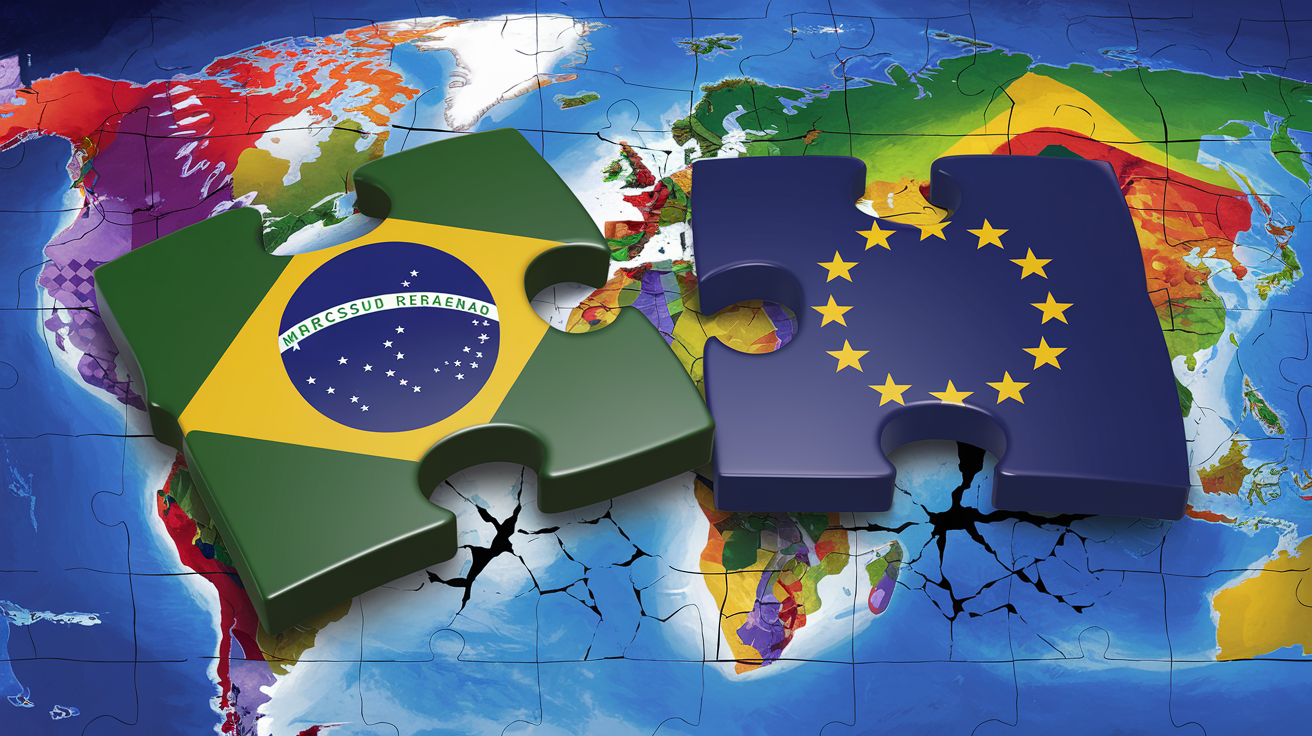
Mercosur-European Union Agreement, Negotiated for 25 Years, Could Be the Key to Boosting the Brazilian Economy and Facing Global Challenges. However, French Resistance, Political Instabilities, and Economic Impacts Create Uncertainties. Learn What Is at Stake for Brazil and the World.
A historic negotiation involving two gigantic economic blocs may finally come to fruition.
But not everything is a celebration: while some see the Mercosur-European Union agreement as a promising path for the Brazilian economy, others point to political, environmental, and trade challenges that could compromise its implementation.
After 25 years of negotiations, Mercosur and the European Union are about to announce what could be one of the largest trade pacts in history.
-
Larger than entire cities in Brazil: BYD is building a 4.6 km² complex in Bahia with a capacity for 600,000 vehicles per year, but the discovery of 163 workers in conditions analogous to slavery has shaken the entire project.

-
With an investment of R$ 612 million, a capacity to process 1.2 million liters of milk per day, Piracanjuba inaugurates a mega cheese factory that increases national production, reduces dependence on imports, and repositions Brazil on the global dairy map.

-
Brazilian city gains industrial hub for 85 companies that is equivalent to 55 football fields.

-
Peugeot and Citroën factory in Argentina cuts production by half and opens a layoff program for more than 2,000 employees after Brazil drastically reduced purchases of Argentine vehicles.


The agreement, which provides for tariff reductions and investment facilitation between the two blocs, promises to create an integrated market of 700 million people, according to European Commission President Ursula von der Leyen.
According to information from BBC Brasil, the official announcement is expected to be made this week during the Mercosur Summit in Uruguay, with the presence of President Luiz Inácio Lula da Silva and leaders from other South American countries.
If realized, the agreement will represent a significant political victory for Lula’s government, especially after the impasses that marked previous years, such as the freeze during Jair Bolsonaro’s presidency due to tensions with European powers.
However, there is a long journey ahead before the treaty comes into effect. France, a major opponent of the pact, leads a coalition of countries questioning the agreement’s impacts, especially in the agricultural sector.
Resistance and Political Challenges
The French government, under Emmanuel Macron’s leadership, is one of the biggest critics of the agreement. The main concern relates to competition in the agricultural sector.
French farmers fear losing ground to South American products, produced with less stringent environmental and sanitary standards.
Recently, Carrefour, one of France’s largest supermarket chains, announced it would stop buying meat from Mercosur, but backtracked after criticism.
This opposition reflects not only economic interests but also internal political issues in France, which is experiencing a moment of instability with a divided Parliament and early elections that have strengthened the radical right.
Experts consulted by BBC Brasil believe that the French resistance also has geopolitical roots.
The advance of external influences, such as China and Russia, in South America pressures European countries to strengthen ties with Mercosur.
However, Macron faces domestic and international pressures that complicate unanimous approval within the European Union.
The Role of Donald Trump in the Global Scenario
Another factor that may influence the decision is Donald Trump’s return to the presidency of the United States.
Known for his protectionism, Trump has promised to impose new tariffs on foreign products, which may prompt Europe and Mercosur to seek strategic alliances to face the economic impacts.
For Cairo Junqueira, a professor at the Federal University of Sergipe, “Trump’s election could serve as a catalyst for the approval of the agreement, just as it did in 2019, when the first signing took place.” Geopolitics, therefore, plays a crucial role in making the treaty viable.
Economic Benefits and Concerns for Brazil
In Brazil, the agreement divides opinions. A study from the Institute for Applied Economic Research (Ipea) indicates that the pact could increase Brazilian GDP by 0.46% by 2040, which is equivalent to US$ 9.3 billion per year.
Furthermore, Brazilian exports to Europe are expected to grow, especially in sectors such as commodities, while European products like vehicles and medicines will become more accessible to Brazilian consumers.
On the other hand, unions and labor organizations, such as the Unified Workers’ Central (CUT), fear that tariff reductions could harm the national industry.
“Brazilian companies may not be as competitive as European ones, leading to factory closures and job losses,” warns a statement from the organization.
The National Confederation of Industry (CNI), however, takes a more optimistic tone. In a document released in November, the CNI argued that trade integration is essential to strengthen the Brazilian economy and ensure its resilience in times of global crises.
Steps for Approval and Bureaucratic Hurdles
Even if the agreement is officially announced, it must go through a long and complex process to come into effect.
On the Mercosur side, it is only necessary to approve it by the parliaments of Brazil, Argentina, Paraguay, Uruguay, and Bolivia.
In the European Union, however, the scenario is more complicated. The pact must be approved by two bodies: the Council of Ministers and the European Parliament.
Subsequently, it may be necessary to gain the approval of all 27 national parliaments, which represents a significant challenge.
“Without unanimous approval, it is unlikely that the agreement will be fully implemented,” assesses Carolina Pavese, an expert in International Relations.
Conclusion: What Is at Stake?
If approved, the Mercosur-European Union agreement will not only strengthen the economies of both blocs but could also reposition Brazil as a global economic power.
However, internal resistance in Europe, environmental challenges, and political uncertainties make the pact’s future uncertain.
The big question remains: is Brazil prepared to make the most of this historic opportunity, or will the obstacles be insurmountable? Share your opinion in the comments!







Seja o primeiro a reagir!