





 Portuguese
  English
  Spanish
  6 min of reading
  0 comments


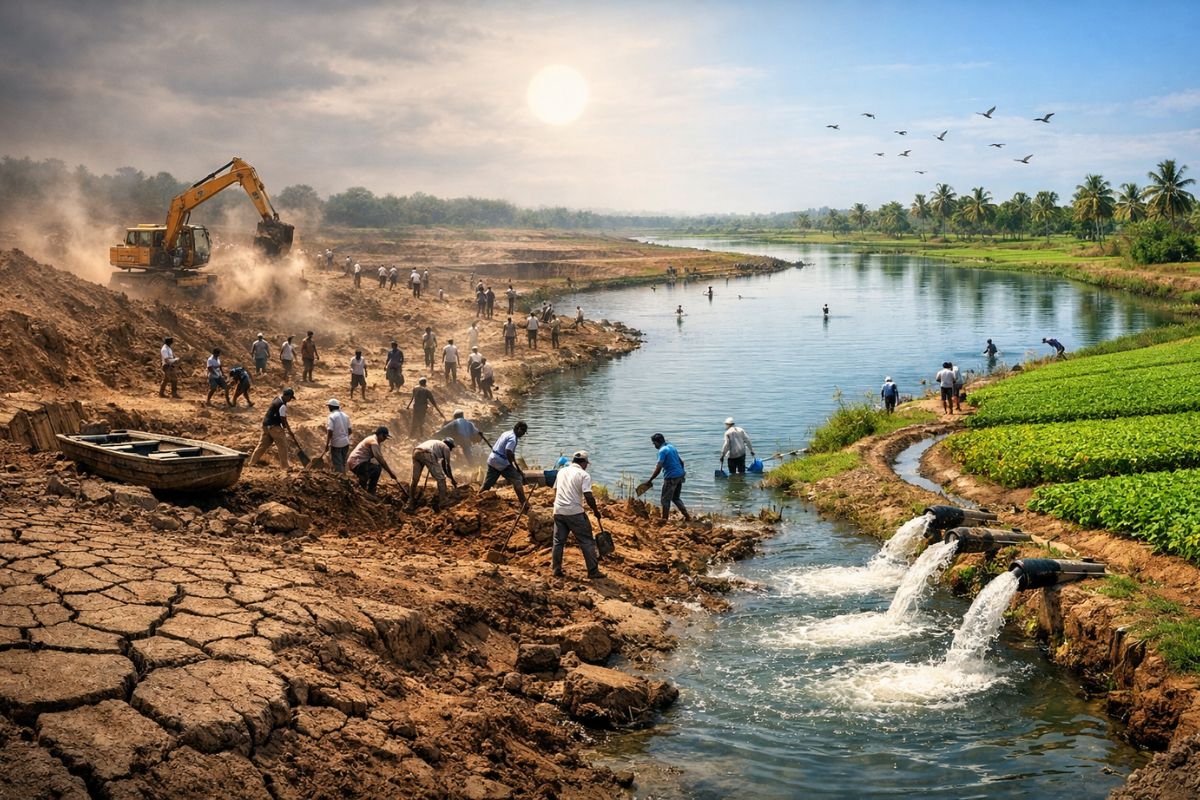
In the Rural Area of Thanjavur District, in the Peravurani Area, Residents Led by Nimal Raghavan Organized Permission, Funding, and Machines to Restore a Silted Lake. The Collective Effort Mobilized Dozens of People, Avoided Concrete Solutions, Reinforced Banks, and Reactivated Channels, Irrigating Thousands of Acres and Recharging Groundwater.
The lake in Peravurani stopped being just a landscape when the drought began to shorten the community’s future. Water was disappearing, agriculture was stalling, jobs were scarce, and the population was declining, with people leaving in search of employment. When the lake dried up and the surroundings became synonymous with abandonment, the impact was not limited to crops: it affected daily routines, income, and the permanence of families.
It was in this context that a local group decided to take action and assume restoration as a collective task, with community leadership and practical organization. The choice was to transform an old problem into a project with a beginning, middle, and maintenance, bringing people together, defining steps, and addressing what often hinders such initiatives: authorization, costs, fuel, machinery, and labor.
Where Is Peravurani and Why the Lake Became a Matter of Survival

Peravurani appears as a rural area connected to the Thanjavur district, with villages and agricultural land that depend on water stored and distributed through channels.
-
Friends have been building a small “town” for 30 years to grow old together, with compact houses, a common area, nature surrounding it, and a collective life project designed for friendship, coexistence, and simplicity.
-
This small town in Germany created its own currency 24 years ago, today it circulates millions per year, is accepted in over 300 stores, and the German government allowed all of this to happen under one condition.

-
Curitiba is shrinking and is expected to lose 97,000 residents by 2050, while inland cities in Paraná such as Sarandi, Araucária, and Toledo are experiencing accelerated growth that is changing the entire state’s map.

-
Tourists were poisoned on Everest in a million-dollar fraud scheme involving helicopters that diverted over $19 million and shocked international authorities.

The lake, when functioning, is not just a reservoir: it becomes a support point for irrigation, water for daily use, and stability of the surrounding soil. When this type of lake silts up and loses capacity, drought doesn’t just “arrive”: it sets in.
In addition to the lack of rain, chain effects emerge. Without water, cultivating large areas becomes “almost impossible,” and the risk is not just losing a harvest: it is losing the viability of local agriculture.
In areas close to the sea, there is also the problem of saltwater intrusion as freshwater diminishes, signaling that the management of the lake and channels is not a technical detail; it is territorial protection.
What Was Done in 107 Days and Why 564 Acres Matter

The practical decision was to restore the lake in Peravurani as a priority, and the work was conducted over 107 days.
The cited dimension of 564 acres recovered helps to understand the scale: it is not merely “cleaning the edge,” but a large-scale intervention capable of altering storage, circulation, and infiltration of water in a vast area. In 107 days, the project moved from discourse to disturbed ground, reinforced edges, and remade bed.
The restoration also appears as a response to a history of projects that “come and go,” leaving structures without continuity.
The group insisted on process and execution: mapping steps, dividing tasks, organizing people, combining rules of what not to do (like removing trees), and maintaining focus on the lake’s functioning. The most evident signal of results is simple: the lake has begun to fill up again, and water has reappeared where there was previously nothing but dust and resignation.
Simple Engineering, Difficult Decisions: Dredging, Slopes, and Channels Without Concrete
From a technical perspective, the focus is on dredging (removing sediments), leveling, and reinforcing edges to increase the “ability to hold” water.
The logic is that of a “sponge model”: holding water longer, facilitating infiltration, and reducing loss through rapid runoff. The stronger and better-maintained the edges and limits of the lake, the greater the control over the retention of water.
A repeated point is the refusal of “showcase” solutions, like concreting banks for convenience. The criticism is straightforward: concrete can disturb the soil, affect microorganisms, and break the natural dynamics that sustain aquatic life and the very quality of the lake environment.
Instead, the plan emphasizes strengthening boundaries, respecting the terrain, and using vegetation as an ally, especially native trees (cited as examples of local species), which help stabilize banks and reduce erosion during rainy periods.
Recharge, Irrigation, and the “Domino Effect” Beyond the Water Reflection

When a lake starts functioning again, the impact doesn’t remain “inside” it. Reports indicate recharge within a radius of about 10 km and irrigation reaching over 5,000 acres of agricultural land, demonstrating a domino effect: more available water, reactivated channels, and the surroundings recovering some water security.
The lake becomes a piece of silent infrastructure: it doesn’t appear as a monumental work, but it changes what can be planted, when to plant, and how long to sustain production.
There’s also a networking aspect: lakes, ponds, small channels, and drainage areas connect. If a channel is overgrown with vegetation and sediment, the water doesn’t “flow” even when there is volume.
Restoration, therefore, is not just about digging: it is ensuring that entry and exit pathways work, that levels are coherent, and that the lake does not lose capacity again due to neglect.
The mention of drone inspections and the removal of accumulated plants reinforces the idea of ongoing maintenance, not a one-off effort.
Local Governance: Permission, Funding, Irrigators Association, and Maintenance
Lakes projects often stall due to two questions that no one likes: “who authorizes?” and “who pays?”.
Here, stages of permission with the government and careful organization of expenses for concrete items such as excavators/JCB, fuel (diesel), transport, and labor appear.
The transparency of costs does not depend on public numbers; it relies on method: calculating, planning, and not starting without being able to sustain the work to the end.
The other pillar is the “community ownership” of the lake. The idea is to engage residents from day one, adding local knowledge and practical experience, and above all, creating a social protection system: if someone tries to dump trash, discharge improper water, or cause damage, the community itself reacts.
The model of an irrigators association, common in agricultural areas, also appears as a structure capable of organizing usage, maintenance, and rules, because without governance, the lake returns to the cycle of abandonment.
What This Case Teaches Other Communities in Recurring Drought
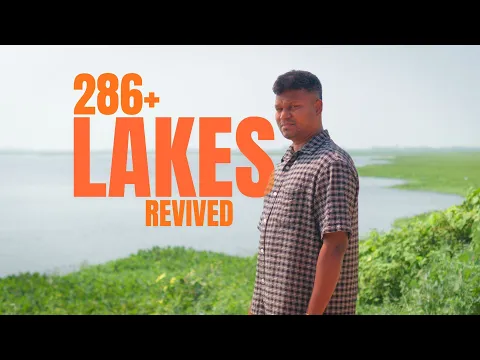

The story of Peravurani points to three hard and useful lessons. The first: restoring a lake requires accepting lengthy, repetitive, and not very “Instagrammable” work: dredging, leveling, reinforcing edges, cleaning channels, removing accumulations, measuring what works.
The second: too quick a solution often incurs interest later, whether through soil degradation or through a structure that does not engage with the local ecology.
The third lesson is human: where the lake fails, the community loses water and people; where the lake returns, space opens to resume agriculture, reduce pressure for migration, and rebuild trust in the place itself.
It is not magic, and it does not solve everything: drought continues to exist, rains vary, costs reappear. But the restoration of the lake shifts the problem’s foundation from impotence to management, from abandonment to maintenance.
Peravurani shows that a lake is not just a body of water: it is a living agreement between soil, rain, channels, and people.
When the lake was treated as a collective responsibility with permission, funding, technical choices, and maintenance rules, the water returned and carried with it an agricultural and social rebirth. The drought does not disappear, but it loses the power to swallow everything when there is structure and community to hold the water.
In your region, is there any lake, pond, or reservoir that was once important and is now forgotten?
What more prevents a restoration from happening: lack of organization, cost of machinery/fuel, or disputes over responsibility? And, if that lake started functioning again, what would change first in the lives of the people there?









-

Uma pessoa reagiu a isso.