





 Portuguese
  English
  Spanish
  9 min of reading
  0 comments


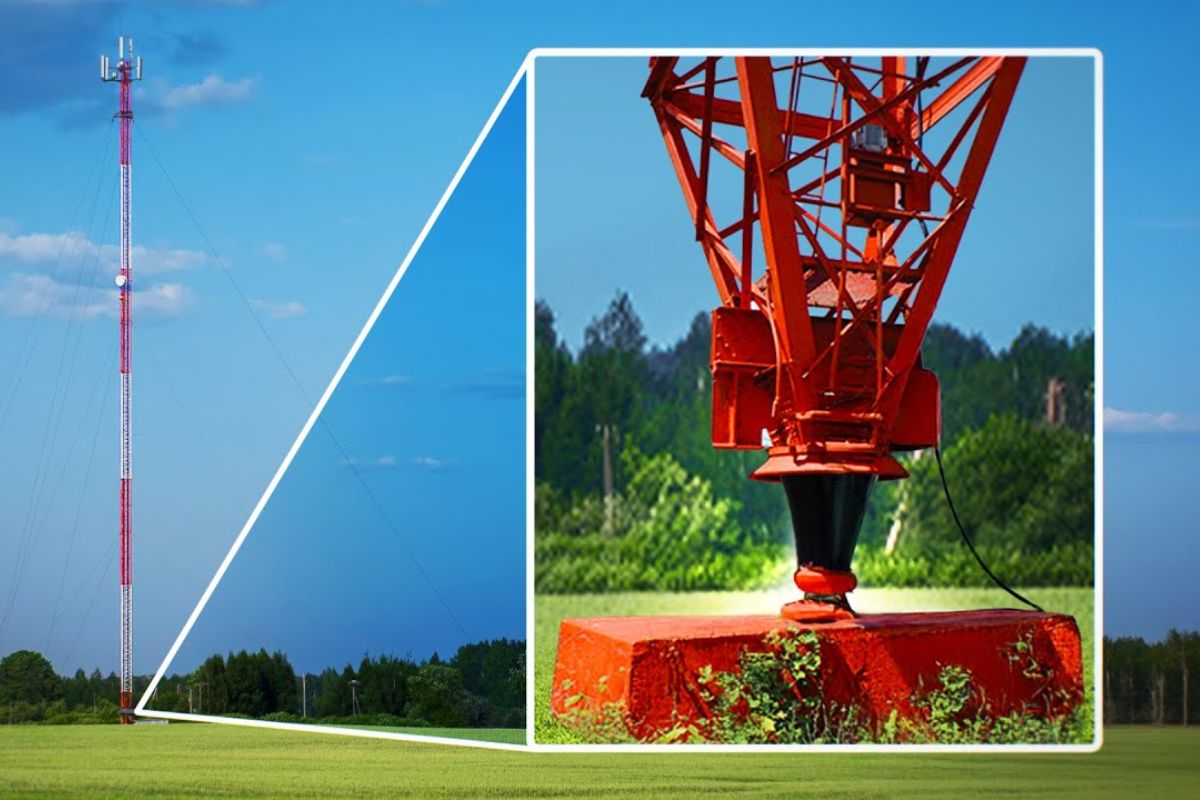
Erected in 1974 to broadcast Polish radio across Europe, the Warsaw radio tower reached 646 meters and set a world record. The maintenance of the cables became expensive, the replacement required temporary cables, and on August 8, 1991, a sequence failure and wind brought down the entire mast
The Warsaw radio tower became a global reference for height and later, risk. Built in 1974, at 646 meters, it was designed to bring Polish-language programming to a vast area and ended up as a classic case of collapse when the maintenance of the cables entered a critical phase.
What brought down the radio tower was not a “mystery from the sky,” but a chain of decisions and predictable forces in extremely slender structures: worn supporting cables, complex replacement, altered sequence, incomplete installation of temporary cables, and a gust of wind that twisted the mast until it tore away its stays.
The 1974 Record and the Mission to Reach Europe

In 1974, a new world record was set for the tallest structure on Earth.
-
Florianópolis will receive a million-dollar BRT that will begin construction in 2026 with nearly 400 million in funding from the federal government and the Inter-American Development Bank, and the map already shows the routes for the exclusive bus corridors.

-
Without a blueprint, without an engineer, and using scrap from the dump, a father spends 15 years building an 18-room castle for his daughter, featuring tram tracks, 13 fireplaces, and over 700 m², which may now be demolished.

-
A megaproject worth R$ 89 billion is advancing in Iraq and promises to change the game in global trade by creating a new corridor between Asia and Europe, reducing traditional routes and repositioning the country as a logistics powerhouse.

-
Goodbye bedside table: floating shelves become a trend in 2026 by freeing up space in the bedroom, improving circulation, bringing visual lightness, and integrating technology without taking up floor space.


The Warsaw radio tower reached 646 meters, about 2,120 feet, and was built to transmit radio programs to the Polish-speaking public across Europe.
The reach depended on the sky.
If the atmospheric conditions were ideal, signals could be picked up from virtually anywhere in the world, reinforcing why the radio tower was pushed to rare heights, where the line of sight extends and the horizon recedes.
The Maintenance Cost: Building Was Only Half the Battle

As with major infrastructure projects, raising the radio tower was only half the work.
Maintaining such a tall and slender structure was incredibly expensive, and the cost was not abstract: over time, the supporting cables that kept the mast standing began to wear out.
By 1991, many cables were already worn and needed to be replaced.
The task was costly and also complex because each cable is part of a delicate balance: altering one stay means redistributing forces throughout the radio tower.
How to Replace a Stay and Where the Sequence Can Bring Down the Mast

The procedure described for replacing a main cable had a safety logic. First, it was necessary to secure two temporary cables to the mast.
Only then could the old cable be removed and replaced with a new one.
On August 8, 1991, the sequence was altered. Reports vary, but the picture presented is consistent: one of the main cables was disconnected before the temporary cables were fully installed.
A gust of wind twisted the radio tower, tore away the temporary cables, and the mast, unsupported, collapsed.
The Fall of 1991: A Catastrophe Without Injuries and a Record Ended
The collapse was an operational catastrophe, but with a rare detail in infrastructure tragedies: no one was injured.
Still, it was a significant and symbolic loss because the Warsaw radio tower did not lose its top to a taller rival, but rather to a failure during maintenance.
Normally, taller structures in the world lose their position because another is built higher. In this case, a tower in North Dakota reclaimed leadership by default, with Warsaw out of the map.
Why This Type of Tower Is Efficient and, at the Same Time, Risky
The Warsaw radio tower was a specific type of structure called a guyed mast.
It has structural characteristics that seem bizarre at first glance, including unusual bases and scattered anchorages, but which make it possible to reach heights where self-supporting towers become economically and technically impractical.
The risk accompanies the efficiency.
The report itself indicates that at least nine guyed masts over 600 meters have collapsed, most in the United States, along with hundreds of similar, shorter structures scattered around the world.
The radio tower, in this context, becomes a symbol of how “it works” and how it can fail.
Height, Horizon, and the Logic of the Line of Sight in Broadcasting
Radio communication is described as remarkable technology, capable of sustaining a huge variety of wireless devices.
Part of the reason for having a giant radio tower is geometric: many frequencies used in communication, especially radio and television, require unobstructed line of sight between transmitter and receiver.
The Earth itself becomes a solid obstacle to radio waves when the antenna is low. That’s why antennas rise to hills, mountains, or very tall towers.
At around 600 meters, the distance to the horizon exceeds 50 miles, about 80 kilometers, increasing the coverage area and justifying projects like Warsaw’s.
Self-Supporting Tower Versus Guyed Radio Tower: Cost and Material
A self-supporting tower needs its own stiffness so it doesn’t turn into “spaghetti” in the wind. This requires more material at the base and along the structure, making these towers ideal when land is scarce, such as in urban areas, but expensive when height increases.
The report describes a simple cost escalation rule: self-supporting towers tend to have costs that grow approximately proportional to the square of the height, while guyed towers grow approximately with the height raised to the power of 1.5.
They require more land due to the anchorages, but above a certain height, they become more economical and, for extreme heights, the technically viable option.
There is a strong material contrast: the Eiffel Tower, at 324 meters, weighs about 7,000 tons. A guyed mast of the same height would weigh approximately five percent of that, a difference that helps explain why the guyed radio tower seems too light to be real, until the wind proves that nothing is light at the top.
Stays Don’t Push: Why Tension Becomes Compression and Can Generate Buckling
A phrase from the report summarizes a structural truth: you can’t push a rope.
Stays work in tension, so to resist wind in any direction, at least three sets distributed around are necessary, and some towers use four.
The problem is that the stay pulls at an angle. While pulling, it not only contains laterally but also compresses the mast.
And long slender compressed elements have a classic enemy: buckling, when the member yields laterally before “crushing.”
Steel supports a lot of compression in short pieces, but in tall and thin elements, it can fail under relatively small loads, even under its own weight, depending on the support conditions.
When the radio tower experiences lateral wind load, the cables transfer part of that load to the mast in the form of compression. If the structure is not stiff enough, it can buckle. Geometry becomes destiny.
The Angle of the Anchorages: Why Spreading Helps and the Terrain Becomes Cost
The report shows a typical trade-off: the shallower the angle of the cable, the greater the efficiency to resist lateral loads with less tension.
By reducing the necessary tension, the induced compression on the mast is also reduced, and the radio tower becomes less prone to buckling under wind.
The calculation, however, goes from paper to ground. For shallower angles, the anchor points need to be farther away, requiring more land.
The design balances the cost of external anchorages with the cost of making the tower stiffer to accept cables at steeper angles.
Levels of Stays: Stiffness Increases, but Compression Also Comes into Account
Low guyed towers sometimes use only one level of support, but the report describes that in the middle of the mast, instability can persist.
Lateral forces still deflect the structure, and the tower remains subject to buckling, even from the weight of antennas on top.
Adding more levels of stays dramatically increases stiffness, but each level also adds compression to the mast.
It’s a two-sided game: more lateral support reduces the length without bracing, but adds vertical loads and requires fine balance.
Another detail is the pre-tensioning of the cables. Stays yield along the length and are not perfectly straight.
In strong winds, they “stretch” and increase stiffness, but in calm conditions, slack can allow oscillation.
Pre-tensioning eliminates slack, but it creates extra compression and can require stronger members, reinforcing the nature of permanent compromise in a tall radio tower.
Articulated Bases and Why Many Towers Narrow Down to a Point
The base is one of the points that seems to challenge logic for those looking at a guyed radio tower. In many structures, we are used to imagining a rigid fixation at the foundation.
But the report explains why this may be disadvantageous in very tall masts.
Fixing a tall tower rigidly to the foundation requires transferring loads to the ground resisting rotation and uplift, complicating the design.
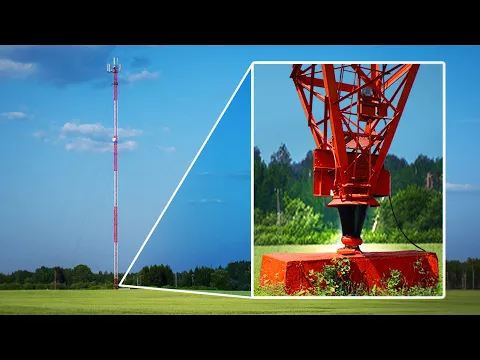
An alternative is to use a spherical bearing or a pin support, allowing the mast to rotate freely at the base.
In this arrangement, the stays provide nearly all the lateral restraint, and the foundation primarily needs to resist vertical force and some shear.
This type of base allows some movement and settlement without imposing unpredictable stresses on the structure. Removing the constraint makes the structural response more predictable and can reduce the need for extreme conservatism and sophisticated modeling in each project variation.
In other words, the articulated base is not whim; it is a way to control what can get out of control.
Ceramic Discs: When the Radio Tower Also Is the Antenna
Some towers not only carry antennas; they are the antennas.
For lower frequency transmissions, such as AM radio, the report states that a large antenna is required, and the tower itself can be energized.
In these cases, the base needs to be electrically isolated from the ground, and that’s easier at a single point.
This is where a curious image emerges: some towers are supported on a ceramic disc, which serves as an insulator at the interface between mast and ground, a visual detail that seems too fragile for a giant but meets the electrical and structural logic of the system.
Operational Risks: Aviation, Ice, Lightning, and Maintenance Work
Besides structural engineering, the report lists operational challenges.
There is a risk for aircraft, and aviation regulations often require paint with alternating bands in orange and white, plus warning lights with defined color and flash frequency, which may even be synchronized with nearby towers.
Ice is another critical factor. Masts pass through layers of colder, moist air, where ice can accumulate on the mast and stays. This increases weight and also surface area, raising the wind load.
When it melts, it can fall and damage what is below, which is why it is common to see protective structures over transmission lines.
Lightning is presented as a recurring threat, more a matter of frequency than possibility. Many towers use lightning rods and robust grounding to keep voltage off lines and equipment on the ground.
In mast radiators, where the radio tower is energized, it cannot be grounded directly, so a spark gap is used: if a lightning strike occurs, the air in the space ionizes, and the surge goes to the ground more safely, preserving isolation under normal conditions.
And there is the human risk. Towers require painting, bulb replacement, and antenna maintenance. Technicians trained for height and electrical work face constant dangers.
Even with non-ionizing frequencies, electromagnetic radiation can generate heat, the basic principle of a microwave. If the radio tower itself is energized, a person could become part of the circuit.
The Warsaw radio tower entered history by reaching 646 meters and by collapsing on August 8, 1991 during a sensitive stage of cable replacement.
The case exposes why guyed masts are efficient, lightweight, and at the same time, dependent on sequence, angles, pre-tension, bases, and maintenance that cannot tolerate improvisation.
The next time you pass by a radio tower, it’s worth looking more closely at the stays, the anchorages, and the base, because there lies the signature of engineering that supports what seems impossible.
In your opinion, what weighs more in preventing a new collapse of a radio tower: the maintenance sequence, the control of the pre-tension of the stays, or the design of the articulated bases?








-

-

2 pessoas reagiram a isso.