





 Portuguese
  English
  Spanish
  5 min of reading
  0 comments


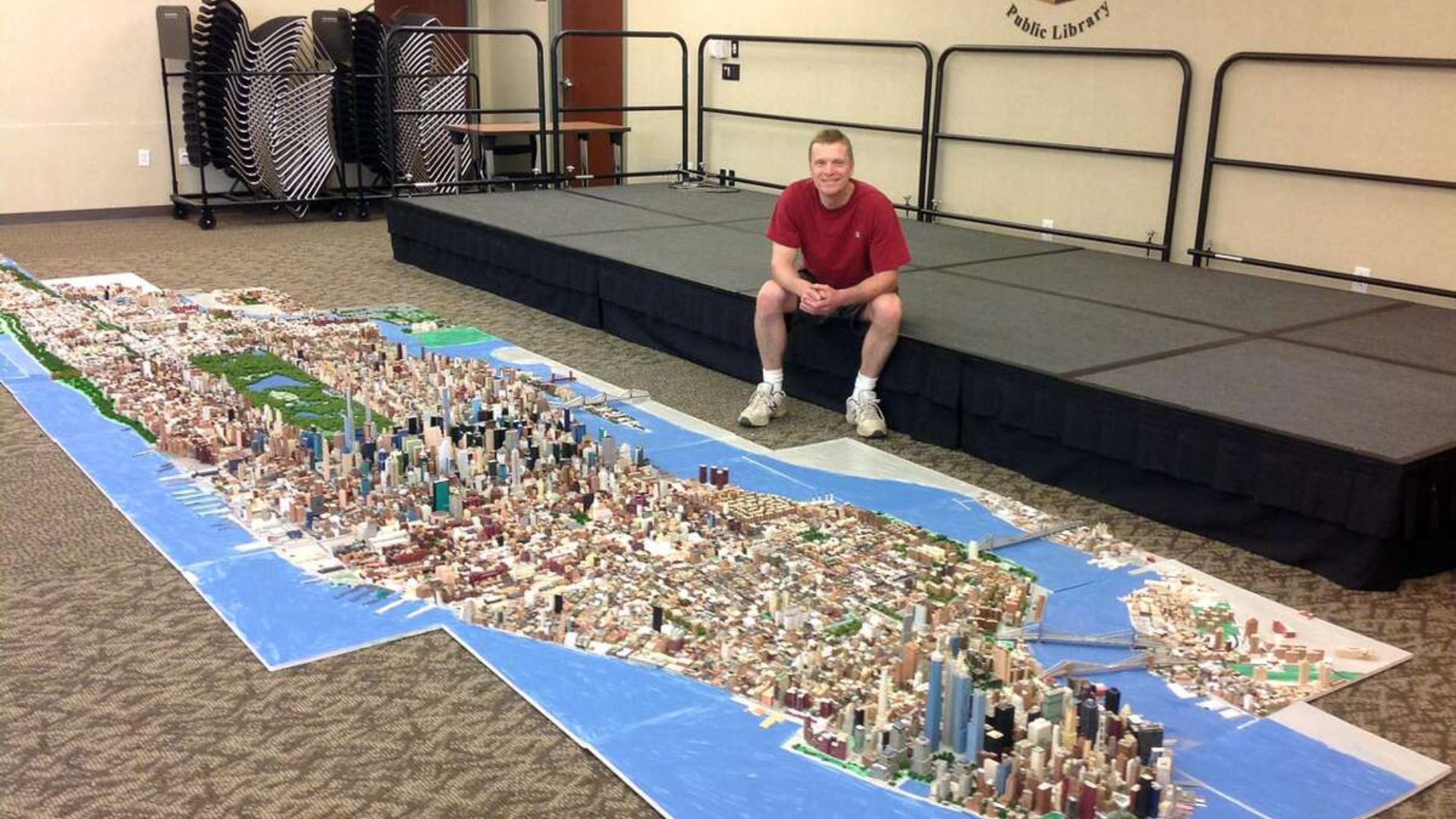
Decades-long handcrafted project transforms simple materials into one of the largest miniature representations of New York ever displayed to the public, bringing together thousands of structures and drawing attention for its scale, level of detail, and the unusual trajectory of its creator.
After more than two decades of nearly daily work, truck driver Joe Macken saw a monumental model of New York, handmade with balsa wood, cardboard, glue, and acrylic paint, leave his home environment and gain space at the Museum of the City of New York.
The installation, open to the public since February 12, 2026, features a miniature version of the metropolis built over 21 years and presented by the museum as one of the most ambitious handmade representations ever created of the city.
Origin of the project and start of construction
Born in Queens, Macken started the project in 2004 with a reproduction of 30 Rockefeller Plaza, also historically known as the Comcast Building.
-
More than 138 stone tools found on the seabed between Turkey and Europe reignite the hypothesis of a lost land bridge from the Ice Age that may have been used by humans to cross continents.

-
Argentina places the first U.S. Stryker 8×8 armored vehicles in operational units, while Brazil sets a record of $3.1 billion in military exports, reaching 140 countries and strengthening the Defense Industrial Base.

-
A flight attendant fell from 10,160 meters without a parachute after an airplane explosion, survived against all logic, and still holds the record for the highest fall ever survived by a human being.

-
With a monumental stone structure dating back over 2,000 years, excavated 6 meters deep and with dimensions that surprise archaeologists, the newly discovered tank in Gabii may be one of the first major public works of Ancient Rome outside of temples and walls.

What began as an isolated piece gradually transformed into a large-scale urban portrait, expanding section by section to include the five boroughs of New York and neighboring areas of New Jersey and Nassau County.
Size of the model impresses visitors

The size of the work helps explain the impact.
According to the museum, the model measures 50 by 27 feet, approximately 15 by 8 meters, and was produced entirely by hand.
The institution also reports that the set has more than 340 sections, while the exhibition’s launch material recorded 320 distinct sections, indicating that the public count varied between the official presentations of the project.
In terms of occupied area, Smithsonian Magazine described the work as a model of approximately 1,350 square feet, equivalent to about 125 square meters.
In the same report, the publication stated that the model was made to a scale of 1:2,400 and includes nearly 1 million structures, including buildings, streets, bridges, and stadiums.
Viewed from afar, the installation impresses with its volume; up close, it draws attention for the precision with which entire neighborhoods have been condensed into minimal surfaces.
Simple materials and handcrafted technique
The choice of materials also contrasts with the scale of the endeavor. Instead of resorting to resins, industrial machinery, or sophisticated modeling techniques, Macken built the city with everyday items and simple tools.
The use of common glue, cardboard, manually cut balsa wood, acrylic paint, and small artificial trees became one of the hallmarks of the work, precisely because it contrasts with the scale of the final result.
This handcrafted character is central to the interpretation of the model.
When presenting the exhibition, the Museum of the City of New York emphasized that the work translates the skyline, neighborhoods, and urban landmarks with “precision, character, and imagination.”
Stephanie Hill Wilchfort, the director and president of the institution, stated that the model reflects “the wonder and complexity of this city” from the perspective of someone who has lived in the city and reconstructed it piece by piece.
Influence of the Panorama and personal trajectory

Macken’s relationship with miniatures began in childhood, during a school visit to the Queens Museum.
It was there that he encountered the Panorama of the City of New York, an urban model created for the 1964 World’s Fair.
Decades later, recalling that experience, he said he remembered walking through the attraction and thinking, “Wow, this is what I want to do.” This phrase helps situate the origin of a project that matured over years before becoming a daily practice.
The comparison between the two works helps to gauge the individual effort involved.
The Panorama of the Queens Museum, cited as a formative reference for Macken, was built by more than 100 people over three years.
In contrast, the replica now presented at the Museum of the City of New York was developed almost entirely alone and over a much longer period, spanning house moves, work routines, and space limitations.
Production routine and expansion of the model
First in Middle Village, Queens, and then in Clifton Park, New York, Macken continued the project for over 20 years.
When production occupied all available space at home, he needed to rent a storage unit to keep completed parts and maintain the progress of the model.
The modular dynamic ultimately shaped the expansion of the work itself, which grew like a continuous mosaic of the city.
Smithsonian also reported that the cost of materials was around $20,000, a modest amount considering the extent of the work.

This figure becomes significant when viewed alongside the method employed: each building was constructed manually, with cuts, painting, and assembly repeated over the years.
The result did not depend on a large workshop or a large technical team, but on consistency, visual memory, and familiarity with the depicted territory.
Exhibition at the museum and public experience
Another aspect that broadened the reach of the story was the recent circulation of the work outside traditional art circuits.
According to Smithsonian, the model gained significant visibility after appearing in videos on social media last year, a movement that helped bring it to the museum.
The institutional debut, however, gave the project another weight by placing it in a space dedicated to urban evolution and the memory of the city.
In the current setup, the museum sought to explore both the impact of the whole and the richness of the details.
The installation, displayed in the Dinan Miller Gallery, allows visitors to observe the model from different angles, and the institution provides binoculars for the public to identify specific areas of the city.
On favorable days, visitors can also access the outdoor area to see the north side of the model.
This format reinforces a decisive characteristic of the work: the piece functions simultaneously as a panorama and as a recognition experience.
In a statement reproduced by Smithsonian, chief curator Elisabeth Sherman recounted that, upon seeing the model for the first time, the team’s reaction was to immediately locate the museum itself, the Met, and the Guggenheim.
For her, the strength of the project lies precisely in this meeting of emotional identification and material invention.
Macken also summarized the drive that sustained the model for so many years by stating to the New York Times, in a report reproduced by Smithsonian, that he wanted to keep New York close.
This statement helps to understand why the replica is not limited to a catalog of postcards.
It extends beyond the most well-known buildings and seeks to encompass an entire city, with its network of neighborhoods, streets, bridges, and residential areas.
Upon entering the museum, the public finds more than just a monumental miniature.
They find a work built through patient repetition, prolonged observation, and a personal relationship with the urban landscape.
Without resorting to noble materials or an industrial structure, Joe Macken transformed an intimate project into a museum piece and a visual document of a city that continues to be recognized, block by block, by those who traverse it every day.






Seja o primeiro a reagir!