





 Portuguese
  English
  Spanish
  4 min of reading
  0 comments


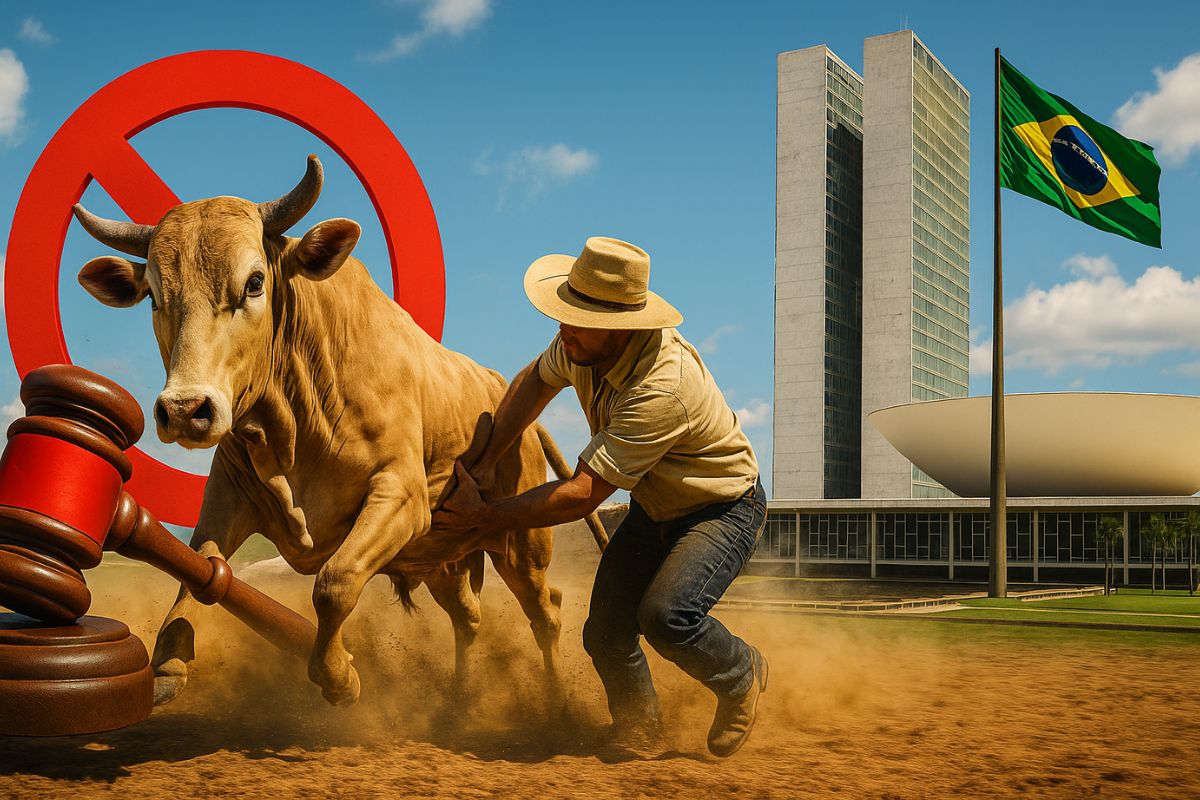
Banned by the Supreme Court for Animal Cruelty, the Vaquejada Was Legalized by a Constitutional Amendment in a Maneuver That Redefined the Boundaries Between Powers and Cultural Protection in Brazil.
The Vaquejada, a traditional practice in Brazil’s Northeast, was at the center of one of the most notorious institutional conflicts in the country’s recent history. In 2016, the Supreme Federal Court (STF) deemed it unconstitutional, accepting the argument that the activity inflicted cruelty on animals, which is prohibited by the Constitution. However, the decision did not end the debate; on the contrary, it ignited a strong political reaction that culminated in a direct amendment to the Constitution.
In a bold and direct response, the National Congress, propelled by a powerful front of ruralist parliamentarians, not only contested but reversed the decision of the highest court in the country. The maneuver, conducted through a Constitutional Amendment, legalized the practice and solidified a clash that transcends animal welfare, touching on fundamental issues regarding the separation of powers, cultural identity, and the economic strength of rural traditions that generate millions of reais annually.
The Ban by the Supreme Court

The starting point of the conflict was the judgment of Direct Action of Unconstitutionality (ADI) 4.983, in October 2016.
-
A couple buys an old chalet, breaks the kitchen floor for renovation, and finds over a thousand coins of gold and silver hidden since the English Civil War over 4 centuries ago.

-
Rigid bags with their days numbered: new trend prioritizes comfort in 2026.

-
YouTuber creates an excavator equipped with a giant 4.5-meter sword to challenge his brother to a rematch, and the invention quickly goes viral on social media.

-
The U.S. Army surprises the world by presenting the UH-60MX Black Hawk helicopter capable of flying without pilots, controlled by a tablet, featuring the MATRIX system, smart sensors, and full autonomy in real combat and rescue missions.


The action, filed by the Attorney General’s Office, questioned the validity of a law in the state of Ceará that regulated the vaquejada as a sporting and cultural practice.
The central argument was that the activity violated Article 225 of the Federal Constitution, which establishes the state’s duty to protect fauna and flora, prohibiting practices that subject animals to cruelty.
In a deeply divided decision, by a vote of 6 to 5, the STF declared the Ceará law unconstitutional.
The majority opinion held that the suffering inflicted on the bulls, which are pulled by the tail until they are thrown down, was inherent to the practice and therefore constituted the cruelty prohibited by the Constitution.
For those ministers who voted for the ban, the duty to protect the environment and fauna should prevail over cultural expression when it involved cruel treatment of animals.
The decision generated immediate protests in several capitals, with cowboys and supporters defending the practice as a pillar of their identity and livelihood.
The Congress Response and the Constitutional Amendment
The STF decision was seen as an affront by sectors of the National Congress, who viewed the measure as an interference of the Judiciary in cultural and economic issues.
The reaction was immediate and calculated.
First, in November 2016, Congress approved a law that elevated the vaquejada and rodeo to the status of intangible cultural heritage of Brazil.
However, this ordinary law was legally fragile, as it could not supersede an interpretation of the Constitution made by the STF.
The final and most forceful move came in June 2017, with the promulgation of Constitutional Amendment 96.
Instead of creating a new law, Congress amended the text of the Constitution itself, a legislative tool of maximum power.
A paragraph was added to the same Article 225, establishing that activities involving animals are not considered cruel, as long as they are cultural expressions registered as national heritage and regulated by law to ensure animal welfare.
The maneuver was designed to nullify the foundation of the STF decision, creating a constitutional exception to the cruelty rule.
The Final Validation and the New Legal Scenario
With the Constitution amended, the legality of the vaquejada was once again brought to the STF, this time from a new perspective.
The question was no longer whether the practice was cruel, but whether Congress had the power to make such an alteration to the Constitution to reverse a court decision, especially on a theme related to a fundamental right like the environment.
In a judgment concluded in 2023, the Supreme Court, by a majority of 8 to 3, validated Constitutional Amendment 96, putting an end to the legal dispute.
The majority of ministers understood that Congress acted within its prerogatives as Derived Constituent Power, which is the capacity to amend the Constitution.
According to the new interpretation, the amendment did not abolish the protection of animals but balanced it with the protection of culture, as long as animal welfare was assured through specific regulation.
This final decision represented a political victory for the defenders of the vaquejada and consolidated the practice as legal in the country, shifting the focus of the debate from “if it can be done” to “how it should be” to monitor the animals’ conditions.
The saga of the vaquejada in Brazil is a striking example of the complex relationship between the powers of the Republic and reflects a profound cultural division.
The clash between the STF and Congress not only redefined the legal status of the practice but also established a powerful precedent on how conflicts between constitutional values, such as environmental protection and cultural preservation, can be resolved.
The legalization via amendment demonstrated the strength of the Legislative branch in setting the agenda and even reversing judicial decisions on sensitive topics.
Is the vaquejada an essential part of regional culture or a cruel practice that should be abolished? Do you believe Congress acted correctly in reversing the STF’s decision? Share your opinion in the comments – we want to know how you see this complex debate.








-

Uma pessoa reagiu a isso.