





 Portuguese
  English
  Spanish
  6 min of reading
  2 comments


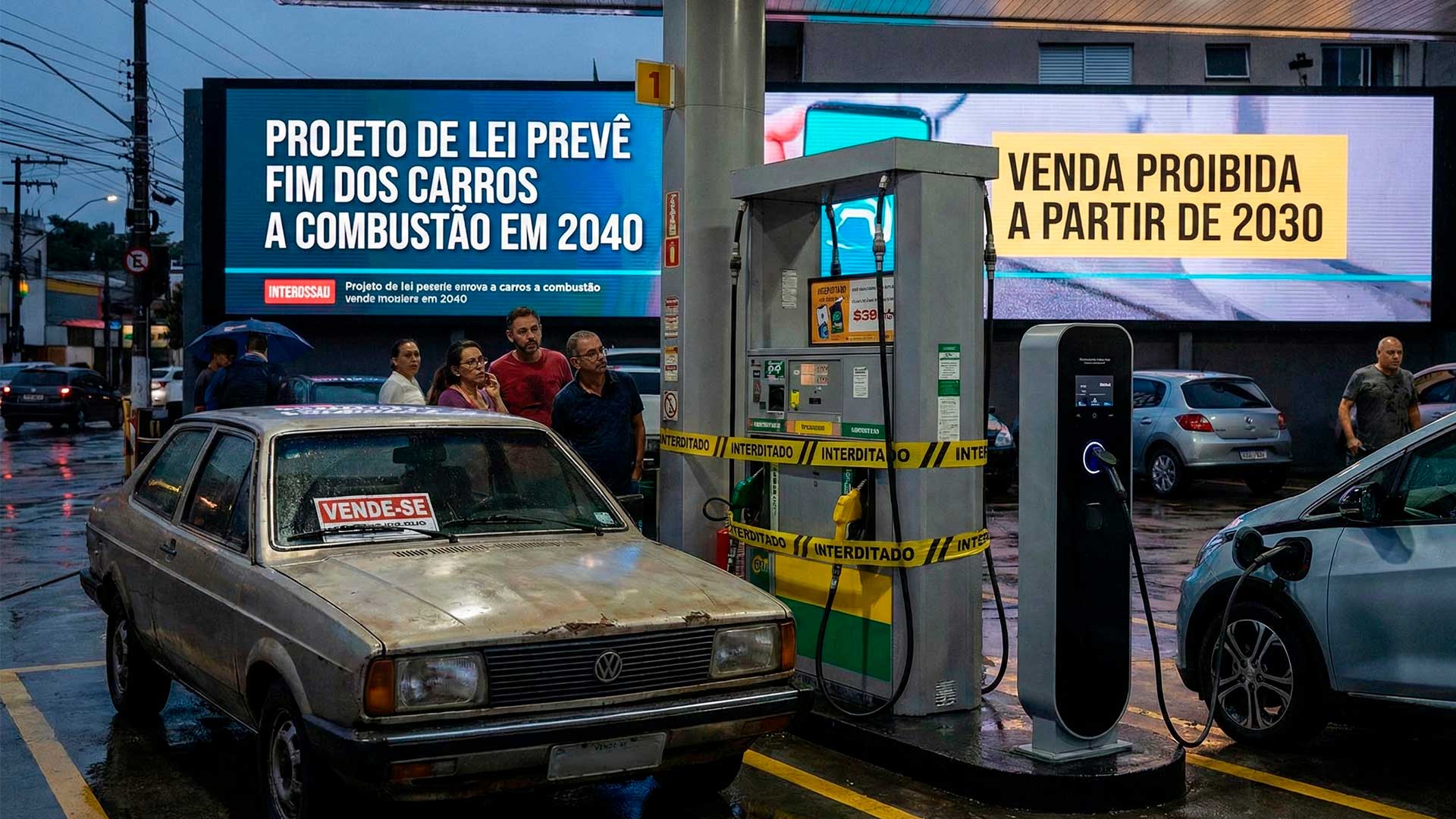


PLS 304 of 2017 Seeks to Prohibit the Sale of New Gasoline and Diesel Cars from 2030 and Ban Their Circulation in 2040, Except for Ethanol and Electric Cars; Proposal Advances in the Senate Environment Committee and May Change the Lives of Millions of Drivers.
The possibility of prohibiting the sale of gasoline and diesel cars in Brazil starting in 2030 has returned to the center of debate in Brasília. The focus is on Senate Bill 304 of 2017, authored by Senator Ciro Nogueira, which creates a policy for replacing fossil fuel-powered vehicles.
According to the text, no new car powered by gasoline, diesel, or natural gas could be sold after January 1, 2030. Starting in 2040, the circulation of combustion engine vehicles using fossil fuels would be prohibited, with exceptions for collector models, official, diplomatic, and foreign visitor vehicles.
In practice, the project preserves vehicles powered solely by biofuels, such as ethanol and biodiesel, in addition to electric cars. According to the Federal Senate, PLS 304 of 2017 has already passed through the Constitution and Justice Committee and is currently in the Environment Committee, where it is being processed in a terminative manner.
-
The Senate approves a bill that criminalizes misogyny, hatred, or aversion towards women, and includes the crime in the Racism Law with a penalty of up to 5 years.

-
Chamber Approves Bill That Allows Pepper Spray for Women Over 16 and Imposes Strict Rules for Purchase, Possession, and Use as Self-Defense

-
Chamber Approves Law to Combat Leucaena, Fast-Growing Plant That Dominates Land and Threatens Native Species in Various Regions of the Country

-
Asset Division: Know What Cannot Be Divided in Case of Divorce


If approved in the CMA, the text could go directly to the Chamber of Deputies, without another vote in the Senate Plenary. Therefore, the discussion has gained extra weight among automakers, environmentalists, and drivers, who are trying to understand how a potential law would change the daily lives of those who depend on combustion cars.
What PLS 304 of 2017 Provides for the End of Combustion Cars
According to the justification of the project, the objective is to establish a policy for replacing fossil fuel-powered vehicles over two decades. The first stage is the end of sales in 2030, and the second is the gradual removal of gasoline, diesel, or gas vehicles starting in 2040.
The text makes it clear that automobiles powered solely by biofuels, such as ethanol and biodiesel, and battery or hybrid electric cars that do not use fossil fuels remain allowed. Collector, official, and diplomatic vehicles, as well as foreign tourist cars for a limited period, are also permitted.
In defending the PLS, Ciro Nogueira mentions countries that are already discussing or have approved similar timelines, such as the United Kingdom and France, aiming for the end of sales of fossil fuel vehicles by 2040, and India, which is targeting 2030, while Norway discusses restrictions as early as the 2020s.
Processing in the Senate, Rapporteur, and Next Steps to the Chamber
The project was presented in 2017 and, after years stalled, gained momentum in 2020 when the Senate Constitution and Justice Committee approved the text with a favorable opinion. Since then, the matter has been waiting for analysis by the Environment Committee, a stage where the decision is terminative within the Senate.
An official Senate document updated in April 2025 shows that the current rapporteur in the CMA is Senator Cid Gomes, and that PLS 304 of 2017 is ready for the agenda, awaiting a public hearing before the vote. If the committee approves the text without major changes, the project will proceed to the Chamber of Deputies, where it can be modified or even shelved.
Ethanol and Biofuels as Brazil’s Card in the Transition from Combustion Cars
One of the unique aspects of the Brazilian debate on ending combustion cars is the strength of ethanol and other biofuels. PLS 304 of 2017 explicitly excludes from the prohibition vehicles powered solely by biofuels, precisely because they have a smaller carbon footprint than gasoline and diesel, according to the project’s justification.
Data from the National Agency of Petroleum indicates that total ethanol production in Brazil reached about 35.4 billion liters in 2023, a 15.5 percent increase compared to the previous year, consolidating the country as one of the largest global producers of biofuels. Biodiesel production also grew by over 20 percent in the same period.
There is also the rapid expansion of corn ethanol, whose supply increased 450 percent over five harvests between 2018 and 2023, reinforcing the agricultural base that supports this energy alternative. Experts connected to the agro-industrial sector point out that this infrastructure makes the Brazilian path different from the European one, where the transition is almost exclusively considered for battery electric vehicles.
In practice, the exemption for ethanol and other biofuels preserves a significant part of the flex fleet and future hybrid vehicles capable of operating solely with renewable fuels. This aligns the interests of agribusiness and automakers that are already developing flex hybrid vehicles, combining electricity and ethanol as a strategy for gradual decarbonization.
Brazilian companies are also beginning to advance solutions for heavy transport, such as technologies that convert diesel engines in harvesters, trucks, and tractors to operate 100 percent with hydrated ethanol, promising emission reductions and lower fuel costs. This movement reinforces the view that ethanol can play a central role in both light vehicles and agribusiness.
Obstacles: Cost of Electric Vehicles, Aging Fleet, and Dependence on Diesel
Despite the environmental advantages, experts point to considerable obstacles to meet the deadlines of 2030 and 2040. Reports on the current fleet show that Brazil surpassed 47 million motor vehicles in 2023 and nearly 124 million registered vehicles in 2024, with an average vehicle age close to 11 years, the highest since 1992.
At the same time, electric cars still have high prices for most Brazilian families. Market surveys indicate that entry-level models, such as the Renault Kwid E Tech and BYD Dolphin Mini, start at around 100 thousand reais, and many fall within the range of 115 thousand to 180 thousand reais, well above the most sold combustion compact cars in the country.
There is also the weight of cargo transport, where diesel trucks account for about 40 percent of emissions from road transport, according to a recent inventory from the sector. Studies indicate that transport was responsible for approximately 13 percent of national greenhouse gas emissions in 2020, reinforcing the need for decarbonization but also highlighting the difficulty of quickly replacing this infrastructure.
Lessons from Europe: Ambitious Goals and Retreats on the End of Combustion Engines
While Brazil discusses 2030 and 2040, the European Union has approved the end of sales of new combustion vehicles by 2035, requiring that all new cars sold have zero CO2 emissions from that date. This measure is part of the Fit for 55 package, one of the pillars of the European Green Deal.
In recent months, however, governments like Germany’s have begun to pressure Brussels for flexibilizations, including exceptions for hybrids and engines using low-emission synthetic fuels, and there is already discussion about postponing the European deadline to 2040 in some scenarios. Analysts view this retreat as a sign that, even in wealthy countries, the transition requires constant adjustments in the face of high costs and still limited charging infrastructure.
How Brazilian Drivers Can Prepare for Possible Changes by 2040
In Brazil, PLS 304 of 2017 can still be altered in the Environment Committee, in the Chamber, and may even receive presidential vetoes if approved. Therefore, mobility experts recommend keeping track of the progress on the Senate portal, where it is possible to read the full text of the project and register opinions in the official public consultation.
Even without an approved law, global trends point toward increasing restrictions on combustion vehicles, either through national timelines or low-emission zones in large cities. When planning to change cars, many consumers already consider factors such as energy efficiency, compatibility with ethanol, and the potential future adoption of hybrid or electric models as a way to reduce regulatory risks and usage costs.
Do you feel prepared to give up a gasoline or diesel car by 2040 if the law goes through, or do you think the country still lacks the infrastructure and income for that? In your opinion, should ethanol be the priority, or does Brazil need to accelerate towards electric and hybrid vehicles? Leave your comment and participate in the debate about which path makes more sense for the wallet, the industry, and the climate.










Não existe infraestrutura para viabilizar este tipo de lei a curto prazo precisaria de pelo menos mais quarenta anos no mínimo sem falar em automóveis antigos restaurados…..sem chance….🇧🇷🇧🇷🇧🇷😎⚓
Como sempre, o político faz leis para o seu benefício, excluindo o povo que o elegeu, como o caso em questão. Está claro que este imenso país precisa de mais tempo para erradicar a venda de carros a gasolina e diesel, sendo um prazo ainda para estudo, por volta de 2100.
O Brasil não pode jamais ser comparado com Europa no que tange as exigências climáticas, visto que este continente esgotou suas reservas e agora quer nos impor suas condições e os nossos políticos coniventes (alguns) fazem lobby para o Brasil “entrar” na onda. Na verdade tudo é por dinheiro, nada é para o clima, para a natureza ou para o povo. Oxalá Deus nos ajude!!!