





 Portuguese
  English
  Spanish
  3 min of reading
  0 comments


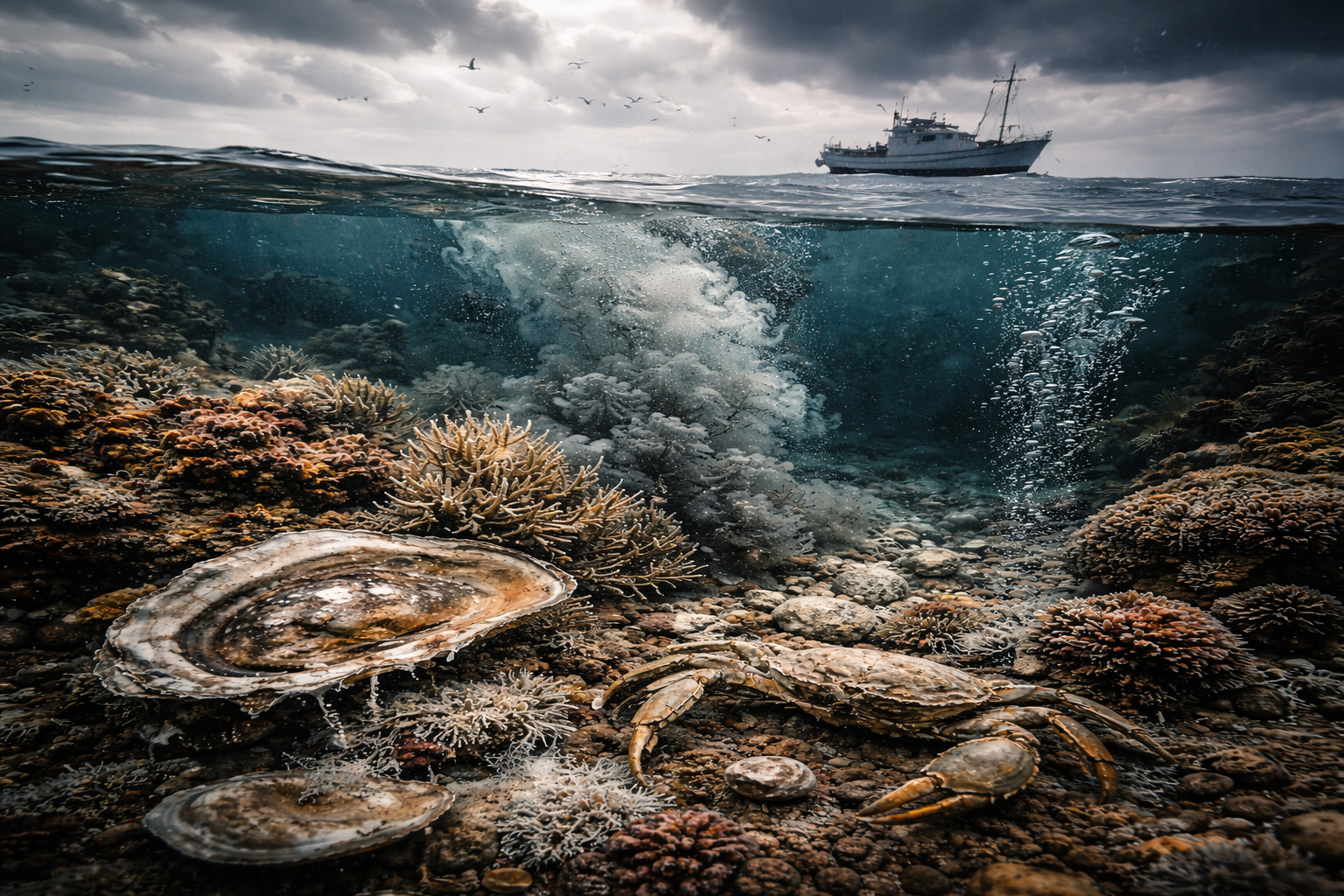
Recent Studies Show That Upwelling Currents And Atmospheric CO₂ Are Intensifying The Drop In pH In Coastal Waters And Increasing Pressure On Ecosystems And Local Economies
Coastal waters are acidifying more rapidly than was predicted by models based solely on increased atmospheric CO₂.
Researchers from the University of St. Andrews revealed in 2024 that powerful upwelling currents bring carbon-rich deep waters to the surface. As a result, the drop in pH exceeds previous projections and amplifies the impacts of ocean acidification.
According to consolidated scientific data since 2013, the oceans absorb nearly one third of the carbon dioxide emitted since the Industrial Revolution.
-
Motorola launched the Signature with a gold seal from DxOMark, tying with the iPhone 17 Pro in camera performance, Snapdragon 8 Gen 5 that surpassed 3 million in benchmarks, and a zoom that impresses even at night.

-
Satellites reveal beneath the Sahara a giant river buried for thousands of kilometers: study shows that the largest hot desert on the planet was once traversed by a river system comparable to the largest on Earth.

-
Scientists have captured something never seen in space: newly born stars are creating gigantic rings of light a thousand times larger than the distance between the Earth and the Sun, and this changes everything we knew about stellar birth.

-
Geologists find traces of a continent that disappeared 155 million years ago after separating from Australia and reveal that it did not sink, but broke into fragments scattered across Southeast Asia.

This process has raised surface acidity by about 26% and reduced the average pH by 0.1.

Technical Investigation Reveals Unexpected Chemical Acceleration
The team analyzed historical coral skeletons from the 20th century to reconstruct coastal chemical changes. Using boron isotopes, acidity variations were identified over the decades. Subsequently, regional ocean models projected scenarios into the 21st century.
According to Dr. Hana Jurikova from the University of St. Andrews, predicting the response of these systems to climate change is complex. Natural processes and human emissions combine and amplify chemical changes.
Upwelling Currents Place Regions on The Frontline
In upwelling systems, intense winds drive the rise of cold, nutrient-rich waters. This phenomenon sustains some of the most productive marine ecosystems on the planet.
However, these waters are naturally more acidic. When human-derived CO₂ is added, the chemical buffering weakens.
Thus, additional drops in pH are recorded in strategic coastal regions.
Economic And Social Impacts Gain Global Dimension
Acidification affects calcifying organisms such as oysters and shellfish. Shells become more fragile, while survival rates decrease.
Consequently, aquaculture farms, artisanal fishermen, and processing chains face losses.
Furthermore, culinary tourism and food security in coastal cities are under pressure.
Global Systems Share Similar Vulnerabilities
Large upwelling areas around the world sustain fisheries that are essential for millions of people.
With the continued increase of atmospheric CO₂, these regions may experience similar intensification of acidification.
The challenge, therefore, is global and interconnected.
Technology And Monitoring Come Into Play
Scientists are investing in smart buoys that monitor pH and CO₂ in real-time. These systems send early alerts to hatcheries and fishing areas.
Sensors installed on docks and vessels allow for quick adjustments in harvesting schedules.
Meanwhile, community science initiatives expand local data collection. Ocean chemistry has begun to influence daily economic decisions.
The Future Of Fishing Will Depend On Adaptation And Governance
Although ocean currents have shaped marine chemistry for millennia, human emissions disrupt this balance.
Experts advocate for science-based policies, continuous monitoring, and adaptive fishing.
The preservation of productive ecosystems and coastal livelihoods depends on rigorous planning.
In this scenario, will it be possible to balance productivity, food security, and the ocean’s chemical stability in the coming decades?








Seja o primeiro a reagir!