





 Portuguese
  English
  Spanish
  6 min of reading
  0 comments


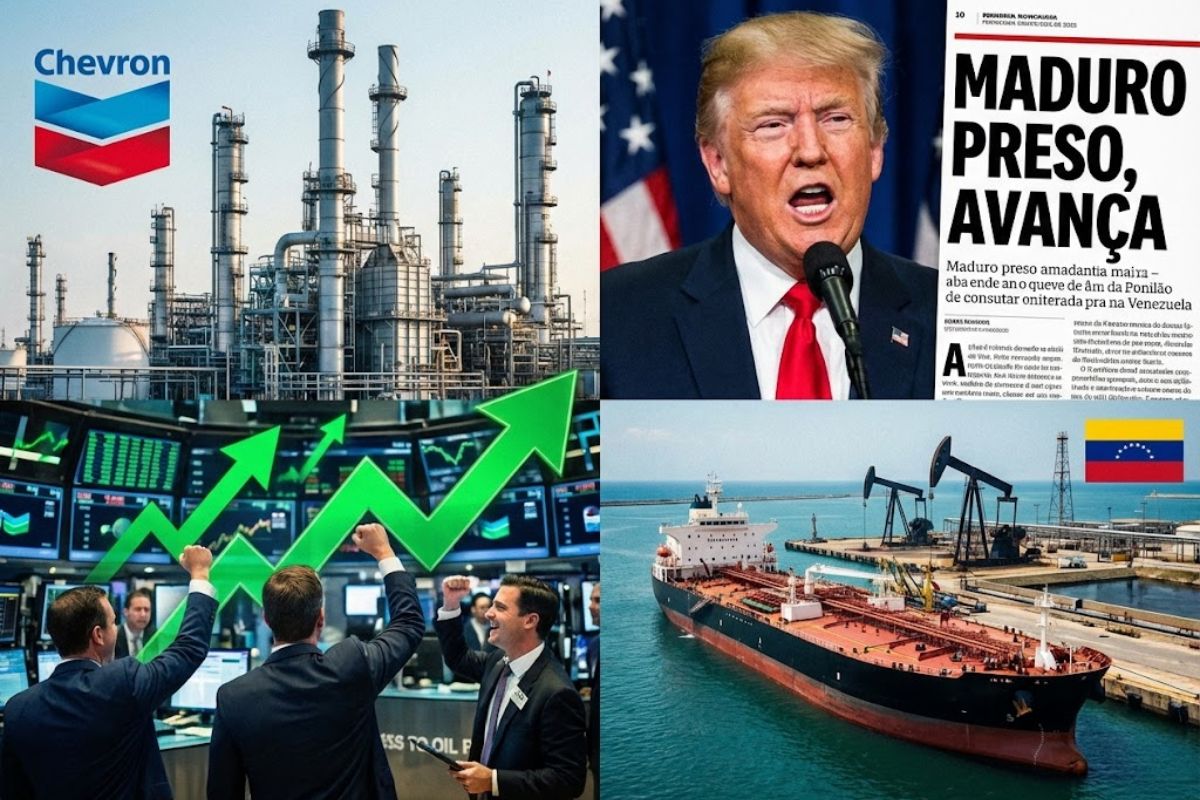
Chevron Rises 7.3% and Refineries Like Phillips 66, Marathon Petroleum, Valero Energy, and PBF Energy Advance 5% to 16% in Pre-Market on Monday (5). Investors Assess That Trump’s Offensive and Maduro’s Arrest Could Unlock Venezuelan Oil, Possibly Easing Sanctions with a Focus on Heavy Sour Oil.
Shares of Chevron and U.S. refineries rose in pre-market trading on Monday (5), driven by investors’ reading that President Donald Trump’s offensive against Venezuela’s leadership could unlock greater access to the country’s oil.
The movement gained momentum after Trump stated that the U.S. needs to have “full access” to Venezuelan reserves, following the arrest of President Nicolás Maduro. The expectation, according to the news itself, is that Washington might ease sanctions and other restrictions currently limiting Venezuelan crude oil exports, a hypothesis considered controversial and likely to reshape the heavy oil market.
What Rose in Pre-Market and Why It Caught Attention
The immediate highlight was Chevron, which advanced 7.3%. The text emphasizes that it is the only major U.S. company with direct operations in Venezuelan oil fields, meaning any policy change in Washington has an almost instant effect on the investment thesis surrounding the stock.
-
Offshore industrial demand in Macaé skyrockets with the recovery of oil and gas and could grow by up to 396% by 2026 in the Campos Basin.
-
Offshore industrial demand in Macaé surges with the recovery of oil and gas and could grow by up to 396% by 2026 in the Campos Basin.
-
Brazilian giant expands borders in the Southeast: Petrobras confirms new oil discovery in ultra-deep waters in the pre-salt of the Campos Basin.

-
Alert in the global energy market: Severe tropical cyclone hits the coast and disrupts gas production at major plants in Australia, threatening global supply.


At the same time, the uptrend spread to the refining sector. Shares of refineries like Phillips 66, Marathon Petroleum, Valero Energy, and PBF Energy posted gains ranging from 5% to 16%.
The market’s reading was of a “package”, not just a bet on an oil company with a presence in Venezuela, but also on the supply chain that can transform that oil into fuels.
The Central Thesis of Investors: “Full Access” to Venezuelan Oil
The logic underpinning the rally is straightforward and is presented in clear terms in the text: investors assess that Trump’s offensive and Maduro’s arrest can open up greater access for American companies to Venezuelan oil, described as coming from the largest oil reserves in the world.
This type of bet often anticipates regulatory changes before any confirmation. Here, the trigger was Trump’s statement that the U.S. needs to have “full access” to the reserves, coupled with the expectation that Washington could ease sanctions and restrictions that hinder exports. The share price, therefore, reflects the hypothesis of a reconfiguration of the political and operational environment.
Why Chevron Is the Most “Sensitive” Asset to Any Turnaround
Chevron stands out as a focal point for a clear reason: it is the only major American company with direct operations in Venezuela at the moment.
Moreover, its operations are authorized through a waiver granted by the U.S. government, a relevant detail as it suggests that the level of activity already depends on a set of permissions and exceptions.
If there is an easing of sanctions and restrictions, Chevron is likely to be seen as one of the first to capture the benefit, given its existing presence and operations.
This does not mean that the gain is automatic, but it explains why the stock reacted strongly in pre-market trading.
The Role of Refineries and the Importance of Heavy Sour Oil
Refineries also participated in the rally because the text highlights the nature of Venezuelan oil. It is classified as heavy sour, a heavier oil with a high sulfur content.
This characteristic has practical consequences:
- It is better suited for producing diesel and other heavy fuels
- Compared to lighter oils, it tends to generate lower profit margins
- It requires refining capacity compatible with this type of raw material
According to Ahmad Assiri, a research strategist at Pepperstone, the heavy sour profile fits well with U.S. Gulf Coast refineries, which have historically been designed to process this type of oil.
In other words, it’s not just “more oil”, it’s “a type of oil” that aligns with the engineering and design of part of the American refining landscape.
Sanctions, Restrictions, and Why the Topic Is Controversial
The report describes that Trump’s declaration reinforced the expectation that Washington might ease sanctions and other restrictions limiting Venezuelan crude oil exports.
It is precisely here that the controversy lies: the market is pricing in a shift in posture that, if it occurs, alters not only the oil flow but also the political dynamics surrounding Venezuela.
Trump also stated on Saturday that he intends to allow major American oil companies into the South American country to invest billions of dollars, restore the sector’s deteriorated infrastructure, and increase production.
He argued that this would help companies generate financial returns while also benefiting the U.S. economy.
This combination of economic promise and geopolitical decision is, by definition, sensitive and contested.
The Portrait of Venezuelan Production: From Peak to Rapid Decline
The text contextualizes why any expectation of “opening” needs to be read with caution.
Venezuela produced about 3.5 million barrels per day in the 1970s, equivalent to more than 7% of global production. Over the decades, this level collapsed.
By the 2010s, production had already fallen to less than 2 million barrels per day.
Last year, the average was around 1.1 million barrels per day, about 1% of global supply.
The text attributes this trajectory to a combination of lack of investments, deterioration of infrastructure, and economic sanctions imposed on the country.
This history explains an essential point: even if the market reacts in minutes, production does not respond at the same pace.
Why the Market “Bought” the Story, Even with Evident Risks
Pre-market movements often reflect an attempt to position oneself ahead of consensus.
In this case, what investors seem to be doing is making a bet across three layers:
- A political and regulatory shift, with possible easing of sanctions
- A rebalancing of heavy oil supply closer geographically to U.S. refineries
- Asymmetrical benefits for those already better positioned, such as Chevron, and for refineries compatible with heavy sour
At the same time, the text itself includes the counterpoint: analysts warn that a significant recovery of Venezuelan production will take time. Political instability, deteriorated infrastructure, and years of underinvestment remain obstacles to a faster recovery.
Thus, the rally may reflect both a rational expectation and an excess of optimism typical of high-impact headlines.
What Could Happen to the Heavy Oil Market if the Thesis Is Confirmed
If the hypothesis of greater access to Venezuelan oil advances, the potential impact goes beyond daily pricing. The text suggests a redesign of the heavy oil market because:
- Venezuela offers oil with specific characteristics, heavy sour
- American refineries, especially in the Gulf Coast, have a history and capacity to process this type of input
- An increase in supply, being geographically closer, might alter logistics and the availability of raw material for refining
Still, it is important to maintain the central premise of the text itself: recovering production takes time and depends on conditions that cannot be resolved with a presidential statement.
The “Equilibrium Point” of the News: Expectation Versus Operational Reality
What makes this episode particularly relevant is the contrast between narrative and execution. The narrative is set: “full access,” easing of sanctions, billion-dollar investments, recovery of infrastructure, and production expansion.
Execution, however, faces obstacles described in the text: instability, deteriorated infrastructure, and underinvestment.
The market is saying that the chance has increased, not that the outcome is guaranteed.
In your reading, is Chevron and the refineries’ leap an exaggerated reaction to “full access” or does it make sense as a forward-looking bet on easing sanctions and the return of Venezuelan oil to the game?










Seja o primeiro a reagir!