





 Portuguese
  English
  Spanish
  4 min of reading
  0 comments


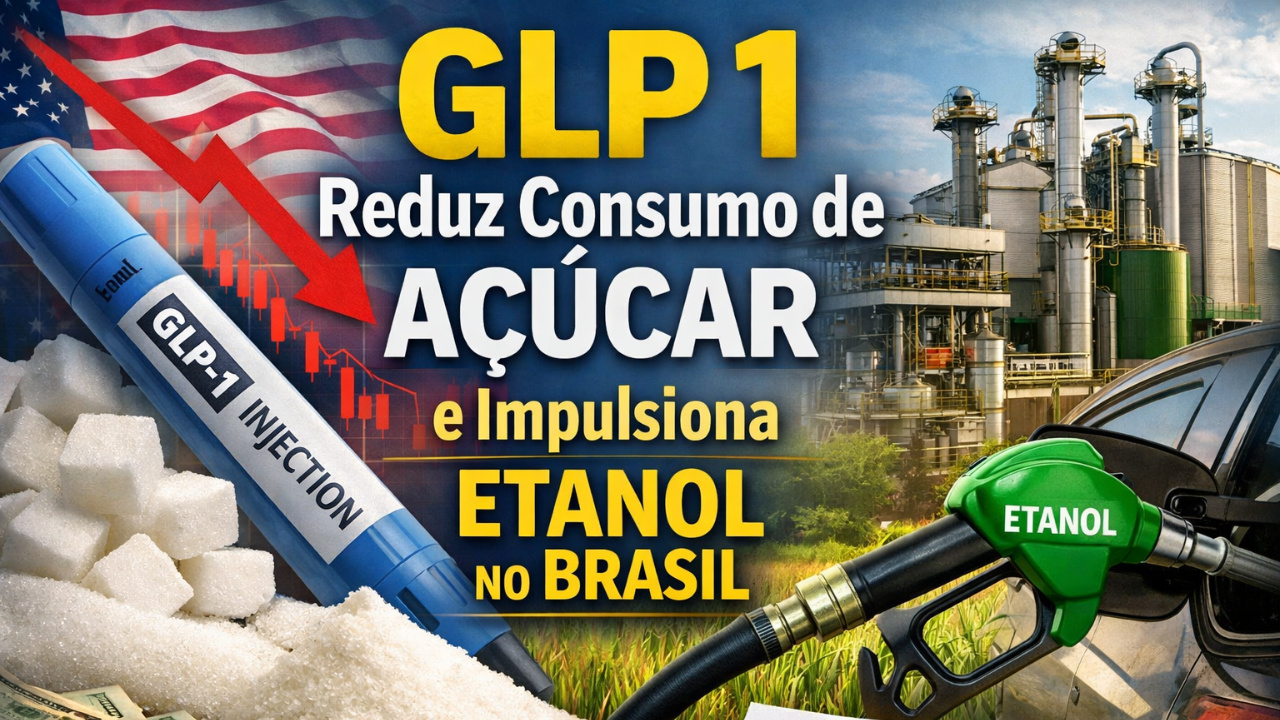
GLP 1 Reduces Sugar Consumption in the US, Affects Brazilian Exports, and Boosts Ethanol and Agricultural Contract Revisions.
The global sugar market has gone on alert after projections indicated a strong reduction in sugar consumption in the United States throughout 2026.
The movement is linked to the rise of weight loss pens based on GLP 1, used for diabetes control and weight loss.
The changes in eating habits of American consumers are already affecting futures contracts, international prices, and strategies of the Brazilian sugar-energy industry.
-
The sugar-energy sector advances with agricultural technology, but agricultural productivity still raises concerns.

-
The eggshell that almost everyone throws away is made up of about 95% calcium carbonate and can help enrich the soil when crushed, slowly releasing nutrients and being reused in home gardens and vegetable patches.

-
This farm in the United States does not use sunlight, does not use soil, and produces 500 times more food per square meter than traditional agriculture: the secret lies in 42,000 LEDs, hydroponics, and a system that recycles even the heat from the lamps.

-
The water that almost everyone throws away after cooking potatoes carries nutrients released during the preparation and can be reused to help in the development of plants when used correctly at the base of gardens and pots, at no additional cost and without changing the routine.


According to estimates from the United States Department of Agriculture, the consumption of the commodity could drop by up to 65% in the country next year.
Since the US is among Brazil’s main buyers, the tendency is for pressure on prices and the need to adapt national production.
In this scenario, the redirection towards ethanol emerges as the main economic alternative.
GLP-1 Changes Habits and Reduces Sugar Consumption
The advancement of GLP 1-based medications, such as Mounjaro and Ozempic, has caused a silent transformation in the eating behavior of consumers.
These drugs reduce appetite and, consequently, decrease the intake of sugar-rich products.
International trading companies already indicate that this change has contributed to a drop of more than 50% in futures contracts for the commodity in the United States.
Therefore, the reduction in sugar consumption is not just a nutritional trend, but a market factor with direct effects on Brazilian exports.
Moreover, the official forecast from the US government reinforces the scale of the impact.
Thus, the consumption estimate for 2026 has been revised to historically low levels, altering the global balance between supply and demand.
Brazil Feels the Impact and Seeks a Way Out in Ethanol
Brazil accounts for about 23% of the world’s sugar production and relies on external markets to maintain the sector’s profitability.
With the potential contraction in demand, mills are now evaluating the migration of raw materials to ethanol, a strategy already known for the industrial flexibility of the sugar-energy sector.
This change allows sugarcane to be redirected to biofuels when the international sugar market becomes less attractive.
Therefore, internal factors such as gasoline prices, fuel policies, and carbon credit systems gain even more relevance.
However, experts warn that the alternative does not eliminate all risks.
The increase in ethanol production could create an oversupply and put pressure on fuel prices in the domestic market.
Cascading Effect on Prices and Mills
The drop in sugar prices tends to trigger a cascading effect.
With smaller margins, mills redirect more sugarcane towards ethanol, increasing the production of the biofuel.
This movement may lower the price of ethanol at the pumps, affecting the sector’s profitability.
In other words, the solution to one problem may create a new economic challenge.
Still, the balance will depend on market conditions.
If ethanol remains competitive against gasoline, the strategy may cushion the industry’s losses.
Agricultural Contracts Come into Legal Focus
The price volatility also raises a legal alert.
Thus, long-term agricultural contracts, including export, hedge, and financing, may undergo revisions if the profitability of operations is affected.
The so-called hardship clauses require renegotiation when unforeseen events make the contract excessively burdensome.
Therefore, the advancement of GLP 1 is now considered an indirect risk factor for agribusiness.
New Rules and Protection Mechanisms
In light of this scenario, agricultural contracts tend to incorporate more robust protection mechanisms.
Price adjustment clauses, volume flexibility, and performance indicators are becoming more prominent in negotiations.
According to Ieda Queiroz, “price adjustment clauses, earn-outs linked to market indicators, volume flexibility, and financial covenants calibrated to more conservative scenarios may be included in contracts.”
Earn-outs are payments conditioned on the future performance of the business.
Covenants are financial rules that protect creditors in credit operations.
Sugar-Energy Sector Facing a New Cycle
The advancement of GLP 1 demonstrates how public health factors can influence global production chains.
Thus, the reduction in sugar consumption in the United States alters international prices, pressures exports, and demands rapid adaptation from Brazilian mills.
In this context, ethanol emerges as a safety valve, but not without risks.
At the same time, the revision of agricultural contracts indicates that the impact goes beyond the economy and reaches the legal structure of the sector.
Thus, the sugar market enters a new cycle, in which pharmaceutical innovation, energy transition, and risk management walk hand in hand.
See more at: Use of Weight Loss Pens in the US May Reduce Sugar Prices in Brazil










Seja o primeiro a reagir!