





 English
  Francês
  Alemão
  Italiano
  Japonês
  Norueguês
  Portuguese
  Spanish
  5 min of reading
  1 comment


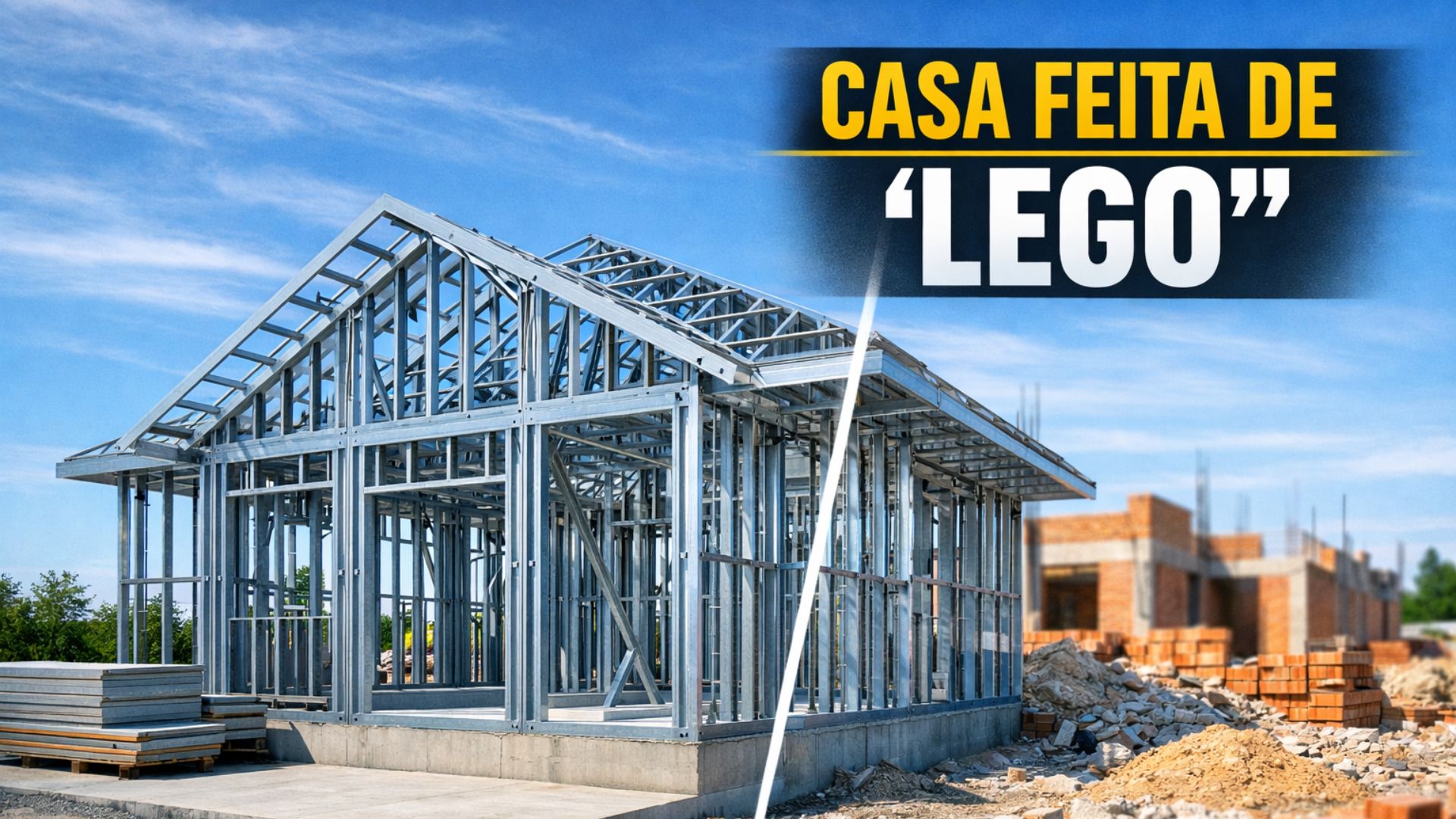


Dry Construction Advances in Brazil by Reducing Deadlines, Debris, and Cost Uncertainties, with an Industrialized System that Exchanges Bricks for Light Steel and Promises More Financial Control, Thermal Comfort, and Predictable Execution in Residential Works of Different Standards.
Dry construction with galvanized light steel frames, known in the industry as Steel Frame or Light Steel Framing, has been advancing in Brazil by offering a cleaner job site, shorter deadlines, and greater budget predictability compared to traditional masonry.
In studies and technical comparisons already published in the country, execution can be close to a time reduction of around 50% in residential projects, depending on the scope and finishing standard.
In practice, the change appears right at the beginning of the project.
-
For 45 years, Spain and Morocco have been trying to connect Europe to Africa through a project of just 14 kilometers in the Strait of Gibraltar, and an active tectonic fault on the seabed continues to make the project nearly impossible.

-
Goodbye expensive water tank: residents replace traditional system with a cheaper and more efficient solution that reduces water consumption and reuses rainwater.

-
Mexico is building a 300-kilometer railway corridor that connects the Pacific to the Atlantic in just seven hours and wants to compete directly with the Panama Canal, which is already facing water scarcity issues.
-
The largest tunnel module factory in the world was built from scratch on a beach in Denmark to produce 89 concrete blocks and will be demolished after the project: each structure weighs up to 10 times the Eiffel Tower and will be installed on the bottom of the Baltic Sea with an accuracy of 12 millimeters in a tunnel that will halve the travel time between Hamburg and Copenhagen.
Instead of large volumes of sand, piles of blocks, and long stages of curing and drying, the industrialized system organizes assembly by components, with planned cuts and fixings.
This logic usually reduces rework and decreases waste generation on site, a point also highlighted in academic research comparing the amount of debris between the methods.
Steel Frame System and the Logic of Industrial Assembly
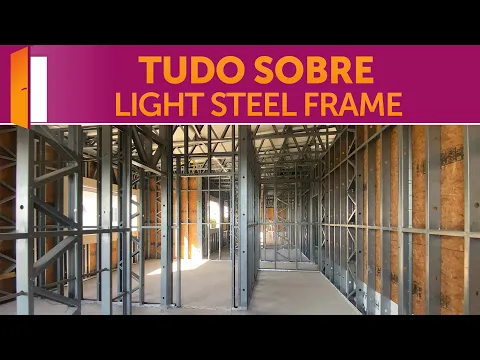
Technically, the Steel Frame is an industrialized construction system where the building structure is formed by light galvanized steel profiles cold-formed.
Instead of erecting structural walls with ceramic blocks or concrete, the project assembles a skeleton of metal profiles and applies enclosures and performance layers around it, in a process akin to step fitting, which is why the comparison to “Lego” has become popular in the market.
In Brazil, this type of construction is regulated by a specific technical standard from the Brazilian Association of Technical Standards.
The ABNT NBR 16970 establishes requirements for systems structured with cold-formed light steel profiles with thin sheet enclosures, including guidelines that cover performance, structural design, and interfaces between systems.
Technological Wall Replaces Traditional Brick

One of the most relevant differences compared to masonry is that the wall ceases to be a solid block and starts to function as a set of layers, each with a defined function.
External enclosures usually use cement board, accompanied by a waterproof membrane and, often, OSB board as part of the bracing and rigidity ensemble.
In the core, the gaps between profiles receive insulators, such as glass wool or PET, to contribute to thermal and acoustic performance.
On the inside, the most common finishing is plasterboard, drywall, also associated with OSB depending on the project and expected loads.
This type of composition aligns with the requirements of the ABNT NBR 15575 performance standard, which addresses minimum criteria for residential buildings, including requirements for thermal and acoustic comfort, as well as safety and durability.
How Much Does It Cost to Build with Steel Frame in Brazil
The price per square meter for Steel Frame is not fixed.
It varies according to finishing standard, project complexity, frames, insulation level, foundation type, and local availability of specialized labor.
Nonetheless, indices used by the market help to see a reference range.
In the update of the Steel Frame Architecasa Index in December 2025, the cost per square meter for a popular standard was around R$ 2,959.46 in the Northeast and R$ 3,060.26 in the South, with similar numbers in other regions.
For the average standard, the cited values were around R$ 4,346.21 in the Northeast and R$ 4,573.58 in the South.

Meanwhile, the high standard is above R$ 5,800 per square meter and can exceed R$ 6,200 depending on the region and finishing level.
Therefore, the idea of “cost starting at R$ 2,500/m²” tends to serve as a reference floor for specific contexts, not as a universal rule.
Where Is the Savings Beyond the Price Per Square Meter
Even when the price per square meter approaches that of masonry, Steel Frame often shifts the financial balance in less visible items.
The time reduction lowers indirect expenses, such as team time, rentals, and operational costs on the job site.
Technical comparisons in Brazil indicate significant productivity gains.
In a study presented at a technical event related to the Confea/Crea system, a Light Steel Frame project was completed in about 11 weeks, while the conventional solution took up to 19 weeks.
The difference was described as almost 50% faster in certain stages.
The reduction of waste also appears consistently in academic studies.
Research comparing Steel Frame housing and conventional masonry indicates a significantly lower generation of debris in the industrialized system.
At the same time, technical documents from the sector state that material losses in masonry can vary between 15% and 25%, depending on management and execution.
Thermal and Acoustic Comfort Depends on the Project
One of the most common doubts about steel houses involves temperature and noise.
However, performance depends less on the steel and more on the set of layers, sealing, and specification of insulators.

The metal structure does not solely determine comfort.
What matters is the presence of insulating materials inside the walls and the continuity of the system, avoiding gaps that hinder thermal and acoustic performance.
The ABNT NBR 15575 establishes minimum criteria for this type of performance in residential buildings.
When well specified and executed, the system tends to reduce airborne noise and improve thermal stability compared to walls without insulation.
Lighter Foundation and Impact at the Beginning of the Work
Being a lighter structural system, Steel Frame often allows for simpler foundations in compatible projects.
The slab is cited as a common solution for this type of construction in Brazil.
The financial impact depends on the land and structural sizing.
There are technical and market references indicating savings in the foundation stage when compared to heavier solutions, as long as the project is correctly sized.
In industry content, estimates of savings can reach up to 30% in concrete, although this percentage is not guaranteed and varies depending on each project.
Why Steel Frame Is Gaining Ground in Civil Construction
The consolidation of Steel Frame in Brazil is linked to technical standardization, the expansion of the supply chain, and the need for productivity.
With specific standards for light profiles and clear performance requirements, the system has found a more defined path for regular projects and oversight.
Another factor is the organization of the job site.
The industrialized model reduces improvisation, rework, and waste volume, as well as facilitates control over deadlines and costs.
With figures increasingly present in the debate about cost, time, and performance, the open question remains whether the Brazilian consumer will treat Steel Frame as a singular alternative or as a competitive standard in future residential projects.









2.500 o m2 numa casa de 40m2 fixa em 100mil reais só a estrutura.
Onde está o barato aí? A esse custo vc levanta uma casa complete em ovenaria.