





 Portuguese
  English
  Spanish
  4 min of reading
  0 comments


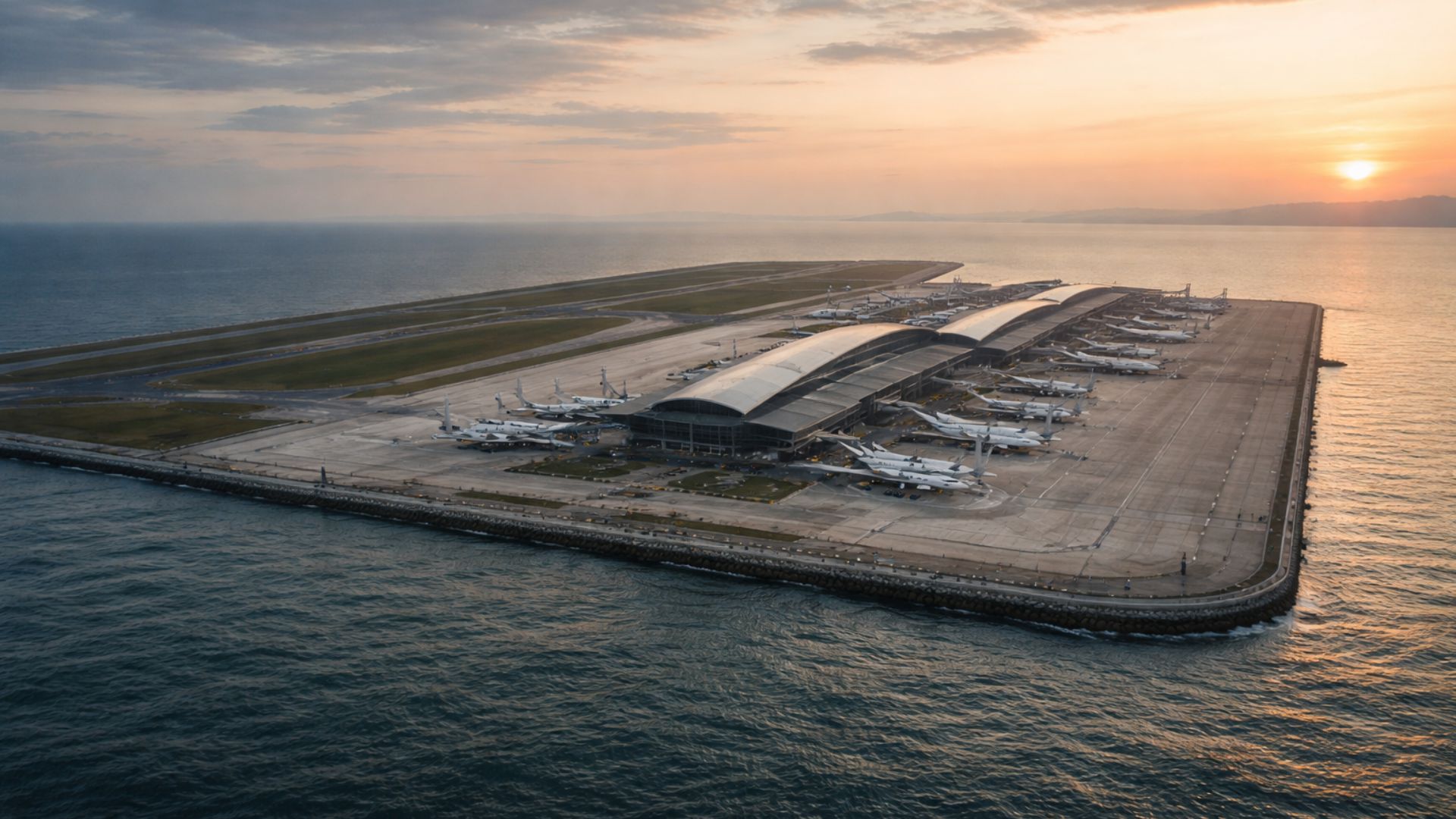
Japanese Mega Structure Faces Decades of Progressive Subsidence While Authorities Monitor Structural Risk and Sea Level Impact.
Kansai International Airport, in Osaka Bay, Japan, has been facing a continuous subsidence process for decades, with a gradual land lowering of an artificial island supporting runways, terminals, and essential structures of the complex that opened in 1994.
Data released by the operator Kansai Airports indicates that, on the first phase island, the average cumulative subsidence since the start of construction reached 13.66 meters by December 2024, with an annual rate of around 6 centimeters that year, following an initial period of faster settlement.
Despite social media posts attributing the problem to a sinking of “more than 8 meters in 10 years” and projecting “disappearance by 2090,” official numbers and reports based on this data point to a different magnitude and timeline.
-
Friends have been building a small “town” for 30 years to grow old together, with compact houses, a common area, nature surrounding it, and a collective life project designed for friendship, coexistence, and simplicity.

-
This small town in Germany created its own currency 24 years ago, today it circulates millions per year, is accepted in over 300 stores, and the German government allowed all of this to happen under one condition.

-
Curitiba is shrinking and is expected to lose 97,000 residents by 2050, while inland cities in Paraná such as Sarandi, Araucária, and Toledo are experiencing accelerated growth that is changing the entire state’s map.

-
Tourists were poisoned on Everest in a million-dollar fraud scheme involving helicopters that diverted over $19 million and shocked international authorities.


Subsidence of Kansai Airport and Soil Characteristics

The central explanation lies underground: the airport was built on a thick layer of clay and sediments that compact under the weight of the landfill and infrastructure, a behavior expected in large-scale works but difficult to control.
In the technical material published by Kansai Airports, the company describes that the subsidence of more superficial layers was accelerated by drainage methods, while the portion that remains today is associated with deeper deposits, with a gradual reduction of speed over time.
To face this scenario, teams turned to ground improvement technologies and permanent monitoring, including the installation of a massive volume of sand drains, a strategy used to accelerate soil consolidation during the early stages of the project.
Still, the operator itself acknowledges that long-term subsidence in deep layers continues a natural progression, with variations between measurement points, requiring continuous monitoring to estimate future trends more accurately.
Updated Numbers of Accumulated Subsidence
On the first phase island, the company reports that the average cumulative subsidence even before the airport’s opening had already reached 9.82 meters, which helps explain why the largest drops occurred in the early years of the project.
Later, with the airport in operation, the rate of sinking decreased, and international reports documented this slowdown as a result of engineering measures, while still maintaining the warning that the settlement had not been eliminated.
The situation is different on the second island, associated with operational expansion: Kansai Airports reports that, in phase 2, total subsidence reached 17.47 meters by December 2024, and the average annual rate measured in 2024 was 21 centimeters.

Based on this data, part of the international coverage began to highlight a more immediate risk for sections of the structure related to sea level, with projections from experts cited by the press indicating the possibility of areas being below sea level in the coming decades.
Billion-Dollar Investment and Strategic Relevance in Japan
The total cost frequently cited in reports and historical compilations for Kansai Airport is around US$ 20 billion, a figure associated with the set of landfills, runways, terminals, and facilities, in addition to additional expenses related to the subsidence challenge.
The project was born to relieve congestion at the nearest airport to Osaka and, at the same time, allow 24-hour operations with less noise impact on densely populated areas, which led to the choice of an artificial island.
Over the years, Kansai has established itself as a major regional hub, and passenger traffic has started to grow again recently, with around 30.6 million travelers in 2024, according to data released by the operator.
The problem is that operational relevance does not eliminate vulnerabilities: the press recalls that, in September 2018, the airport was temporarily closed after flooding associated with Typhoon Jebi, an episode that exposed the impact of extreme events on a structure in the sea.

Containment Measures and Permanent Monitoring
Over time, interventions included coastal protection reinforcements and works to reduce potential damage from tides and storms, with reported investments in structures like marine barriers and mitigation systems.
The technical component also involves measuring and comparing dozens of control points, a practice highlighted by Kansai Airports to monitor settlement differences and guide adjustments, as soil behavior varies according to layer thickness and landfill weight.
Even with the slowdown recorded, public discussion has resurfaced strongly because some estimates released by foreign media suggest that, if certain trends continue, sections may face quota issues in a relatively short horizon, such as mid-century.
With millions of passengers passing through Kansai each year and critical infrastructure sitting on land that’s continuing to give way, the question remains: how will authorities and operators balance cost, safety, and continuity of one of Japan’s main airports in the coming decades?









-

-

-

-

-

11 pessoas reagiram a isso.