





 Portuguese
  English
  Spanish
  4 min of reading
  0 comments


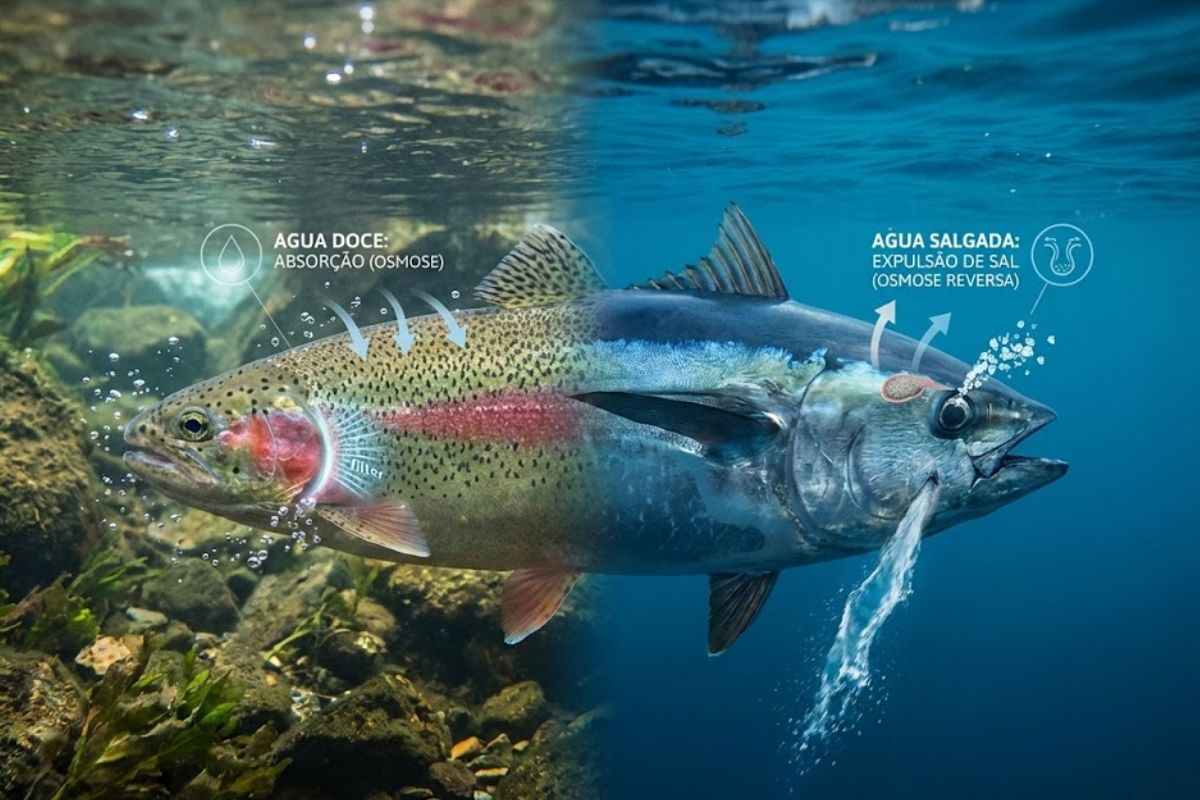
Surrounded by Water, Each Fish Needs to Keep Its Body Balanced. In Rivers, the Fish Almost Doesn’t Drink, Because Water Enters Through the Skin and Gills. In the Ocean, the Opposite Happens: the Fish Loses Water, Swallows the Liquid, and Eliminates Salt with Special Cells and Glands to Live Without Dehydrating.
After all, does the fish drink water? The answer seems obvious because the fish lives submerged all the time, but its body needs to maintain an internal balance of water and salt to function.
What changes everything is where this fish lives. In fresh water, the fish receives too much water effortlessly. In salt water, the fish constantly loses water. And that’s where osmosis, gills, urine, and even specialized glands come into play.
Why the Fish Needs to “Hydrate” Even in Water
The fish is not “protected” just by being surrounded by water.
-
China accelerates global science and may surpass the United States in 2 years with increased public investment, continuous growth, and direct impact on the global technological competition.

-
Scientific studies indicate that drought may be strengthening a much greater silent threat: more resistant superbugs.

-
Man builds functional 5-meter submarine in his garage using gas cylinders, PVC pipes, and a refrigerator motor, and navigates with the vessel on a lake in Colombia.

-
Millions of people have been eating yam for centuries without knowing that this humble tuber contains a compound called diosgenin, which scientists have now discovered can improve memory and help control blood sugar levels.


The fish’s organism has a concentration of salts and liquids that needs to remain stable.
When the surrounding water has less salt than the body, or more salt than the body, a constant push and pull occurs that determines whether the fish gains or loses water.
This adjustment happens at the most obvious point of the fish’s body, the skin and especially the gills, which are in direct contact with the environment.
The fish’s hydration, therefore, does not depend on thirst like humans do, but on invisible mechanisms of balance.
Freshwater Fish: Osmosis Hydrates Without Drinking
In the freshwater environment, the water around the fish has much less salt than the inside of its body.
Result: the water tends to enter the fish naturally through osmosis, seeking to balance the concentration differences.
In practice, the freshwater fish ends up “absorbing” water through the skin and gills, without needing to swallow water the way we imagine when thinking of drinking.
It’s a type of automatic, continuous, and efficient hydration, happening exactly where the fish exchanges gases and interacts with the environment.
Constant and Diluted Urine: How the Fish Avoids Swelling
While osmosis solves the entry of water into the freshwater fish, it creates a problem: too much water enters.
To avoid accumulating liquid and disrupting its body functions, this fish needs to eliminate the excess.
The fish’s solution is straightforward: constantly urinate, and this urine is very diluted.
This continuous disposal prevents water from “building up” inside the organism, maintaining the internal balance necessary for the fish to remain active, breathing through its gills and feeding without losing control of its own system.
Saltwater Fish: When Osmosis Makes the Body Lose Water
In the sea, the scenario reverses. The saltwater around has more salt than the inside of the fish’s body.
Thus, instead of gaining water, the fish tends to lose water constantly through osmosis.
To avoid dehydration, the saltwater fish needs to do something that seems contradictory: drink water, swallowing the liquid from the environment as a survival strategy.
Here, “drinking” ceases to be curiosity and becomes a physiological necessity.
Filters in the Gills: The Fish Needs to Expel the Salt It Swallowed
Swallowing seawater keeps the fish hydrated, but brings another challenge: the excess salt.
To avoid turning hydration into a problem, the fish relies on special cells in the gills that function as filters and expel the excess salt.
This work happens in the gills, the main exchange center for the fish with the environment.
Thus, the fish can continue drinking seawater to replenish losses from osmosis while eliminating salt to maintain internal balance.
Special Glands: When the Fish Gains a “Boost” Against Salt
In some species, there is extra help beyond the gills. Sharks, for example, have a gland in the rectum that also eliminates salt.
This is another layer of adaptation to deal with an environment where the fish needs to drink to avoid drying out, but cannot retain the salt along with it.
This type of solution shows how the fish’s body has been shaped to respond to a constant dilemma: gain water without accumulating salt, or lose salt without losing too much water, depending on where it lives.
The Essential Difference Between Freshwater and Saltwater, in One Sentence
The freshwater fish almost doesn’t drink because water enters it naturally and it needs to eliminate the excess with diluted urine.
Meanwhile, the saltwater fish drinks because loses water constantly and needs to replace what is lost, expelling salt mainly through its gills.
In the end, the question “does the fish drink water?” has two true answers, because the fish changes its strategy according to the environment: in rivers, hydration through natural entry and constant disposal; in the ocean, water intake and salt filtration.
Did you imagine that the freshwater fish almost doesn’t drink, or have you always believed that every fish swallows water the same way?








-

-

-

-

13 pessoas reagiram a isso.