





 Português
  Inglês
  Espanhol
  6 min de leitura
  0 comentários


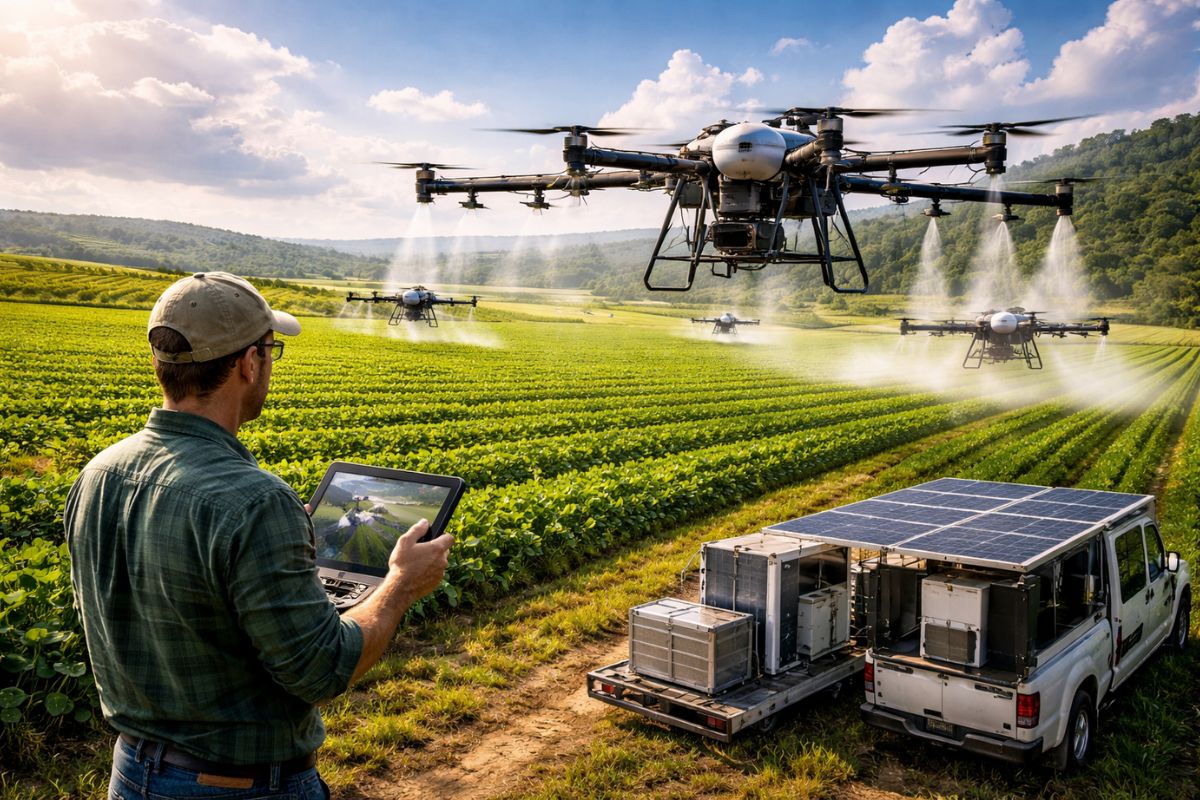
The technology with drone, battery, and optimized structure increases productivity, reduces cost, and places the uniporte in the comparison within the farm
The expression increases productivity has ceased to be an abstract promise and has become a daily practice on a farm in Sinop, where an operator managed to cover 7,400 hectares with a T100 drone supported by an optimized structure. The result combines lower cost, less maintenance, less noise, and a much smoother work routine for those who need to operate alone in the field.
More than just showing equipment in action, the case reveals how organization and logistics can change the performance of the operation. When the structure is designed to reduce movements, shorten the time between landing and takeoff, and concentrate everything within the operator’s reach, the drone ceases to be just a complementary tool and begins to compete for real space with larger machines.
Optimized structure becomes the central piece of the operation
The most important point of the case is not just the T100 drone, but the way the entire structure was built around it.
-
China banned the export of 22 tons of meat from Argentina.
-
JBS, founded by the Batista brothers, continues to conquer the world: entrepreneurs built a ‘factory in the desert’ creating 3,000 jobs.
-
With only 1% of Brazil’s territory, Santa Catarina has built one of the most competitive industrial parks in the country, with 64,000 companies, nearly 1 million jobs, and a growth rate of 5.3% while the national industry is practically stagnant.

-
Brazil has just secured a secret route through Turkey to save agribusiness exports that were threatened by the closure of the Strait of Hormuz amid violent clashes in the Middle East.

The operator works with landing and takeoff on a retractable platform, with batteries, charger, mixer, hose, and access to supplies positioned at the same level.
This eliminates steps that normally steal time and energy throughout the day. The logic that increases productivity is precisely in cutting unnecessary movements, avoiding unloading and loading items constantly, and allowing the operation to continue quickly even when only one person is in charge.
According to the report, it was this structure that made it possible to apply all 7,400 hectares already recorded on the T100 alone.
Battery system reduces cost and improves comfort
Another important change was replacing the traditional generator with a battery charging system. In practice, this removed daily expenses with oil, filters, mechanical maintenance, and diesel.
The gain was not just in the account. The new arrangement also eliminated the constant noise and smoke that previously accompanied the operation.
The work became more comfortable, cleaner, and less stressful, especially during long days in the field.
According to the reported experience, the system maintains performance similar to that of a common generator and operates normally up to the range of 150 to 160 hectares before requiring recharging of the main battery.
Solo operation helps understand why productivity increases
One of the most impressive data points from the case is that the operator claims to have accumulated about 24,000 hectares over the course of his journey with drones, moving from T40, T50, and now T100. Just with the current equipment, there are already 7,400 hectares applied.
This volume helps explain why the phrase increases productivity carries so much weight in the discourse. It is not just theory, but a routine that has been tested on soybeans, corn, and even pasture areas.
With everything within reach on top of the structure, the operator can land, change batteries, refuel, and take off again without relying on external help. Productivity increases because unproductive time decreases, and this changes the account at the end of the day.
Drone T100 already enters the conversation with the uniporte

One of the most relevant moments in the report appears when the operator compares the performance of the drone with the uniporte.
According to him, half of the farm was serviced by the uniporte and half by the drone, without overloading either system.
In the evaluation presented, the T100 can already work at a very competitive level, especially in areas where soil compaction weighs on the final result.
The harvesters noticed a difference in the harvest, and the farm’s agronomist reportedly observed a better response in emergency applications made with the drone.
When the field begins to notice practical differences in compaction and application efficiency, the debate shifts from technology to economics.
The best area of the farm was 100% applied with a drone
Another point that caught attention in the report was the performance of the best productive area of the property. According to the operator, the area that reached 81 sacks in the year was managed with 100% application via drone.
This data does not serve as isolated proof of superiority in any scenario, but reinforces the perception that technology can no longer be seen as a secondary resource.
When the best area is included in this account, the argument that the drone increases productivity gains even more strength within the gate.
Good practices and mapping prevent accidents
Besides the structure, the operator attributes part of the results to care with mapping, preventive maintenance, and constant cleaning of the equipment.
According to him, the entire outline of the areas is done with remote control to better understand the terrain, identify obstacles, and avoid surprises.
This practice has been repeated since previous models and redone on the T100. The goal is not to rely on improvisation and not to turn off sensors just to find shortcuts in the operation.
It increases productivity, but also requires method. The report makes it clear that high productivity does not come just from the size of the drone, but from operational discipline, care for the equipment, and correct reading of the area before application.
Retractable platform, channels, and clean water speed up the routine
The structure used on the farm also includes details that may seem small but greatly assist in daily operations. The retractable platform facilitates movement between areas.
The channels installed around help to direct the liquid from washing the drone, avoiding excessive dirt on the structure. The clean water tank allows for quick cleaning at the end of the day.
This set creates a more organized routine and reduces time lost with improvised cleaning or unnecessary corrective maintenance.
It is in this type of detail that the expression increases productivity ceases to be a slogan and becomes a concrete field result.
Average per hour reinforces the efficiency of the model
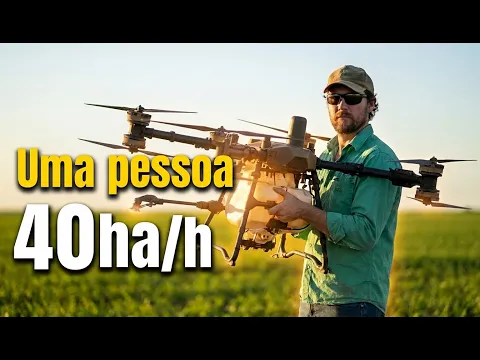

According to the report, the operational average with the current system is between 38 and 40 hectares per hour in liquid, which may drop in specific applications, such as those requiring solid or adjustments to the mixture.
Even so, the number is considered very good given the equipment’s proposal and the way the structure was designed.
The operator himself states that, if they wanted, it would be possible to cover up to a thousand hectares with the T100 in this work logic, especially with a well-resolved structure.
The central reasoning is simple: without a good structure, the drone loses performance; with a good structure, it changes levels.
Rural technology advances because it affects the producer’s account
The final testimony makes clear the vision of someone who is in the field. For him, anyone who wants to remain competitive in the field will end up having to look at this type of solution.
The argument is not ideological, but practical: lower cost, cheap maintenance, less soil compaction, more operational comfort, and efficiency gains.
In other words, technology advances because it solves real problems. If it increases productivity and also helps reduce costs, it ceases to be a novelty and becomes a strategy.
Agricultural drone stops being a trend and becomes a tool for permanence
The case in Sinop shows that the agricultural drone has already entered a different phase. It no longer appears just as a fair curiosity or a promise for the future.
With optimized structure, battery charging, and operation adjusted to the farm’s routine, the equipment begins to take on tasks that previously seemed restricted to traditional machines.
In the end, what stands out is not just the number of hectares applied alone, but the message behind it.
It increases productivity, reduces costs, and expands the operator’s autonomy. And when these three points come together, the drone stops being a gamble to become operational reality.
Do you believe that a structure like this can make the drone surpass the uniporte in some applications in the field?








Seja o primeiro a reagir!