





 Portuguese
  English
  Spanish
  5 min of reading
  11 comments


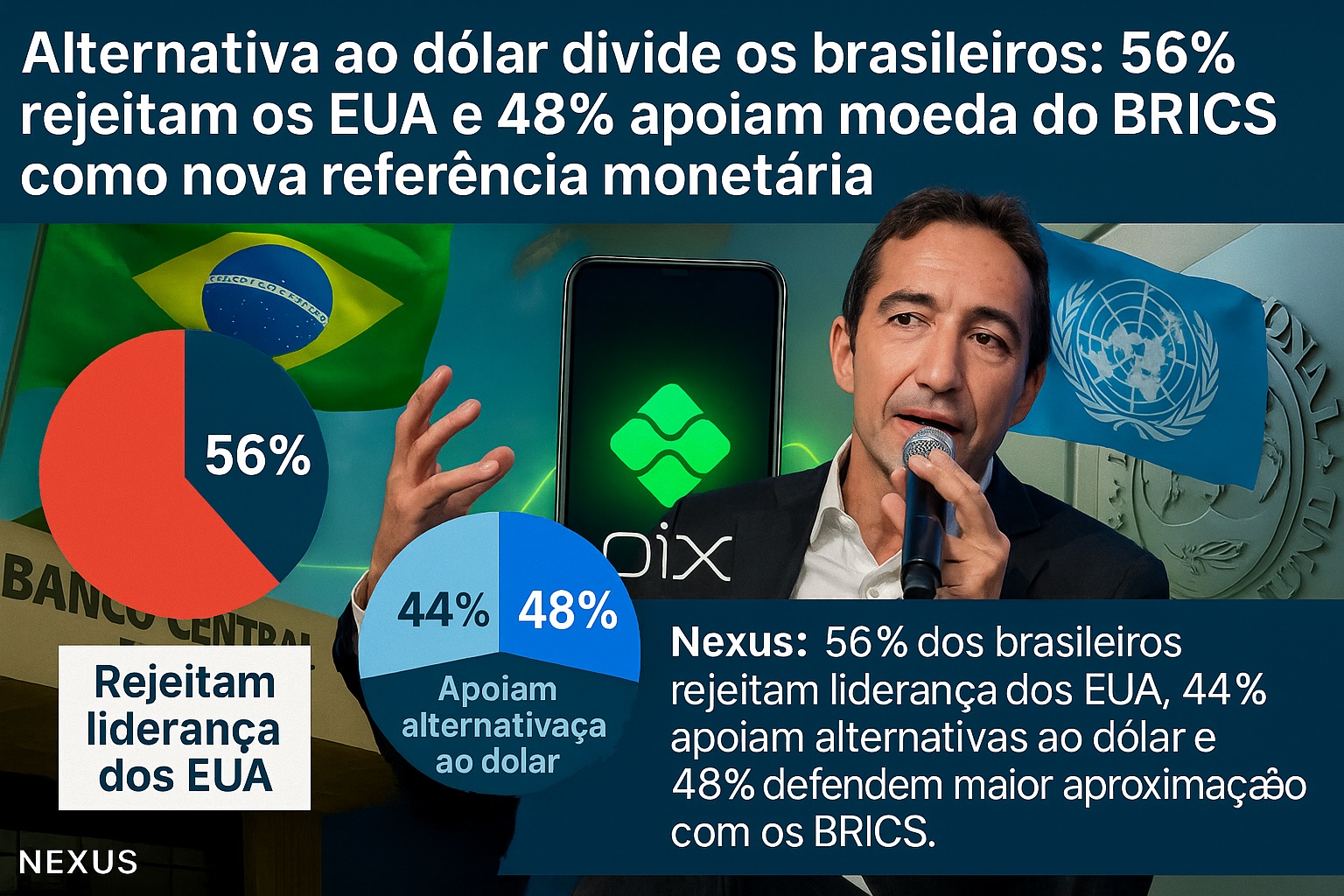


Nexus Research Reveals: 56% of Brazilians Reject US Leadership, 44% Support Alternatives to the Dollar, and 48% Advocate for Closer Ties with BRICS.
The dollar has always played a central role in global trade and, consequently, in the daily lives of Brazilians — whether in gasoline prices, international contracts, or the trade balance. However, a groundbreaking survey by Nexus, released in August 2025, revealed that this hegemony is under scrutiny. According to the survey, 56% of Brazilians disapprove of the global leadership of the United States, while 44% support alternatives to the dollar in international trade.
These numbers indicate that, amid a backdrop of geopolitical instability, Brazilians are divided between the pragmatism of maintaining trust in the dollar and the desire to seek greater autonomy through alternative currencies, such as the real or systems articulated by the BRICS.
How the Dollar Reached Its Level of Hegemony
Since the Bretton Woods agreements in 1944, the dollar has solidified its status as the international reference currency. Today, more than 80% of global transactions are denominated in the US currency, which gives the US unparalleled power: defining monetary policies that directly impact all countries, controlling sanction mechanisms, and influencing global trade.
-
Larger than entire cities in Brazil: BYD is building a 4.6 km² complex in Bahia with a capacity for 600,000 vehicles per year, but the discovery of 163 workers in conditions analogous to slavery has shaken the entire project.

-
With an investment of R$ 612 million, a capacity to process 1.2 million liters of milk per day, Piracanjuba inaugurates a mega cheese factory that increases national production, reduces dependence on imports, and repositions Brazil on the global dairy map.

-
Brazilian city gains industrial hub for 85 companies that is equivalent to 55 football fields.

-
Peugeot and Citroën factory in Argentina cuts production by half and opens a layoff program for more than 2,000 employees after Brazil drastically reduced purchases of Argentine vehicles.


For Brazil, this dependence has always been clear. Export products, strategic imports, and even international reserves are dollarized.
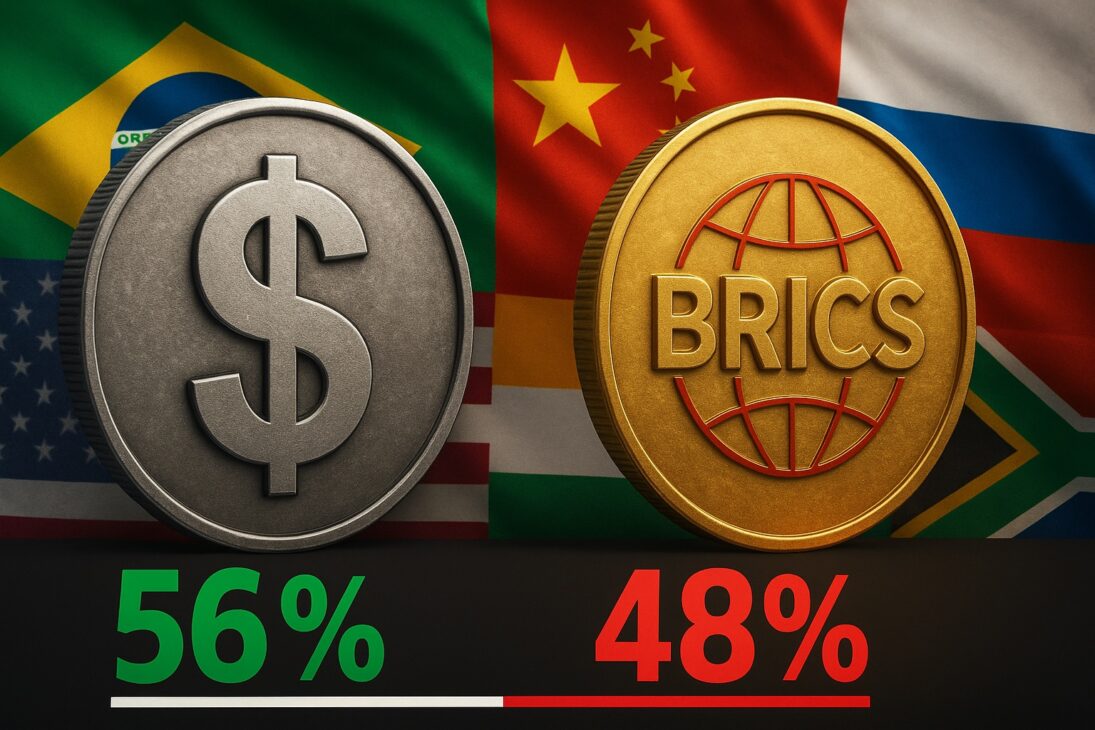
However, as the BRICS bloc gains prominence and trade tensions with the US intensify, Brazilian society begins to see alternatives — albeit still in a divided manner.
The Noteworthy Data: Majority Rejection of the US
The Nexus survey shows that 56% of respondents rate the international actions of the United States negatively, while only 38% maintain a positive view. Among young people aged 16 to 24, the division is more balanced: 46% positive against 43% negative, revealing that newer generations have a less hostile but still critical perception.
This data is revealing because, even with the strength of American culture in Brazil, the political and economic image of the US is tarnished.
The trade war with China, sanctions imposed on emerging countries, and the maintenance of dollar hegemony seem to have fueled a sentiment of rejection among a significant portion of the population.
BRICS on the Scales: Alternative or Illusion?
When asked about the BRICS bloc, 48% of Brazilians supported closer commercial and political ties, while 33% preferred distancing. This data indicates a real expectation that emerging countries, such as Brazil, India, and China, could articulate alternative monetary solutions.
Within this group, young people aged 16 to 24 were the most favorable: 53% advocate for closer ties with the bloc, compared to only 27% rejecting. This suggests that the new Brazilian generation sees BRICS not only as a space for economic cooperation but also as a symbol of independence from American power.
The Division on the Currency of International Trade
The most delicate point of the survey emerges when the question is direct: should we maintain the dollar as the central currency or seek alternatives?
- 44% of Brazilians advocate for alternatives, whether in local currencies or regional systems.
- 43% prefer to maintain the dollar, seen as more stable and reliable.
- The remainder did not know how to respond.
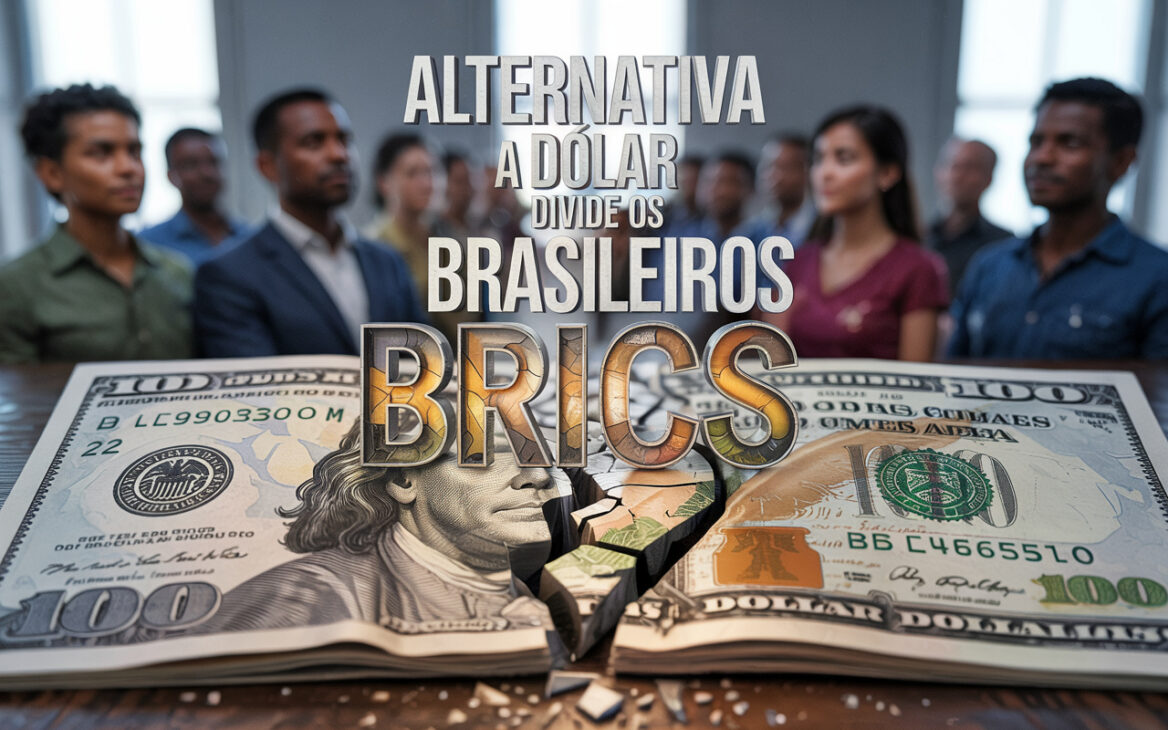
The almost symmetrical division shows that there is no consensus. While part of the population sees the real or the yuan as an opportunity to challenge the current system, another part maintains the pragmatic view that altering the base of global trade may generate insecurity and economic risks.
Why the Debate Gained Momentum in 2025
The study was released during a time when China and BRICS are expanding their influence in international trade. The bloc is discussing independent payment systems, such as BRICS Pay, and has intensified bilateral agreements in local currencies.
Simultaneously, trade tensions between Brazil and the US in sectors like steel, meat, and coffee have increased the perception of vulnerability. By depending on the dollar, Brazil becomes exposed to tariffs, sanctions, and exchange rate fluctuations that directly impact the domestic economy.
Region and Gender: How Brazilians Are Divided
The survey shows that opinions are not homogeneous across the country:
- Northeast: more likely to advocate for alternatives to the dollar and closer alignment with BRICS.
- South: more pragmatic and supportive of maintaining the US currency as a reference.
- Women: more inclined to support monetary alternatives.
- Men: greater tendency to defend the dollar, viewed as more secure.
These variations reinforce that the discussion about the international monetary system is not only economic but also crosses regional, social, and cultural factors.
The Challenge of Transition
Even with support from part of the population, replacing the dollar is not a simple task. Brazil would need to:
- Build reserves in alternative currencies to ensure stability.
- Integrate regional financial systems capable of operating outside of the American sphere.
- Establish large-scale bilateral trade agreements in local currencies.
Without this, the transition becomes risky, potentially generating exchange rate volatility and loss of credibility.
Brazil Between Two Paths
The Nexus study clearly exposes a country divided between two paths:
- Maintain the dollar as a reference, betting on stability and predictability.
- Advance towards a multipolar alternative, aligning with BRICS and new trade routes.
The first option keeps Brazil in the existing system, while the second opens doors for greater autonomy, but with risks of instability in the short term.
More than numbers, the survey shows a country seeking political and monetary autonomy. The rejection by 56% of Americans indicates weariness of American hegemony, while the support of 44% for alternatives demonstrates that there is room for change.
However, the issue goes beyond the economy: it is about national sovereignty, geopolitical identity, and vision for the future. Brazil, alongside BRICS, may become a protagonist in a transition to a multipolar world. But for now, the scales remain divided — between the pragmatism of the dollar and the hope for an alternative.







Não tem sentido mexer no que sempre deu CERTO. É SÓ PIRRAÇA do Pres. LULA que é Comunista.
Se essa pesquisa for séria e verdadeira, o Bostil não tem mais jeito não.
Qual é o apoio econômico dos BRICS? Muitos brasileiros adoram ir aos Estados Unidos; eles vão aos BRICS para ver como se saem. O mesmo vale para quando vão à Europa.
O comércio internacional utiliza o dólar como moeda padrão. Aqui no Brasil, o real será substituído pelos BRICS?