





 Portuguese
  English
  Spanish
  4 min of reading
  6 comments


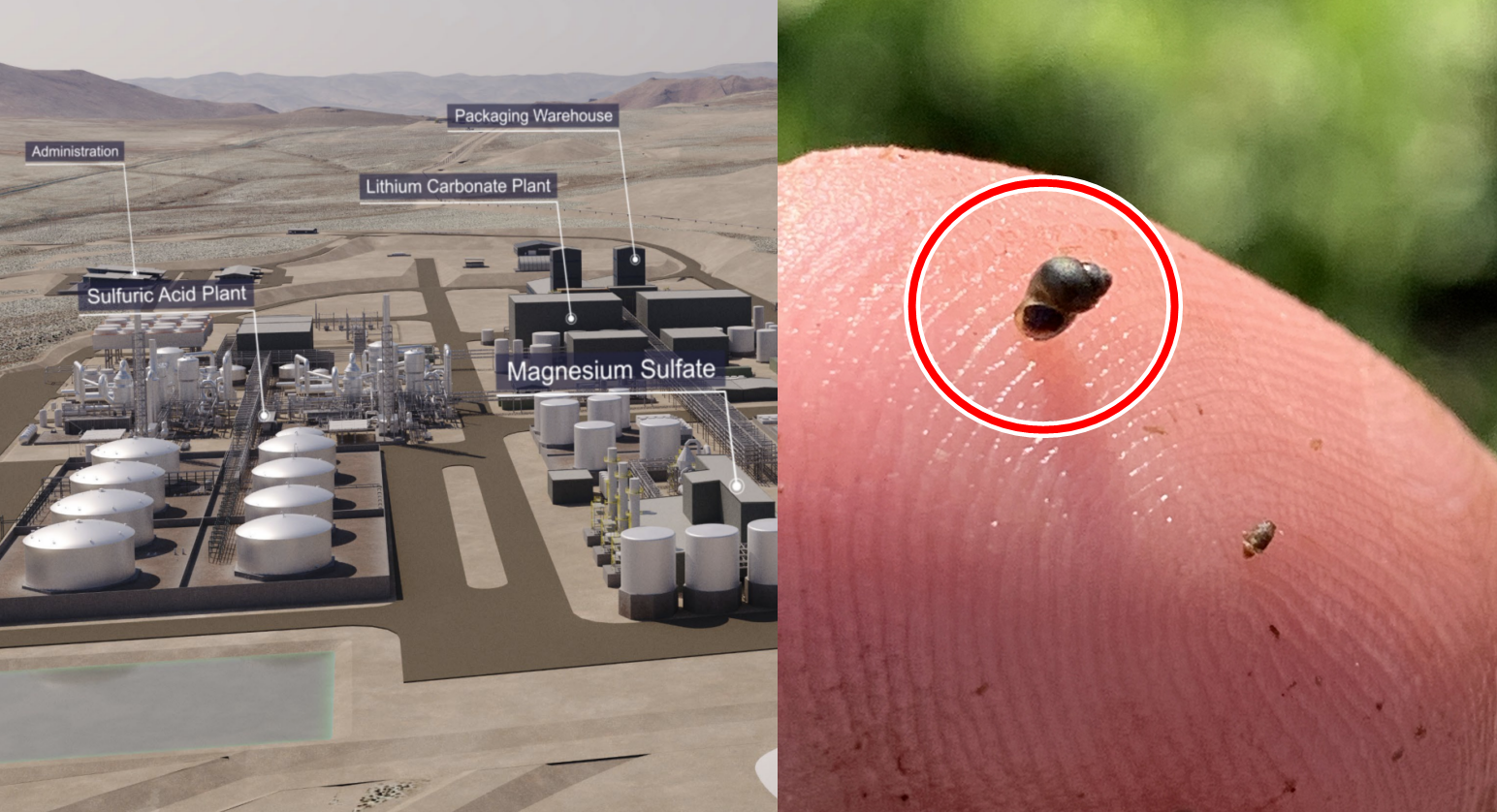


The Largest Lithium Mine In The USA, With Potential To Produce 40,000 Tons Per Year And Billions In Revenue, Faces Environmental Opposition For Threatening A Small Snail.
In the vast deserts of Nevada, United States, construction is underway for the largest lithium mine in the country, located at Thacker Pass. The project, led by the Canadian company Lithium Americas, promises to drive the transition to a clean energy economy by providing an essential mineral for electric vehicle battery production.
However, the initiative has faced strong opposition from environmentalists and Native American communities who warn of its potential environmental and cultural impacts.
The main point of contention is the suspicion that the mining activities are contributing to the decline in the region’s groundwater levels, threatening the existence of the Kings River pyrg, a small snail unique to the local springs.
-
Motorola launched the Signature with a gold seal from DxOMark, tying with the iPhone 17 Pro in camera performance, Snapdragon 8 Gen 5 that surpassed 3 million in benchmarks, and a zoom that impresses even at night.

-
Satellites reveal beneath the Sahara a giant river buried for thousands of kilometers: study shows that the largest hot desert on the planet was once traversed by a river system comparable to the largest on Earth.

-
Scientists have captured something never seen in space: newly born stars are creating gigantic rings of light a thousand times larger than the distance between the Earth and the Sun, and this changes everything we knew about stellar birth.

-
Geologists find traces of a continent that disappeared 155 million years ago after separating from Australia and reveal that it did not sink, but broke into fragments scattered across Southeast Asia.
The debate over environmental risks and local wildlife has intensified tensions between the parties involved and raised questions about the balance between development and preservation.
An Endangered Species

The Kings River pyrg, a snail species slightly larger than a grain of rice, lives exclusively in 13 isolated springs in the Thacker Pass mining area.
These small mollusks depend on just a few centimeters of water to survive, making them extremely vulnerable to changes in groundwater levels.
Paul Ruprecht, director of the Western Watersheds Project in Nevada, warns that small changes in the snail’s habitat could dry up the springs and lead to the species’ extinction.
According to him, the US Fish and Wildlife Service is violating the Endangered Species Act by delaying a response to a 2022 petition that requests the classification of the snail as threatened or endangered.
Meanwhile, groups such as the Western Watersheds Project and the People of Red Mountain have notified their intention to sue the authorities and Lithium Americas for failures in monitoring environmental impacts.
Strategic Partnerships And Investments
The Thacker Pass mine represents a milestone in lithium production in the United States. Recognized as the largest known deposit of the mineral in the country, the mine plays a strategic role in the supply chain of critical minerals, essential for the global energy transition.
Recently, the project received a $625 million investment from General Motors (GM), securing the automaker a 38% stake in the mine.
Additionally, the US Department of Energy approved a loan of $2.26 billion for the development of the mine, reinforcing its strategic importance in reducing dependence on foreign suppliers.
Set to commence operations later this decade, the mine is projected to produce approximately 40,000 metric tons of lithium carbonate suitable for batteries annually in its first phase.
This production will be sufficient to equip up to 800,000 electric vehicles each year, solidifying Lithium Americas’ position as a leader in lithium supply on the continent.
The Weight Of History And Culture
The dispute surrounding the Thacker Pass mine transcends environmental issues. For Native American communities, the site carries profound historical and cultural significance.
In 1865, the region was the site of a massacre against their ancestors, making it a sacred site for these communities.
Previous court decisions have denied the tribes’ requests to recognize the site as sacred, but the fight for recognition continues.
The mine itself is seen as an example of the conflict between industrial development and respect for Indigenous lands, highlighting the need for solutions that consider both progress and cultural preservation.
Monitoring And Controversies
Reports presented by Lithium Americas indicate that the company has lost access to private lands where several monitoring wells were located, complicating the assessment of impacts on groundwater.
Although Nevada regulators approved changes to the monitoring plan in 2024, the situation raises concerns about the transparency and effectiveness of the measures taken.
Data analyzed by Professor Payton Gardner from the University of Montana shows that the water levels in a nearby well have dropped about 1.5 meters since 2018.
However, regulators claim that there has not yet been confirmation of this decrease and assure that the situation will be monitored throughout the life of the mine.
The Race For Lithium And Future Challenges
The demand for lithium, driven by the transition to a clean energy economy, is expected to grow exponentially over the next decade.
President Joe Biden has included increasing electric vehicle production as a central part of his energy agenda, reinforcing the importance of projects like Thacker Pass.
However, the history of mineral exploitation in the western US is marked by legal disputes involving threats to wildlife and water resources.
The lithium mine at Thacker Pass is no exception, facing challenges in balancing the needs of energy transition with environmental preservation and respect for local communities.








Mandem enfiar o caracol no kó e prende por 10 anos todo esquetdophat@ que defende isto. Não fotam eles que incitaram os carros elétricos, fizeram o mundo piorar os motores, poluir 10 vezes mais com fsbricação de bateria?
Quero mais que se **** o caracol!
Se for seguido a risca o que querem os ambientalistas a humanidade vai retornar ao seu estado primitivo, ou talvez todos morrerão de fome….