





 English
  Francês
  Alemão
  Italiano
  Japonês
  Norueguês
  Portuguese
  Spanish
  5 min of reading
  0 comments


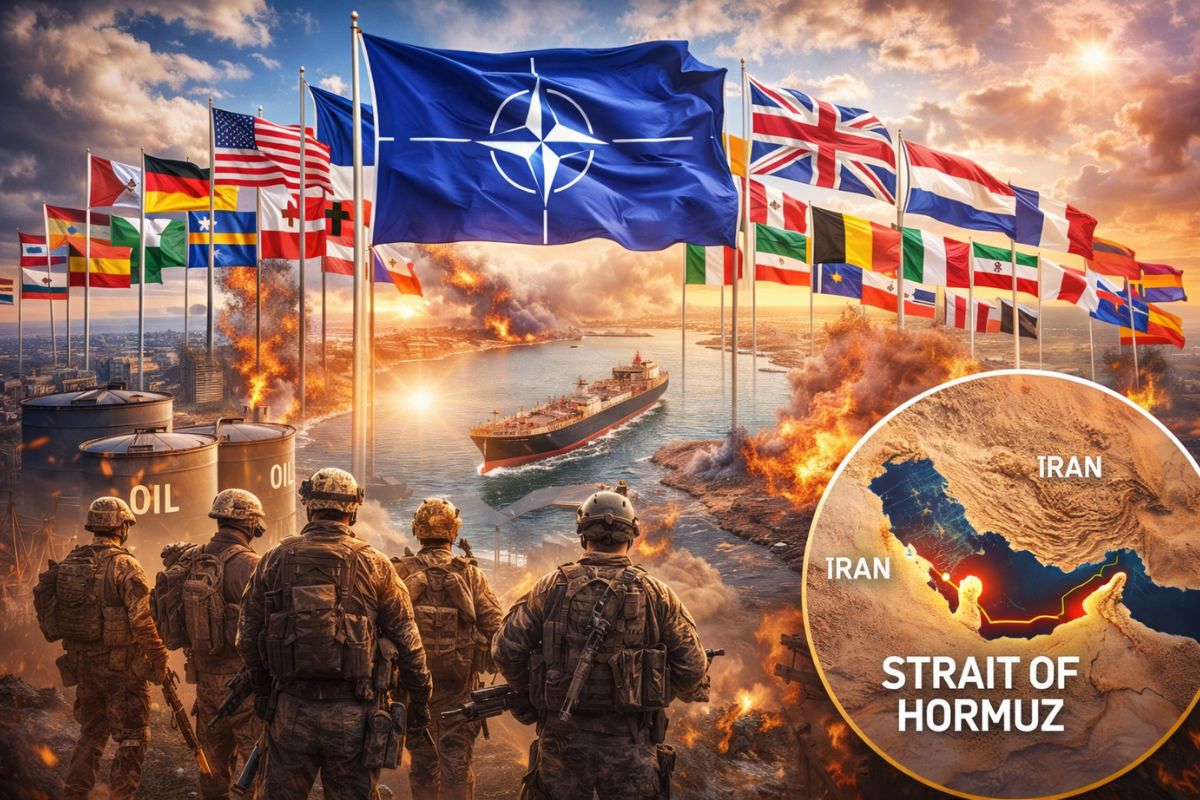
NATO Secretary General Mark Rutte confirmed that 22 countries are coordinating efforts to reopen the Strait of Hormuz. The coalition includes allies such as Japan, South Korea, and the United Arab Emirates, as oil prices soar in international markets amid tensions between the US and Iran.
NATO is leading the formation of an international coalition of 22 countries to force the reopening of navigation through the Strait of Hormuz, a strategic passage through which about one-fifth of all oil consumed in the world flows. The announcement was made by the organization’s Secretary General, Mark Rutte, in an interview on the Fox News Sunday program this Sunday (22). According to Rutte, most of the countries in the coalition are NATO members, but the group also includes allies such as Japan, South Korea, Australia, New Zealand, the United Arab Emirates, and Bahrain.
NATO’s movement comes at a time of extreme tension between the United States and Iran. On the eve of the announcement, President Donald Trump threatened to annihilate Iranian nuclear plants if Tehran did not reopen the Strait of Hormuz within 48 hours. Oil prices are already fluctuating in the international markets, with investors reacting to the risk of a collapse in global energy supply.
What NATO announced about the coalition of 22 countries
NATO Secretary General Mark Rutte stated that 22 nations are joining efforts to ensure that the Strait of Hormuz is free and reopened as soon as possible. The statement was made to Fox News host Shannon Bream and represents the first public confirmation that NATO is coordinating a multilateral response to the crisis in the strait.
-
Expansion of Federal Institutes: 38 new campuses and R$ 200 million for public education; see the cities included.

-
Lula’s government changes rule in important benefit and thousands of Brazilians will no longer receive it; see what has changed.
-
New Gripen fighter makes Argentines surrender to Brazil, and the heavy reaction exposes envy, frustration, and shock at Brazil’s technological leap.
-
This discovered deposit near the Andes could change the future of Argentina, attract billions, and even shake up the global metals market.


According to Rutte, most of the countries involved are NATO members, but the coalition goes beyond the Atlantic alliance. The inclusion of Japan, South Korea, Australia, New Zealand, the United Arab Emirates, and Bahrain shows that concern for freedom of navigation in the Strait of Hormuz transcends regional borders and involves economies that directly depend on the flow of oil through the passage. Japan and South Korea, for example, are major energy importers from the Middle East.
Why the Strait of Hormuz is so important for world oil
The Strait of Hormuz is a narrow maritime passage that connects the Persian Gulf to the Gulf of Oman and, from there, to the Indian Ocean. Through this naval corridor, which is only 33 kilometers wide at its narrowest point, approximately 20% of all oil traded in the world passes. Any blockage or restriction to navigation in the strait has an immediate effect on global energy prices.
Iran controls the northern coast of the Strait of Hormuz and has historically used its geographic position as a tool of geopolitical pressure. NATO’s decision to form a coalition to ensure reopening reflects the seriousness of the current scenario, where prolonged closure of the passage could provoke a collapse in oil supply to Europe, Asia, and other importing regions.
Trump’s threat to Iran and the escalation of tension
The announcement of the NATO-led coalition came one day after US President Donald Trump drastically raised the tone against Iran. On Saturday (21), Trump threatened to annihilate Iranian nuclear plants if Tehran did not reopen the Strait of Hormuz within a 48-hour deadline. The statement intensified pressure on the Iranian government and generated immediate reactions in financial markets.
The American threat occurs in a context of tense negotiations between Washington and Tehran over the Iranian nuclear program. For NATO, the declared priority is to ensure freedom of navigation in the Strait of Hormuz through multilateral coordination, preventing the crisis from escalating into direct military confrontation.
However, the combination of the American ultimatum and NATO mobilization signals that the West is prepared to act if diplomacy fails.
How oil prices are reacting to the crisis
Oil prices fluctuated on Monday (23), with international markets reacting simultaneously to the rising tension in the Strait of Hormuz and targeted relief measures. On one hand, threats to Iran’s energy infrastructure and the risk of prolonged closure of the strait push prices up.
On the other hand, Washington temporarily allowed the release of Iranian oil transported by sea, with millions of barrels entering global markets.
This contradictory combination generates volatility, but the upward trend remains while the Strait of Hormuz is not fully reopened. NATO’s coordinated action with 22 countries aims to stabilize the situation before prices spiral out of control, affecting everything from fuel costs to global inflation.
Import-dependent economies, such as those of Japan and Europe, are the most vulnerable to the prolongation of the crisis.
What NATO can practically do to reopen the Strait of Hormuz
NATO has significant naval capacity to ensure freedom of navigation in international waters. The alliance has previously conducted similar operations, including patrolling the Mediterranean and combating piracy in the Horn of Africa.
In the case of the Strait of Hormuz, the presence of warships from multiple nations can serve both as a deterrent against any Iranian attempt to block the passage and as an escort for oil tankers.
The inclusion of Pacific and Gulf countries in the coalition broadens the reach and legitimacy of the operation. For NATO, demonstrating that the reopening of the Strait of Hormuz is a global demand, not just a Western one, strengthens the coalition’s diplomatic position in the international community. The presence of the United Arab Emirates and Bahrain, neighbors of Iran in the Persian Gulf, is particularly relevant as it involves nations from the region in the effort.
What to expect in the coming days
The 48-hour deadline given by Trump to Iran has already expired, and the situation remains undefined. NATO continues to coordinate the coalition of 22 countries, and the expectation is that concrete measures will be announced in the coming days, including possible positioning of naval forces in the Strait of Hormuz region.
Oil markets will remain volatile until there is a clear resolution. NATO’s ability to keep the coalition united and to pressure Iran without provoking armed conflict will be the decisive factor in determining whether the crisis results in negotiation or escalation. The world is watching closely, as the outcome directly affects fuel prices, global inflation, and the geopolitical balance in the Middle East.
NATO is leading a coalition of 22 nations to force the reopening of the Strait of Hormuz amid American threats to Iran and fluctuations in oil prices. The outcome of the crisis could reshape the balance of power in the Middle East and directly impact consumers’ wallets around the globe.
With information from the CNN Brasil portal.
What do you think of the formation of this coalition by NATO? Do you believe that the pressure from 22 countries will be enough to reopen the Strait of Hormuz without military conflict? Leave your opinion in the comments and share with those who follow geopolitics and the energy market.








Seja o primeiro a reagir!