





 Portuguese
  English
  Spanish
 4 min of reading
  56 comments


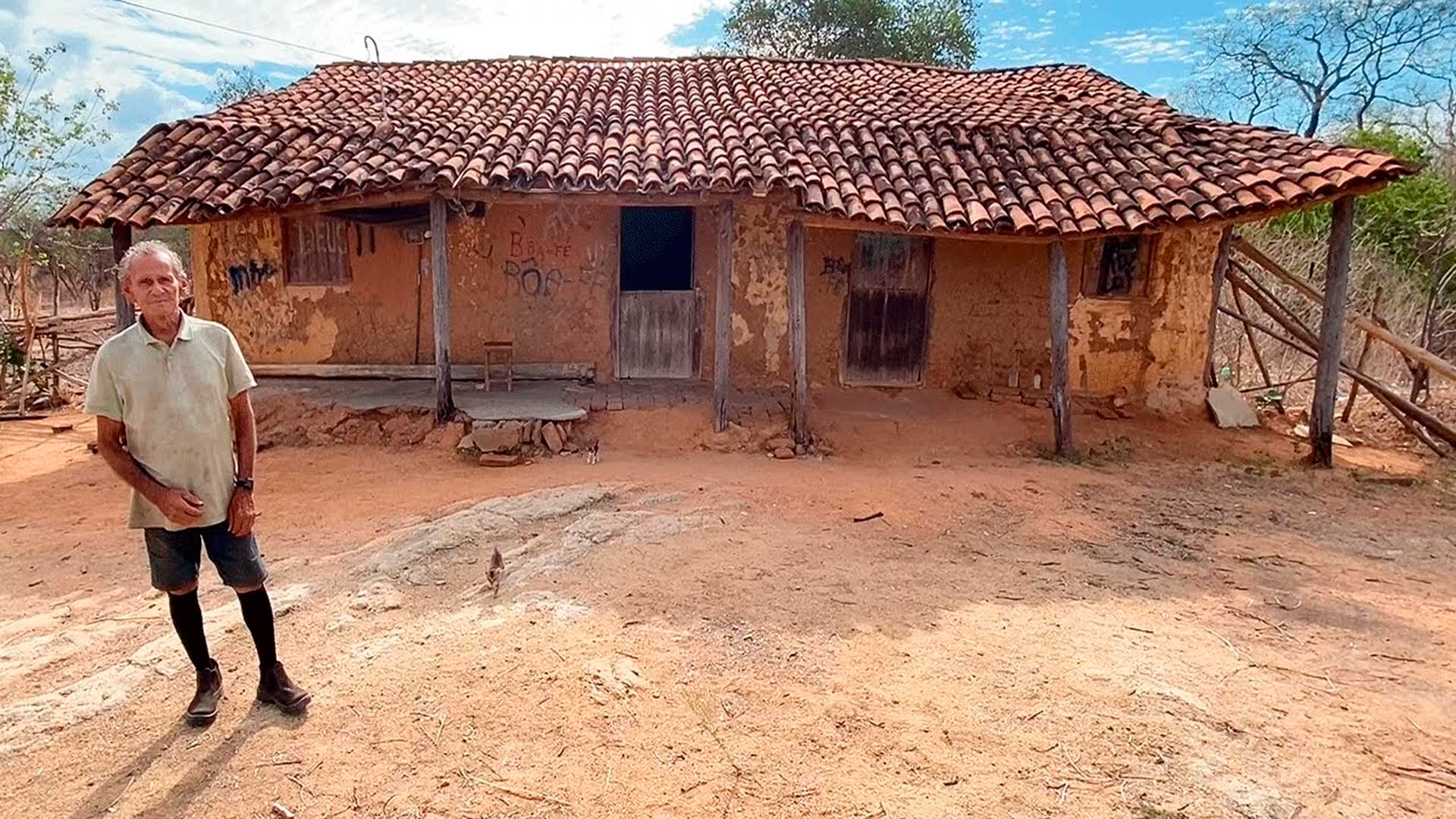


Seu Chiquinho Matias Preserves Traditions From The Countryside For Over 50 Years In A House Built In 1920, Defying Modernity With Well Water And A Wood Stove
The routine of Francisco Matias, known as Seu Chiquinho, contrasts with the fast pace of modern times. At 80 years old, he lives alone in a 105-year-old rammed earth house in the municipality of Hidrolândia, in the interior of Ceará, preserving customs that date back to the early 20th century.
The residence, built in 1920 by his father, Antônio Matias, stands as a silent testament to traditional sertanejo architecture. According to Seu Chiquinho, the structure remains solid despite the years, though it requires repairs after nearly three decades without the presence of his parents.
The sertanejo was born and raised in the same place where he currently lives. His earliest memories date back to about five years old, when he was already helping to herd the family’s cattle.
-
Son of a seamstress from the rural area of Ceará who did not speak English wins a scholarship of over 2 million reais at Williams College, one of the top 10 universities in the United States, covering everything including dormitory, meals, and annual trips to Brazil.

-
Bill Gates revealed that the true secret behind every great achievement is not a brilliant leap but rather small improvements repeated over the years, and the data from his own career and the fight against climate change prove that he is right.

-
With 22 thousand tons of steel, a height nearly three times greater than the Eiffel Tower, and a cost of R$ 1.6 billion, China is building the highest bridge on the planet over a colossal canyon, reducing a crossing time of over 2 hours to just over 2 minutes.

-
With more than 635,000 doctors, Brazil sees competition increasing in large cities, and recent graduates are competing for shifts at an accelerated pace while the countryside still faces shortages.


The resident’s journey includes two stints in Rio de Janeiro, where he spent around a year each time. However, urban life did not seduce him. “I didn’t like Rio de Janeiro much,” he revealed in an interview with the channel Felipe Sena, which documented his routine.
Centenary House Preserves Original Structure In The Ceará Interior

The building that houses Seu Chiquinho dates back to 1920, the year his father married Dona Francisca Simões, known as Dona Chiquinha Simões. The rammed earth technique, traditional in the Brazilian Northeast, consists of compacted clay walls that provide natural thermal insulation.
According to studies by the Institute of National Historical and Artistic Heritage (IPHAN), rammed earth houses were prevalent in Northeastern popular architecture until the mid-20th century. The durability of these constructions, when well maintained, can exceed a century.
Seu Chiquinho emphasizes that the house maintains a pleasant temperature even during the sertão winter. He gathered stones close to the property and plans to use 18 bags of cement to renovate the structure, preserving the original essence of the residence.
Sertanejo Traditions Resist The Passage Of Time In Daily Routine
The life of Francisco Matias follows rhythms that few Brazilians still know. He fetches water from the well every week, storing the liquid in barrels transported by cart. The clear, natural water is kept in clay pots inside the house.
The wood stove remains the only source for preparing food. “I fetch that firewood in the morning, I like to see that high firewood flame in the stove,” says the sertanejo, who enjoys his morning coffee and tapioca prepared the traditional way.
According to data from the Brazilian Institute of Geography and Statistics (IBGE), only 2.3% of rural households in the Northeast still use firewood as the main source of energy for cooking, according to a survey from 2019. Seu Chiquinho’s practice represents an increasingly rare lifestyle.
After breakfast, he dedicates two to three hours to work on the land. The property extends to the banks of the Feitos River, which flows through the village of Irajá. His activities include clearing weeds, fixing fences, and preparing small areas for planting.
Family Memories Mark The Journey In The Sertão
Seu Chiquinho is the only surviving male child of a family of ten siblings – seven women and three men. His older brother, José Simões Peres, known as Seu Zequinha, was a councilman in Hidrolândia between the 1960s and 1980s.
His parents passed away about 28 years ago, with a five-year gap between one death and the other. Since then, Francisco has maintained the house as a family inheritance. Some sisters reside in Brasília and Sobral.
The sertanejo remained single after the end of a courtship in his youth. “I almost got married, but it didn’t work out. The bride married someone else,” he revealed without resentment.
After returning definitively from Rio de Janeiro at 30, Seu Chiquinho has been on the property for five decades. The routine included Sunday visits to the village of Irajá, a habit that has diminished with age.
Simple Life Philosophy Guides Octogenarian In The Countryside
Francisco Matias shows serene acceptance of the passage of time. “I consider myself an old man,” he affirms without melancholy, adding that he always feels well and has never had major health complaints.
For him, longevity is due to natural food and an active lifestyle. Daily work on the land, even at 80, keeps him busy and satisfied. “After breakfast, at 8 o’clock I go to the riverbank,” he describes his morning routine.
Spirituality permeates his reflections on life. According to his words, God represents “a great and greater universal spirit, stronger, more powerful” that governs nature. He accepts mortality calmly, wishing only that life completes itself naturally.
Despite living alone, Seu Chiquinho receives visitors daily. “There is always someone here at least half an hour, a little piece of time,” he shares, demonstrating that geographic solitude does not mean social isolation.
The story of Francisco Matias represents a Brazil that quietly resists the lines of modernization. His routine, documented by the channel Felipe Sena, went viral on social media and sparked curiosity about traditional lifestyles that still persist in the Northeastern sertão.
And you, could you live without modern conveniences like Seu Chiquinho Matias? Leave your comment sharing your opinion on this traditional lifestyle, would it be a form of cultural resistance or just nostalgia for the past? Join the discussion!







No, es lindo vivir en el campo, pero con las comodidades modernas, especialmente Internet.
Uno que esta acostumbrado com familia diría que triste la vida asi
Vivir aislada sola me da miedo. Aunque se que donde esté Dios está conmigo. Dios siempre le cuide y le mantenga con salud y buena energía para seguir haciendo lo que hace