





 Portuguese
  English
  Spanish
  3 min of reading
  0 comments


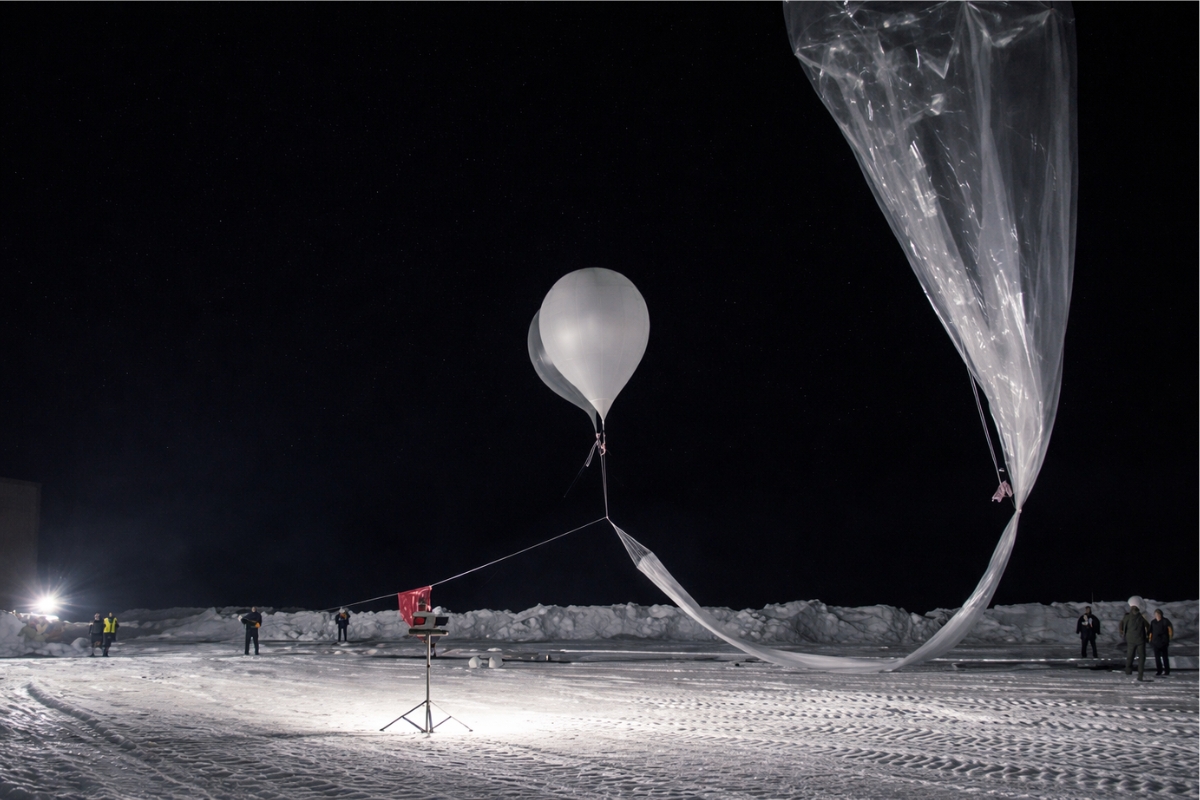
With the Capacity to Carry 100 Kg to 20 Kilometers High, the Barrage Project Aims to Replace Some of the Lost Connectivity After the Starlink Blockade, Using Giant Balloons to Relay 5G Signals Over the Battlefield
After suffering a severe operational impact from the blockade of access to Starlink on the front lines of the war in Ukraine, Russia is racing against time to rebuild its military communication infrastructure. Without the satellite connectivity that ensured real-time coordination, Russian units have come to rely on ground vehicles for logistics and command, drastically increasing their vulnerability to drone attacks.
In light of this scenario, Russian engineers decided to look to the sky — but not exactly to space. The new bet involves high-altitude stratospheric balloons capable of functioning as airborne data transmission platforms.
The Barrage Project and the Promise of 5G Internet on the Battlefield
The Russian Foundation for Advanced Studies (FFAS) announced the first test flight of the military aerostat known as Barrage-1. The device can carry up to 100 kilograms of payload and operate at around 20 kilometers in altitude, in the stratosphere.
-
Motorola launched the Signature with a gold seal from DxOMark, tying with the iPhone 17 Pro in camera performance, Snapdragon 8 Gen 5 that surpassed 3 million in benchmarks, and a zoom that impresses even at night.

-
Satellites reveal beneath the Sahara a giant river buried for thousands of kilometers: study shows that the largest hot desert on the planet was once traversed by a river system comparable to the largest on Earth.

-
Scientists have captured something never seen in space: newly born stars are creating gigantic rings of light a thousand times larger than the distance between the Earth and the Sun, and this changes everything we knew about stellar birth.

-
Geologists find traces of a continent that disappeared 155 million years ago after separating from Australia and reveal that it did not sink, but broke into fragments scattered across Southeast Asia.

The proposal is to use these balloons to elevate transmitters with fifth-generation technology, creating a kind of aerial network capable of providing high-speed internet in areas where conventional coverage has been compromised. Unlike satellites, they operate much closer to the surface, which theoretically would reduce costs and simplify implementation.
The system uses automatic air regulation mechanisms to ascend or descend in search of favorable wind currents, allowing for some degree of positional adjustment over specific regions.

The Great Fragility: The Wind and Military Vulnerability
Although the proposal seems innovative, experts point out significant limitations. Unlike satellites with controlled orbits, stratospheric balloons depend on atmospheric currents to maintain position. In regions such as Ukraine, where prevailing winds blow eastward, maintaining stable coverage can be a significant technical challenge.
Another critical point is vulnerability. Although they operate above the range of many short-range defense systems, these balloons are neither invisible nor invulnerable. Anti-aircraft systems or electronic warfare actions could compromise their effectiveness, especially in a high-intensity conflict environment.
The Impact of the Starlink Blockade on Russian Forces
Recent reports indicate that the blockade of Russian access to Starlink has resulted in a reduction in certain offensive operations on the front lines. Without fast and stable communication, troops have come to rely on trucks, motorcycles, and light vehicles for coordination, many of which were destroyed in drone attacks.
Domestic alternatives, such as terminals associated with Gazprom Space Systems, have reportedly exhibited performance considered slow for the demands of the battlefield. At the same time, the Russian satellite constellation project Rassvet is facing production delays, hindering an immediate replacement of SpaceX’s network.
Emergency Solution or New Technological Strategy?
The bet on 5G balloons reveals the extent of the challenge faced by Moscow. More than a long-term strategic innovation, the project arises as an emergency response to a critical operational gap.
It remains unclear whether the initiative will be able to provide the stability and coverage needed to replace, even partially, the lost infrastructure. What is already known is that, in modern wars, connectivity is power — and losing control of communication can be as decisive as losing territory.








-

Uma pessoa reagiu a isso.