





 Portuguese
  English
  Spanish
 4 min of reading
  1 comment


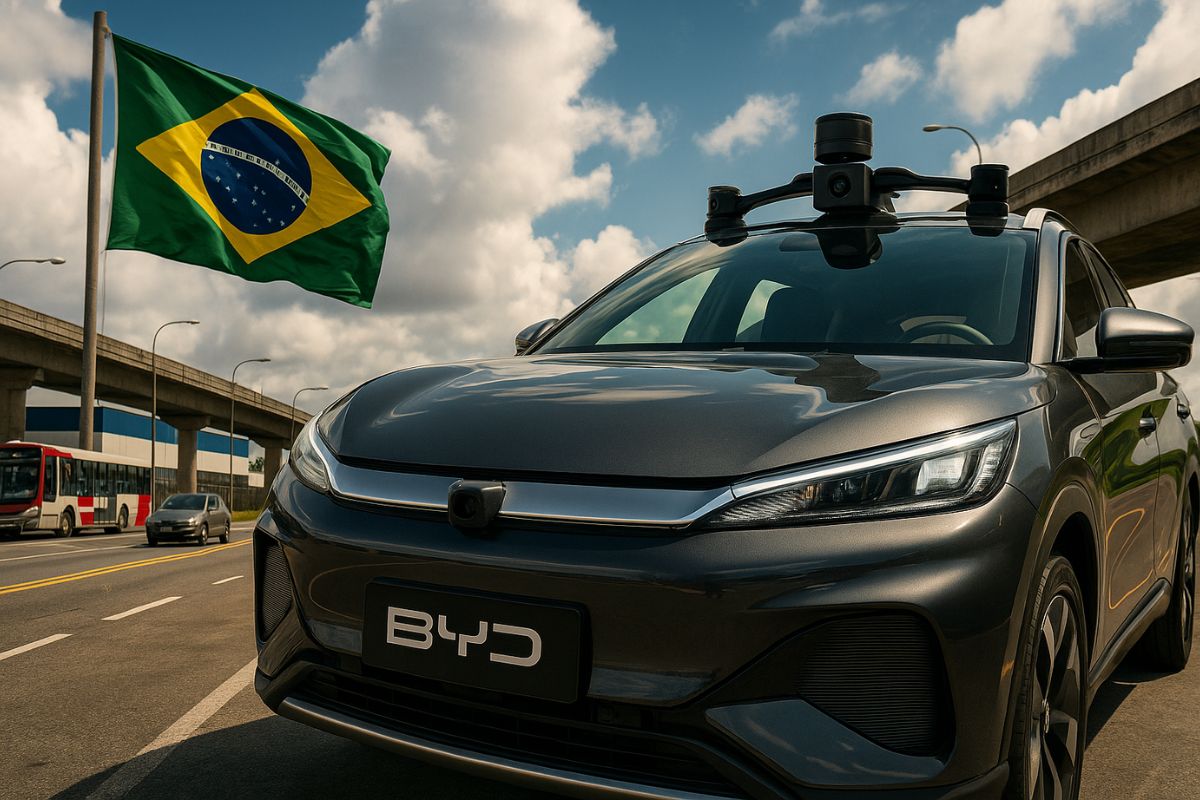


BYD Announces New Center in Rio Focused on Research and Development of Autonomous Vehicles, with Test Track at Tom Jobim International Airport and Emphasis on Technological Innovation, After Investing R$ 5.5 Billion in Factory in Bahia
BYD has announced a new center in Rio de Janeiro dedicated to the development of autonomous cars, reinforcing its strategic presence in Brazil. The research laboratory will be installed on land at Tom Jobim International Airport (Galeão) and will feature a test track that will function as a mini-autodrome for experiments with vehicles that do not require human drivers.
The project, according to Infomoney, announced by Mayor Eduardo Paes alongside the international president of the automaker, Wang Chuanfu, consolidates the country as one of the main automotive innovation hubs for the company outside Asia. The investment is entirely private and is part of BYD’s global expansion following the inauguration of the largest electric car factory for the brand outside the Asian continent, in Camaçari (BA).
A New Automotive Innovation Hub in Rio
The new BYD center will be located in a strategic area, close to Coppe/UFRJ and the Fundão Technology Park, two of the most important research institutions in the country.
-
OMODA & JAECOO grows in Europe in 2026 with an integrated strategy of sales, innovation, local production, and technological advancement in the United Kingdom, Italy, and Spain.

-
OMODA & JAECOO expands after-sales service in Brazil with competitive maintenance, a 7-year warranty, and high availability of parts for technological SUVs.
-
OMODA & JAECOO appoints Alessandra Souza as executive marketing director in Brazil and accelerates brand expansion with a focus on innovation, networking, and hybrid portfolio.

-
Jaecoo 7 with super hybrid SHS system exceeds 1,200 km of combined range with a 1.5 turbo engine, high-density battery, and intelligent energy management.

This location will enable academic and scientific partnerships focused on creating autonomous driving technologies, intelligent sensors, and sustainable propulsion systems.
According to Eduardo Paes, the project represents a crucial step to reposition Rio de Janeiro as a reference in technology applied to mobility.
He emphasized that the arrival of the innovation center also integrates the Galeão revitalization plan, bringing the airport closer to economic and scientific development initiatives.
Why the Project Stayed in Rio and Not in Salvador
The decision to establish the research center in Rio was made after direct negotiations between the company and the city hall.
Initially, BYD planned to build the unit in Salvador, but discussions evolved to Rio following personal mediation by the mayor, who had previously acted as the company’s representative in Latin America between 2017 and 2020.
According to Stella Lee, vice president of BYD for the international market, the mayor was familiar with the company’s technology and demonstrated the logistical and academic advantages of the city.
“He convinced us to bring the entire Research & Development center here,” said the executive.
The Rio center will also include a sector focused on research into flex fuels, adapted to Brazilian energy realities.
BYD’s Expansion in Brazil
The initiative comes just a few months after BYD inaugurated its first national factory in Camaçari (BA), with an investment of R$ 5.5 billion and an annual production capacity of up to 600,000 electric vehicles.
The plant, built on the former Ford complex, is the largest for the company outside of Asia and will be responsible for supplying cars for the domestic market and exports to countries in Latin America.
This move reinforces BYD’s global strategy to decentralize production and invest in local innovation, creating synergies between research, manufacturing, and commercialization.
With the new center in Rio, Brazil will become integrated into the global technological development axis of the automaker, alongside hubs in China, Japan, and Europe.
Autonomous Cars: The Next Technological Leap
The laboratory in Rio will primarily focus on researching autonomous vehicles of different levels of automation, from driver assistance systems to platforms that operate without human intervention.
Tests will include embedded artificial intelligence, perception sensors, radars, and navigation software.
The proposal is for the center to function as a complete innovation ecosystem, capable of generating solutions applicable both to the brand’s fleet of electric cars and to other segments of urban and logistical transportation.
BYD also aims to attract Brazilian startups and researchers for joint projects.
Economic and Symbolic Meaning
BYD’s announcement represents a milestone for the Brazilian automotive sector, which seeks to reconnect with global innovation chains after years of retraction.
For Rio de Janeiro, the project symbolizes the productive reoccupation of a strategic area and the consolidation of the city as a hub for green technology and smart mobility.
The focus on cars that do not require human drivers places the country on the radar of high-impact economic and scientific trends, bringing Brazil closer to international discussions about safety, regulation, and infrastructure for autonomous vehicles.









Esses carros autônomos dependem de boa sinalização e faixas bem visíveis, vai ser uma missão quase impossível.