





 English
  Francês
  Alemão
  Italiano
  Japonês
  Norueguês
  Portuguese
  Spanish
  6 min of reading
  0 comments


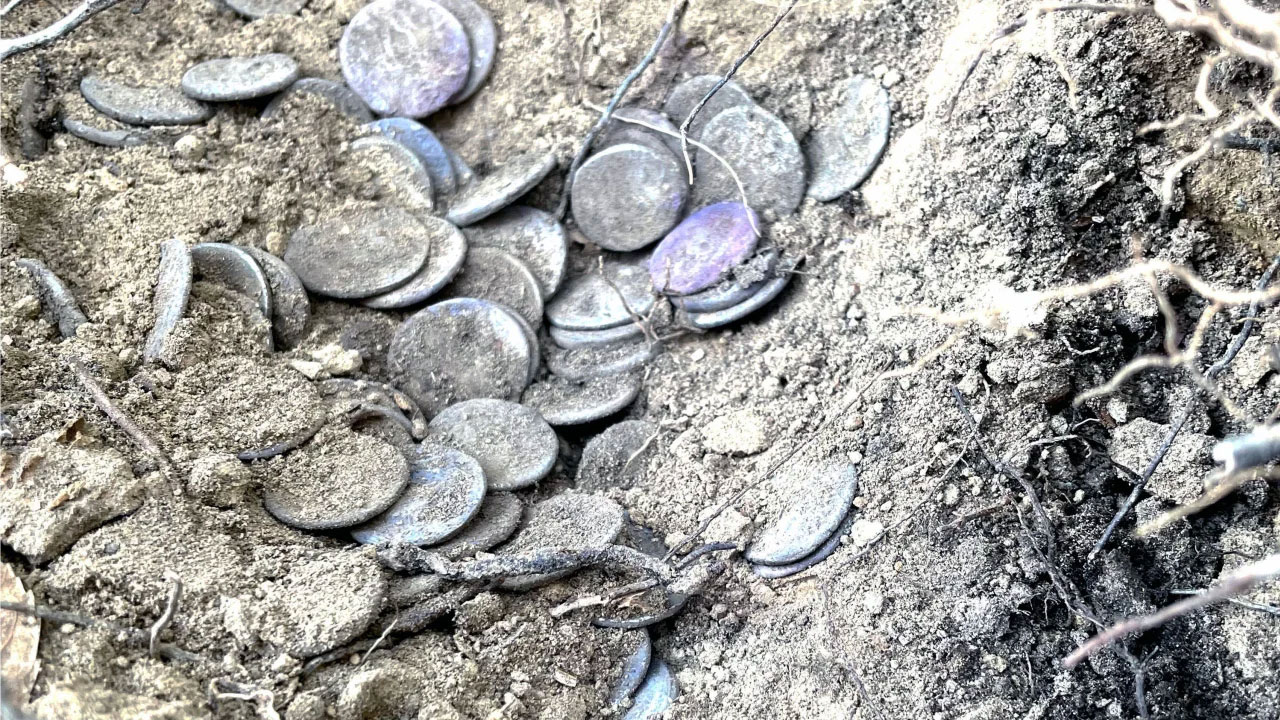
Roman treasure with more than 175 coins found intact in ceramic vase after more than 2,000 years reveals wealth protection strategies in the Roman Empire.
In 2023, archaeologists and Italian authorities announced the discovery of a Roman treasure consisting of more than 175 ancient coins, found inside a sealed ceramic vase preserved for over two millennia. According to CNN Brasil’s report, based on information from Italian archaeologists, the find occurred in the Tuscany region, near the city of Livorno, and attracted international attention due to the rarity and state of preservation of the pieces.
The collection was surprisingly intact, showing no signs of looting or dispersion, indicating that it was deliberately buried and never recovered by its owner. According to the researchers involved in the excavation, cited in the same report, nearly all of the approximately 175 silver coins were in good condition, making the find one of the few completely preserved Roman treasures. The scene frozen in time suggests a moment of crisis, where hiding wealth was often the only alternative in the face of wars, invasions, or political instability.
Buried Roman treasure reveals common practice in times of instability in the Empire
The habit of hiding coins and valuables was relatively common during turbulent periods of the Roman Empire. In times of war, barbarian invasions, or regional collapses, individuals buried their belongings hoping to recover them later.
-
With 241 meters, 48 thousand tons, and a structure designed to accompany aircraft carriers at sea, the Chinese ship that refuels fleets in motion was born to push Beijing away from the coast and has become the hidden gear of its naval projection.

-
“Discreet” city in the interior of SP stands out among the smartest in Brazil thanks to a national ranking.

-
With 27,800 tons, 230.8 meters in length, and space for 18 helicopters, the Canberra class functions as a floating amphibious airbase and gives Australia the capability to operate at sea for more than 45 days.

-
The USA surprises the world by installing 21.9 km of sand fences, planting 195,000 native seedlings, and recreating 1,050 acres of beaches and dunes.


However, many of these treasures were never unearthed by their original owners. This may indicate death, flight, or inability to return to the site. This type of find acts as an economic time capsule, preserving exactly what was in circulation at that historical moment.
In the case of this vase with more than 175 coins, the absence of disturbance at the site indicates that it remained hidden for centuries, protected both by the earth and by chance.
Coins reveal economic and political details of the Roman period
Each coin found in archaeological excavations carries valuable information. They are not just objects of value, but also historical records that help reconstruct economic, political, and social contexts.
Roman coins typically feature images of emperors, symbols of power, and inscriptions indicating specific periods of issuance. This allows researchers to accurately date the moment when the treasure was buried.
Moreover, the metallic composition — gold, silver, or alloys — reveals the state of the Roman economy. In times of crisis, for example, it was common for the amount of precious metals in coins to decrease, a phenomenon known as monetary devaluation.
The collection found allows for analysis not only of the individual wealth of the person who buried it but also of the macroeconomic context of the Roman Empire at that time.
Ceramic vase functioned as an improvised safe more than 2,000 years ago
The container that held the coins is also a crucial element of the discovery. The ceramic vase, used as a type of improvised safe, was carefully sealed and buried.
This type of practice was common, as ceramics were durable, relatively waterproof, and widely available. Burying the container helped protect it from looters and also from environmental conditions.
The fact that the vase was found intact indicates that the site was not disturbed by human activities over the centuries, further increasing the archaeological value of the find.
Wealth protection strategy reveals times of crisis and insecurity
The burial of coins in large quantities suggests a scenario of insecurity. During the Roman Empire, especially in periods of transition or decline, entire regions faced instability.
Invasions, internal conflicts, and economic crises led citizens to take extreme measures to protect their belongings. Burying wealth was one such strategy.

The treasure found may be directly linked to a specific episode of crisis, such as an imminent invasion or an emergency escape. The fact that it was not recovered indicates that something prevented the owner from returning.
Although great monuments and battles dominate historical records, discoveries like this reveal the everyday lives of ordinary people. They show how individuals reacted to risky situations and how they managed their wealth.
The simple act of burying coins reveals practical decisions, fear, and planning. These details humanize history and allow for an understanding of the Roman Empire beyond its emperors and military conquests.
Additionally, the quantity of coins suggests that the owner possessed a significant level of wealth, which may indicate belonging to a higher social class.
Why so many Roman treasures are found centuries later
Europe, especially regions that were part of the Roman Empire, is rich in archaeological finds of this type. This occurs because:
- The Empire had a long duration and vast territorial extent
- There were various periods of instability
- The practice of hiding wealth was common
- Many sites remained unchanged for centuries
Each new discovery expands the understanding of how the Roman economy and society functioned, as well as revealing individual stories that were lost in time.
Archaeological and scientific importance of the find
The value of this type of discovery goes far beyond the financial aspect. Although the coins have material value, their true significance lies in the knowledge they provide.
Researchers can analyze:
- patterns of monetary circulation
- trade relations
- economic changes over time
- distribution of wealth
The intact collection found offers a rare opportunity for study without external interference, which increases its scientific relevance.
Roman treasure reinforces how historical events impacted individual lives
The discovery of the vase with coins highlights how major historical events directly reflected in people’s lives. Decisions such as burying wealth were not made lightly, but rather in response to real threats.
Wars, political crises, and economic instability shaped behaviors and survival strategies. The buried treasure is, in practice, a direct reflection of these conditions.
The fact that the treasure remained intact for so long makes this discovery an exceptional record. Unlike objects that pass through generations, this collection remained isolated since the moment it was buried.
This means it faithfully represents a specific point in time, without later alterations. It is as if a fragment of Ancient Rome had been preserved exactly as it was over two thousand years ago, allowing for direct and precise analysis by experts.
What this discovery reveals about the Roman Empire
More than just a collection of coins, the treasure reveals fundamental aspects of the functioning of the Roman Empire:
- the importance of currency as an economic instrument
- the existence of periods of instability
- individual strategies for wealth protection
- social differences and concentration of resources
These elements help build a more complete and detailed view of Roman history, going beyond traditional records.
The discovery of the vase with more than 175 Roman coins is not just an impressive archaeological find. It is a window into the past, revealing how real people faced moments of uncertainty and made decisions to protect what they owned.
More than two thousand years later, this gesture continues to resonate, offering clues about economy, society, and human behavior in one of the largest empires in history. The treasure tells not only the story of accumulated wealth but also of fear, strategy, and a future that never came for those who buried it.







Seja o primeiro a reagir!