





 Portuguese
  English
  Spanish
  4 min of reading
  0 comments


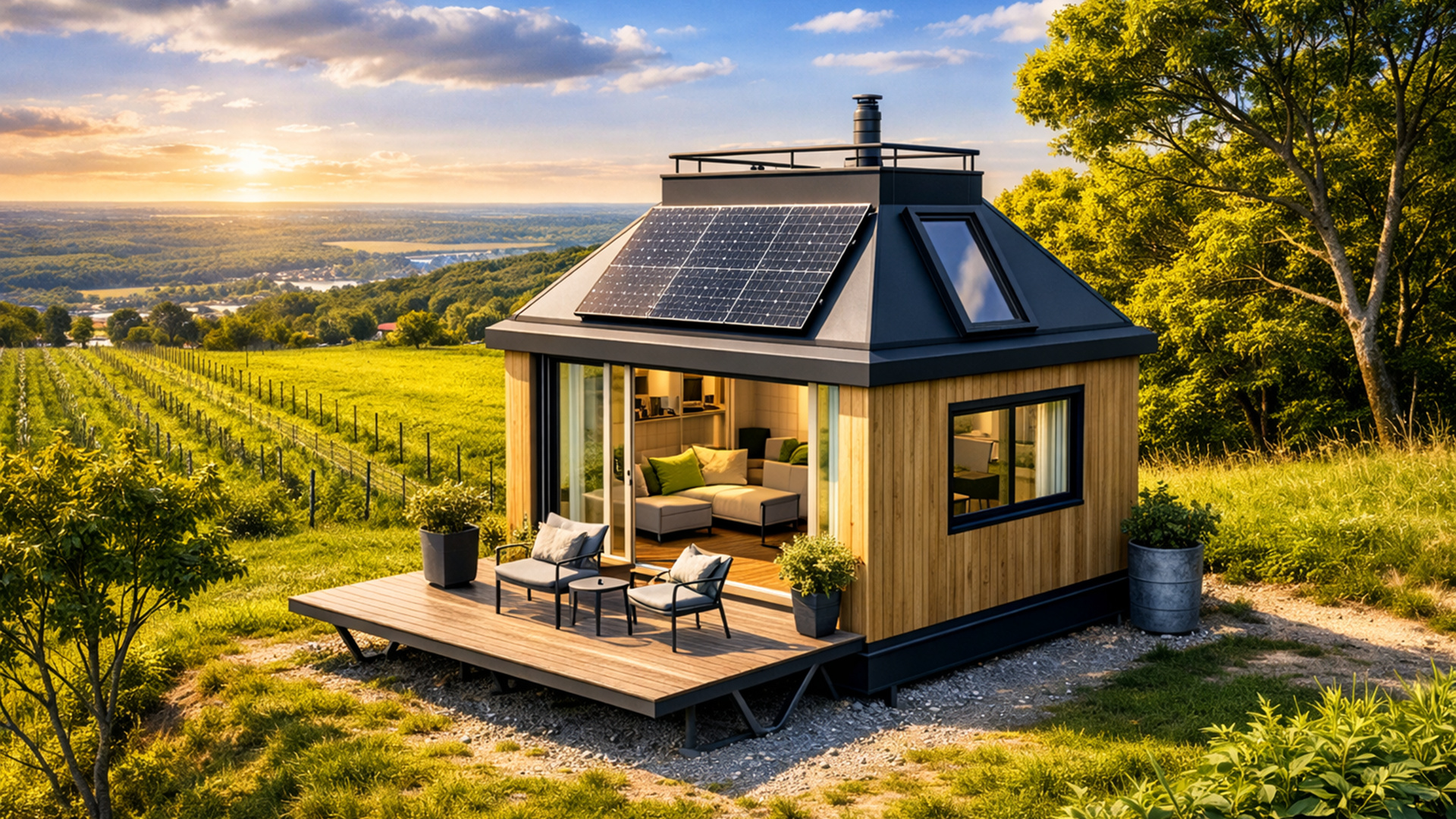
Designed by Ark-Shelter, the 20 m² micro-house bets on solar energy with batteries, a mezzanine, foldable terraces, and minimal consumption to enable a functional and low environmental impact isolated housing without direct connection to the electric grid
The Cabin Devín micro-house, developed by the Slovak studio Ark-Shelter, brings together an off-grid housing proposal with solar energy, batteries, foldable terraces, and internal organization aimed at autonomy, all within just 20 square meters.
Installed in a rural area near the Devín Castle in Bratislava, the structure focuses on low energy consumption, integration with the landscape, and efficient use of space.
In a scenario marked by rising housing costs and increasing energy demands, the project presents itself as an alternative centered on efficiency, self-sufficiency, and compact design. The idea is not based on expanding the built area, but on the ability to concentrate the essentials in a small, functional, and bright dwelling.
-
Son of a seamstress from the rural area of Ceará who did not speak English wins a scholarship of over 2 million reais at Williams College, one of the top 10 universities in the United States, covering everything including dormitory, meals, and annual trips to Brazil.

-
Bill Gates revealed that the true secret behind every great achievement is not a brilliant leap but rather small improvements repeated over the years, and the data from his own career and the fight against climate change prove that he is right.

-
With 22 thousand tons of steel, a height nearly three times greater than the Eiffel Tower, and a cost of R$ 1.6 billion, China is building the highest bridge on the planet over a colossal canyon, reducing a crossing time of over 2 hours to just over 2 minutes.

-
With more than 635,000 doctors, Brazil sees competition increasing in large cities, and recent graduates are competing for shifts at an accelerated pace while the countryside still faces shortages.


The micro-house was installed in a rural environment near the Devín Castle, a choice that reinforces the relationship between architecture and landscape. Elevated on stilts and clad in wood, the construction was designed to reduce the impact on the land and to rest more lightly on a sensitive natural environment.
Micro-house expands useful area with foldable terraces
One of the main elements of the project is the possibility of transforming the structure over time. Two facades feature foldable terraces that, when opened, expand the useful area to the outside and alter the perception of space within the dwelling.
With the folding of these platforms, large sliding glass panels come into play, creating an almost continuous transition between the interior and exterior. This solution increases the entry of natural light, improves ventilation, and reduces the feeling of confinement in a house with such limited square footage.
In addition to the visual effect, this design also influences the daily performance of the dwelling. In mild weather conditions, the system reduces the need for artificial lighting and contributes to thermal comfort, decreasing reliance on active resources for several hours.
Off-grid system combines solar panels, batteries, and gas support
The Cabin Devín operates entirely off the electrical grid, supported by a system installed on the roof with solar panels connected to batteries. The energy produced during the day can be stored and used later when there is insufficient solar incidence.
During periods when weather conditions are unfavorable, such as prolonged sequences of cloudy days, the house has a gas backup system. Although the text highlights that this is not the ideal solution from a climatic perspective, it is presented as a guarantee of continuity for isolated contexts where supply reliability is crucial.
This combination reveals a hybrid configuration that seeks to balance autonomy and operational security. The project also indicates that total self-sufficiency still faces technical and economic limits, although these barriers are smaller than before.
Compact interior prioritizes natural light, integration, and functionality
Inside, the proposal focuses on the essentials, without superfluous elements. The micro-house adopts high ceilings, an open plan, and extensive use of glazed surfaces, creating a brighter environment with an expanded sense of space.
The main space combines living, dining, and kitchen areas in continuity, without excessive compartmentalization. The kitchen includes basic elements such as a sink, work surface, and optimized storage, following the logic that nothing is wasted within the available 20 square meters.
Heating is provided by a wood-burning stove, a solution described as coherent with small, well-insulated homes, especially in rural environments where access to biomass is feasible. The bathroom, positioned behind the kitchen, maintains the same visual line as the rest of the house, with robust materials, simple shapes, and direct functionality.
The bedroom is installed in a mezzanine accessed by a removable wooden ladder. The arrangement is presented as compatible with the proposal for extreme space optimization, although it is not indicated as a suitable solution for all resident profiles.
Model connects to changes in European housing
The project also fits into trends that have been gaining strength in different countries across Europe. Among them are the expansion of modular and prefabricated architecture, associated with reduced construction time and waste, and the growing interest in simpler ways of living after the pandemic.
According to the text, countries such as Germany, the Netherlands, and Nordic nations are already beginning to integrate tiny houses into specific regulatory frameworks.
In some cases, entire communities have been structured around this type of housing, while in Spain, interest exists but still faces a legal framework considered diffuse, despite initial movements in some autonomous communities.






Seja o primeiro a reagir!