





 Portuguese
  English
  Spanish
  4 min of reading
  0 comments


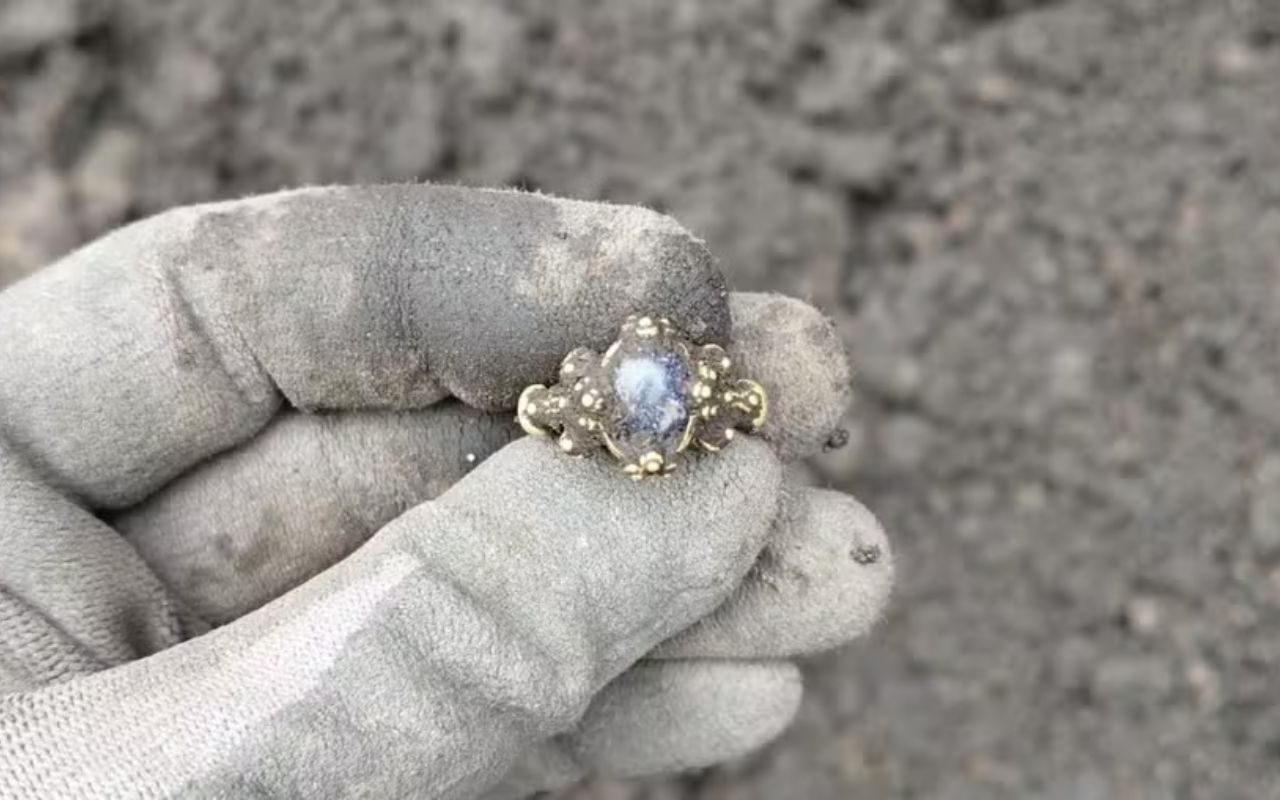
Archeologists Reveal Medieval Gold Ring With Blue Stone in Norway. Rare Piece Found in Tønsberg Highlights Luxury, Ancient Technology, and Cultural Significance.
A rare find transformed an urban work into international news. Archeologists identified a medieval gold ring with a blue stone during excavations in southern Norway. The piece unexpectedly emerged in Tønsberg, an area of great historical relevance.
The object was located while teams were monitoring interventions related to the city’s drainage system.
What would be merely a technical routine ended up revealing an artifact associated with the medieval elite.
-
Friends have been building a small “town” for 30 years to grow old together, with compact houses, a common area, nature surrounding it, and a collective life project designed for friendship, coexistence, and simplicity.

-
This small town in Germany created its own currency 24 years ago, today it circulates millions per year, is accepted in over 300 stores, and the German government allowed all of this to happen under one condition.

-
Curitiba is shrinking and is expected to lose 97,000 residents by 2050, while inland cities in Paraná such as Sarandi, Araucária, and Toledo are experiencing accelerated growth that is changing the entire state’s map.

-
Tourists were poisoned on Everest in a million-dollar fraud scheme involving helicopters that diverted over $19 million and shocked international authorities.


The discovery was made by archaeologist Linda Åsheim from the Norwegian Institute for Historical Heritage Research. According to an official report, she was working alone when she noticed an unusual shine in the ground.
“I was completely shaken and had to ask the construction workers if they were joking with me,” Åsheim stated.
Where the Gold Ring Was Located in Norway
The gold ring was found in the center of Tønsberg, often described as the oldest city in Norway. The region is part of a protected archaeological site associated with medieval occupation.
The piece was about seven centimeters below the surface. Although the specific layer was not directly dated, adjacent elements provided chronological clues.
A fragment of spruce branch, located in the upper stratigraphy, was dated between 1167 and 1269. This range helps archeologists narrow down the deposition period.
Excavations Reveal Medieval Urban Scenario
In addition to the jewel, archeologists documented relevant structural remains. The excavations identified remnants of buildings, possibly linked to ancient paths, and signs of fire.
Among the most intriguing elements are parts of a burned building with segments of the roof preserved.

Defensive structures compatible with a bastion were also recognized.
The set reinforces the strategic and urban importance of the area during the Middle Ages.
Characteristics That Make the Gold Ring Unique
The gold ring features meticulous execution. In the center, a blue stone oval dominates the visual composition.
The gem is surrounded by fine twisted gold wires, forming spiral designs. Small metal spheres, created by granulation, enhance the ornamental effect.
This type of finish requires high technical control. Therefore, it indicates that the piece was produced by specialized craftsmen.
Ancient Techniques Observed by Archeologists
Experts highlight the combination of filigree and granulation. Filigree involves the use of extremely fine metal wires shaped into decorative patterns.
Granulation, on the other hand, involves the application of metal microspheres to the object’s surface. Together, these techniques were associated with items of high symbolic and economic value.
According to Marianne Vedeler, a professor at the Museum of Cultural History at the University of Oslo, such methods reached Norway through external influence.
The tradition is believed to have roots in the Byzantine region, later spread by Carolingian goldsmithing.
Blue Stone Raises Hypotheses About Composition
The nature of the blue stone is still under analysis. Researchers consider the possibility of a sapphire, although the use of colored glass is also plausible.
Ancient techniques allowed for enhancing brightness and color through metal sheets under the gem. This practice has been known for millennia.
So far, however, there is no confirmation that this resource was employed in the found ring.
Symbolism Associated With the Medieval Gold Ring
In the Middle Ages, jewelry surpassed aesthetic function. A gold ring could represent alliances, commitments, and authority.
The blue hue, in turn, carried spiritual meanings. Sapphires were associated with purity, protection, and connection to the divine.
Thus, the object may have played both a social and symbolic role.
What the Size of the Gold Ring Suggests?
The estimated diameter indicates a circumference compatible with fingers between 50 and 55 millimeters. This measurement suggests that the ring may have belonged to a woman.
The technical sophistication and quality of the materials point to someone of high social standing. Pieces of this type were rare and restricted to privileged groups.

Uniqueness Reinforces Impact Among Archeologists
Data from the national database Unimus helps to gauge the find. Currently, about 220 gold rings are cataloged.
Only 63 belong to the medieval period.
For Hanne Ekstrøm Jordahl, project manager at NIKU in Tønsberg, the discovery has exceptional character. “It has been 15 years since we found a gold ring in Tønsberg, and this is a fantastically beautiful and rare specimen,” she stated.
The gold ring found in Norway expands the understanding of the circulation of techniques, styles, and symbolic values in medieval Europe.
Furthermore, it reinforces the archaeological significance of Tønsberg and the importance of preventive excavations in historical urban areas.
Source: Revista Galileu










Seja o primeiro a reagir!