





 Portuguese
  English
  Spanish
 5 min of reading
  0 comments


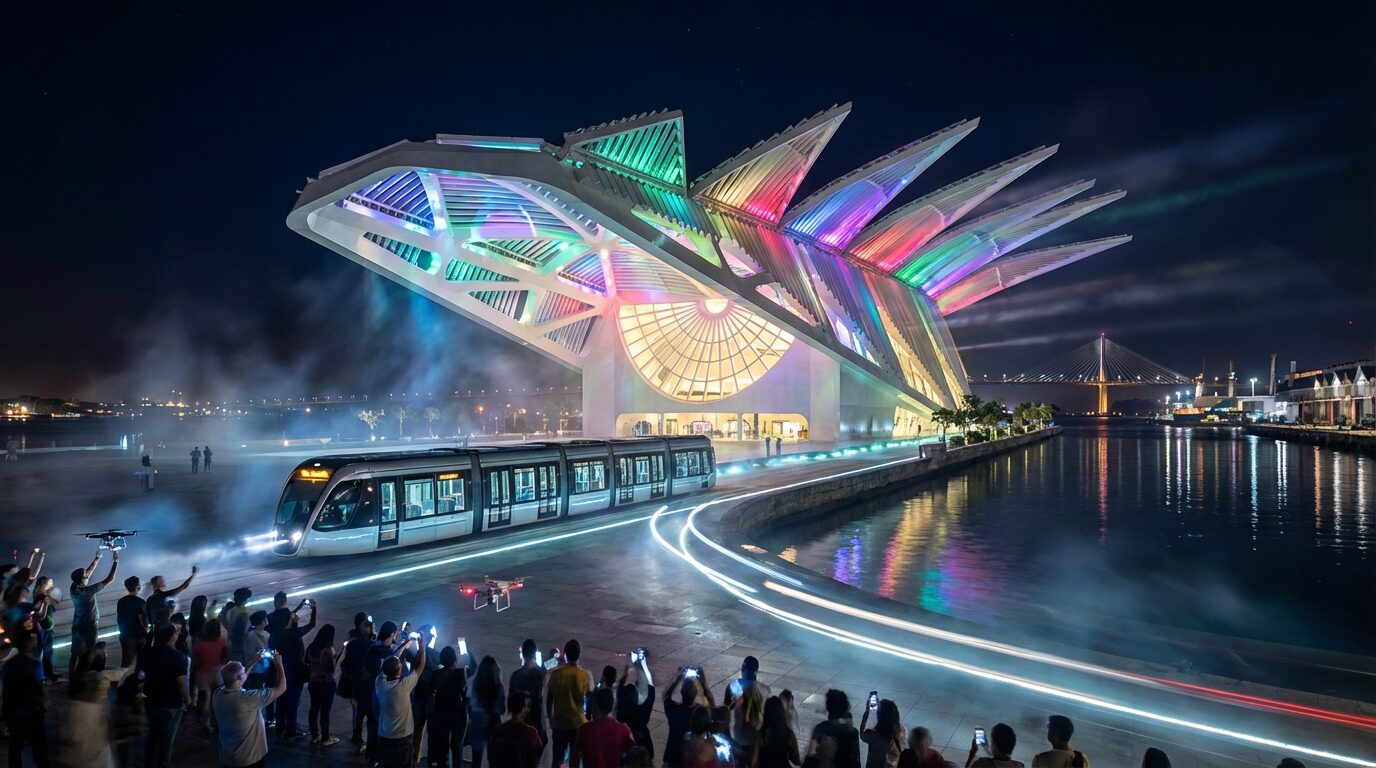
At Praça Mauá, A Landmark of Sustainability and Tourism Repositions the Port Area of Rio with Technology, Art, and Mobility
The Museum of Tomorrow, at Praça Mauá, has established itself as the largest symbol of the revitalization of the port area of Rio de Janeiro. Designed by Santiago Calatrava, the building combines science, art, and urbanism by proposing an experience about the challenges of the future. The proposal relies on clean technology, scientific mediation, and a qualified occupation of public space.
The building draws attention for its shape that resembles a spaceship or a bromeliad, with 15,000 m² of movable solar panels that behave like “wings.” These surfaces follow the light throughout the day and generate renewable energy. The air conditioning system uses water from the Guanabara Bay, reinforcing the commitment to low-impact solutions.
In the curation, the main exhibition is divided into five sections called Cosmos, Earth, Anthropocene, Tomorrows, and Us. On giant screens and through interactive experiences, the public is invited to understand the human impact on the planet and possible paths for transformation. The combination of technology and scientific narrative brings the theme of sustainability closer to everyday life.
-
Friends have been building a small “town” for 30 years to grow old together, with compact houses, a common area, nature surrounding it, and a collective life project designed for friendship, coexistence, and simplicity.

-
This small town in Germany created its own currency 24 years ago, today it circulates millions per year, is accepted in over 300 stores, and the German government allowed all of this to happen under one condition.

-
Curitiba is shrinking and is expected to lose 97,000 residents by 2050, while inland cities in Paraná such as Sarandi, Araucária, and Toledo are experiencing accelerated growth that is changing the entire state’s map.

-
Tourists were poisoned on Everest in a million-dollar fraud scheme involving helicopters that diverted over $19 million and shocked international authorities.


According to information gathered by BM&C News, with data from IBGE Cidades and the City Hall of Rio, the Porto Maravilha area underwent a revitalization of 5 million m². The museum receives over 1 million visitors per year and is connected by the VLT Carioca, which integrates the port with the subway and the airport, expanding access and tourist flow.
Architecture and Sustainability in Action

The lightweight and elongated structure of the Museum of Tomorrow is a study in engineering focused on efficiency and climate. The movable solar panels increase energy capture and converse with the maritime surroundings. The result is a sculpture-like building that reinforces the landscape of the Bay and creates new areas of shade and permanence.
The system that uses water from the Guanabara Bay for air conditioning reduces energy consumption and highlights a local solution to a global problem. According to BM&C News, the project serves as a showcase for urban innovation, positioning the Rio port as an international reference case in sustainable architecture.
Visually, the museum synthesizes form and function. The image that resembles a bromeliad, combined with the photovoltaic “wings,” creates a unique identity and reinforces the message of the future. The design encourages strolling around the area, connecting the museum to the Olympic Boulevard and to requalified public spaces.
Visitor Experience and Urban Impact

The exhibition route through five cosmos explores science, ethics, and collective choices in an accessible way. Immersive technologies help translate complex concepts, while the narrative invites reflection on the present and what is to come.
As an urban anchor, the museum promotes routes that include the Olympic Boulevard, the Ethnicities mural, and the waterfront up to AquaRio. Visiting the Cais do Valongo in the same area helps to understand fundamental historical layers of the city, enriching the cultural experience in the port area.
Integration with Porto Maravilha and Transport
With the requalification of 5 million m² in the center, Porto Maravilha has established itself as a hub of leisure and tourism. The connection via VLT Carioca is key, ensuring integration with the subway and the airport, improving the circulation of residents and visitors.
The most practical way to arrive is by VLT, getting off at the Museums Stop station. According to the City Hall of Rio and data cited by BM&C News, this transport network facilitates access, reduces traffic, and enhances the usage of public space around the museum.
Service, Tickets, and Best Way to Arrive
To avoid long lines, tickets should preferably be purchased online. On Tuesdays, there is free entry, which increases demand and may lead to longer wait times. The schedule of exhibitions and events should be checked on the official website of the Museum of Tomorrow, which serves as a reference for updated information.
The VLT is the most modern and accessible recommendation to reach Praça Mauá. The Museums Stop leaves visitors just a few steps from the entrance, favoring sustainable and quick movements. The rail network also connects other attractions of the cultural corridor, such as the Olympic Boulevard.
For a complete experience, it is worth combining the visit with a walk along the waterfront to AquaRio. Another essential stop is the Cais do Valongo, a heritage site that sheds light on the country’s history. The blend of science, memory, and landscape enhances the itinerary and makes the day more rewarding.
According to BM&C News, the museum operates as a showcase of what the city has most contemporary to offer, without compromising its educational focus. The combination of iconic architecture, technology, and reliable cultural service supports the high annual visitation recorded by the institution.
With approximately 6.2 million inhabitants in the capital, according to IBGE Cidades, the multiplier effect of cultural tourism is significant for the economy. The requalification of the port improves leisure offerings, boosts local businesses, and places Rio on the map of sustainable urban experiences.
Comparisons and Symbols of Rio
As a contemporary icon, the Museum of Tomorrow interacts with other landmarks of the city. On another end of the imaginary, the Christ the Redeemer stands 38 meters tall and weighs 635 tons of concrete and soapstone, reaffirming the weight of symbols in the identity of Rio.
According to BM&C News and complementary content from the Movimente channel, the strength of the museum lies in translating science and the future into an accessible language. The result is an attraction that brings together form, function, and purpose, strengthening the port revitalization.
Open Debate The Museum of Tomorrow is now the largest symbol of the revitalization of Porto Maravilha, but it also sparks discussions about urban priorities. Do you think that the combination of iconic architecture and science justifies the museum’s prominence in Rio’s tourism? Leave your comment and join the conversation.










-

-

2 pessoas reagiram a isso.