





 Português
  Inglês
  Espanhol
  5 min de leitura
  0 comentários



Artemis 2 is scheduled to launch on April 1, will fly around the Moon with four astronauts, and opens a new phase of NASA’s program on a 10-day mission
The Artemis 2 marks a new chapter in space exploration by placing a human crew on a trajectory toward the Moon for the first time in over 50 years. With a launch scheduled for April 1, NASA’s mission departs from the Kennedy Space Center in Florida, aiming to fly around Earth’s natural satellite and return safely, paving the way for even more ambitious stages of the lunar program.
More than just a symbolic journey, Artemis 2 serves as a decisive test mission for the future of human presence in deep space. The flight is expected to last about 10 days, carry four astronauts, and validate essential systems for the next phases of the program, including missions that may return humans to the lunar surface.
The arrival of the crew at the Kennedy Space Center reinforced the historic atmosphere surrounding the operation. Fifty years after the last human visit to the Moon with the Apollo program, NASA is once again targeting the satellite with a crewed mission that combines science, technology, and preparation for even greater goals.
-
A bright yellow mushroom imported from Asia escaped from a cultivation farm in the United States in 2010 and is now aggressively spreading across 25 states, destroying entire communities of native fungi in American forests.

-
Buried under China, a colossal machine weighing 20,000 tons began operating as the largest neutrino detector on the planet and, in just 59 days, surpassed results that science took half a century to achieve.

-
Iran enters the center of a climate alert after the war emitted 5.6 million tons of CO2 in two weeks, surpassing the annual pollution of entire countries.

-
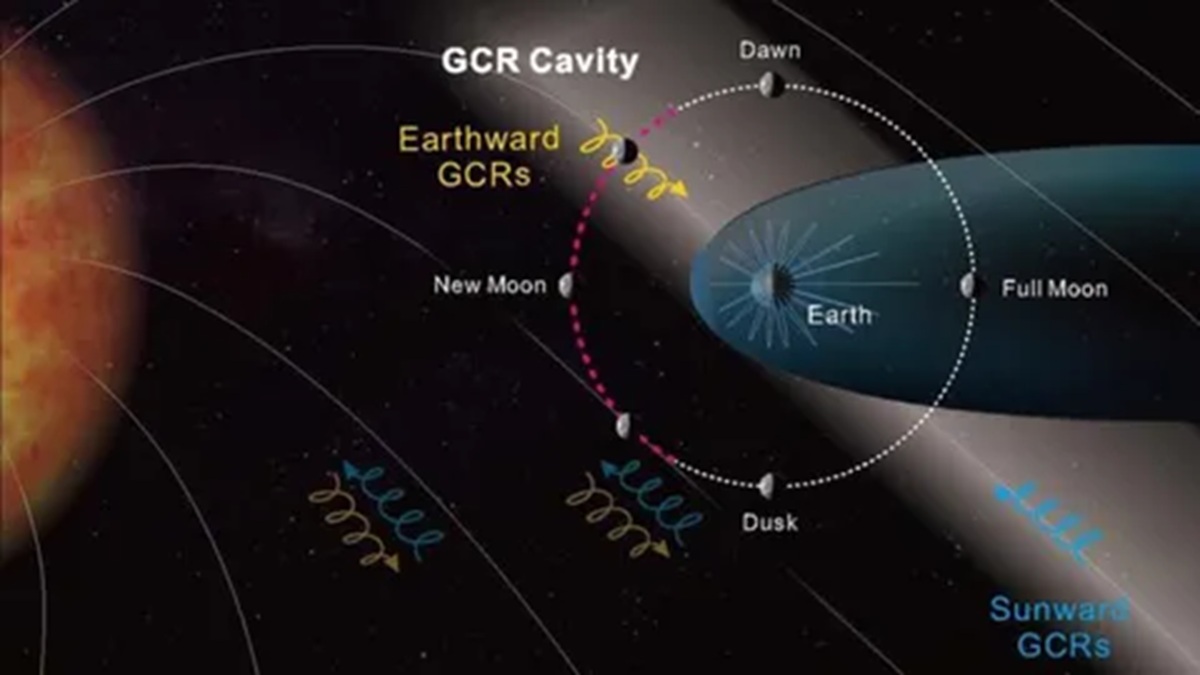
Lunar exploration may change after a Chinese probe finds a “cavity” of radiation that reduces the impact on astronauts by up to 20% at certain times on the Moon.

At the center of this new phase is Artemis 2, seen as an intermediate but essential step between the return of crewed exploration and the goal of establishing a more robust human presence beyond low Earth orbit. This is not just about revisiting the Moon, but about rebuilding the capability to travel further safely.
What Artemis 2 will do
The goal of Artemis 2 is to fly around the Moon and return to Earth, in a flight that will serve as preparation for future crewed landing missions.
The journey does not include a descent to the lunar surface, but it carries immense weight precisely for testing the spacecraft, the rocket, and the systems that will support the next stages of the program under real conditions.
According to the information presented, the astronauts intend to reach the farthest point ever achieved by humans since the Apollo era, flying over the far side of the Moon. This trajectory places the mission in a historic position within modern space exploration.
Mission may surpass historical records of the Apollo program
One of the most impressive aspects of Artemis 2 is the expected distance from Earth. The mission is set to exceed 380,000 kilometers, surpassing the previous record cited in the material as belonging to Apollo 10.
This data reinforces the symbolic and technical dimension of the flight. Artemis 2 not only represents a return to lunar orbit but also an attempt to take humans further into space than in historical missions of the last century. This amplifies scientific interest and also the geopolitical weight of the operation.
Crew brings diversity and historic debut
The crew of Artemis 2 consists of four astronauts who will make history in space exploration. The group will be formed by commander Reid Wiseman, Victor Glover, Christina Koch, and Canadian Jeremy Hansen.
The mission also stands out for carrying, according to the material, the first Black person and the first woman on a mission to the Moon.
This aspect enhances the historical value of the journey and shows how the new lunar cycle seeks to incorporate milestones that go beyond technology and engineering.
Orion capsule and SLS rocket will be tested in crewed flight
Artemis 2 will be the first spaceflight with astronauts in the Orion capsule, launched by the SLS rocket.
This combination is central to the future of the program, as the mission will serve to test the performance of the system under real human use conditions.
Among the objectives are the verification of life support systems and oxygen duration, essential points for any prolonged operation in space.
Without this validation, future missions of the program would not have sufficient practical basis to proceed safely.
The Moon returns to the center of space geopolitics


The resumption of lunar exploration is not seen merely as a scientific project. The material itself highlights that the new race to the Moon has an important geopolitical component, especially in the context of technological and strategic competition with China.
In this sense, Artemis 2 also functions as a signal of space capability and technological leadership.
The flight places the Moon at the center of a global competition that mixes science, international prestige, and projection of power in space.
Mission may also generate advancements for Earth
Beyond its symbolic value, Artemis 2 is regarded as part of an effort to develop technologies that can improve life on Earth and pave the way for even more ambitious missions.
NASA states that the Artemis program can help establish a human presence in deep space and test useful solutions for future space bases.
This movement includes, in the more distant horizon, missions to other worlds, such as Mars. The Moon appears as an intermediate step and a natural laboratory for what humanity intends to build in the coming decades beyond the planet.
Lunar study may reveal clues about the origin of the solar system
The importance of Artemis 2 also lies in the scientific value of the Moon. Due to the absence of an atmosphere, the satellite preserves very old geological records, making it a privileged object for studying the origins of the solar system.
According to the material, the lunar surface offers relevant clues about the formation of bodies in the solar system and the processes that shaped this environment since ancient times.
Returning to investigate the Moon with a new generation of missions also means reopening fundamental questions about the cosmic history of our neighborhood.
Artemis 2 paves the way for human return to the lunar surface
Even without landing, Artemis 2 is an essential piece for the future of the program. The flight will serve as a validation step for subsequent missions intending to take astronauts back to the lunar surface.
The expectation presented is that, in the future, Artemis 4 will be among the missions capable of putting people walking again on the lunar soil.
Therefore, the success of Artemis 2 carries much greater weight than a simple orbit around the Moon. It could define the solidity of the entire program going forward.
Do you believe that Artemis 2 could mark the beginning of a new era of human exploration of the Moon?






Seja o primeiro a reagir!