





 Portuguese
  English
  Spanish
  2 min of reading


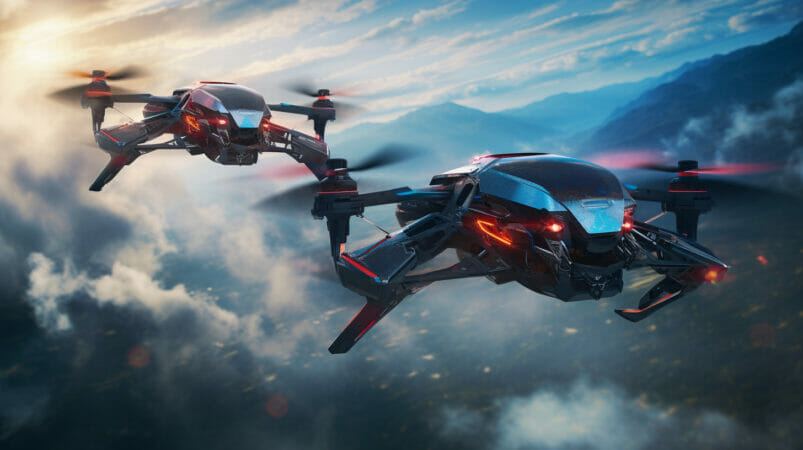
It Was a Day to Go Down in the History Books. For the First Time, an AI-Controlled Drone Defeated Human Champions in a Racing Competition.
Revealing potential advancements not only for sports but also for other fields such as industrial robotics and vehicle automation.
The study, published in the prestigious journal Nature, documents how the autonomous drone, named Swift, navigated through all obstacles and broke records. And we are talking about a quite complex circuit, 75 meters long with seven gates, where the machines easily reach 100 km/h. If you think Formula 1 is exciting, this drone race would leave you astounded!
Man vs Machine
The humans had an entire week to train. Among the participants was a former world champion in drone racing. But it was the machine that took home the trophy.
-
ZCC 11000 crane lands at the port of Vitória and heads to Ceará in a convoy with 64 trailers: Zoomlion, founded in 1992, builds a monster that lifts over 600 compact cars to 93 m.

-
The biggest drama of being born on Mars is not breathing: Rice biologist says that colonists’ children may cease to be Homo sapiens, shaped by low gravity, radiation, and isolation that divides humanity.

-
With no separate outdoor unit and designed to fit in the window, monoblock air conditioners used in Japan emerge as an alternative for those who cannot install a split system in a rented apartment.

-
China prepares a 78,000-ton pilotable floating island for deep-sea research: it accommodates 240 people for months, withstands category 17 typhoons and 9-meter waves, and uses metamaterials that dissipate nuclear explosions.


Inside the Swift
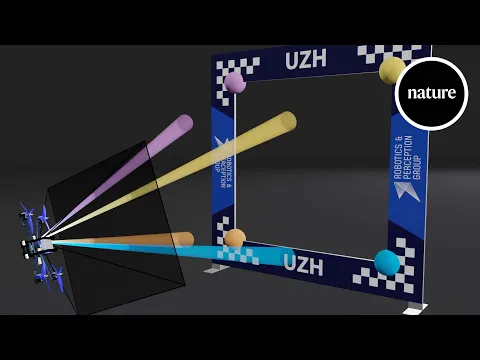
The Swift is not just any drone. It was equipped with a technology called “deep reinforcement learning”, which allowed it to adjust its course in real time and send up to 100 new commands per second. “That’s faster than a blink of an eye,” explains Elia Kaufmann, one of the authors of the study.
While human-controlled drones can benefit from quick adaptation to changes in light and environment, they cannot compete with the processing speed and accuracy of the Swift. However, this speed can be a double-edged sword, as the machine takes significant risks, always operating at the limit.
The success of the Swift is not limited to the world of drone racing. Experts, including military personnel and academics, are keeping an eye on these advancements, as they may impact a much wider range of applications.
Energy Efficiency
According to Kaufmann, the biggest challenge now is how to make these autonomous drones more energy-efficient. After all, what good is speed if you can’t fly for long?








Seja o primeiro a reagir!