





 Portuguese
  English
  Spanish
  4 min of reading
  12 comments


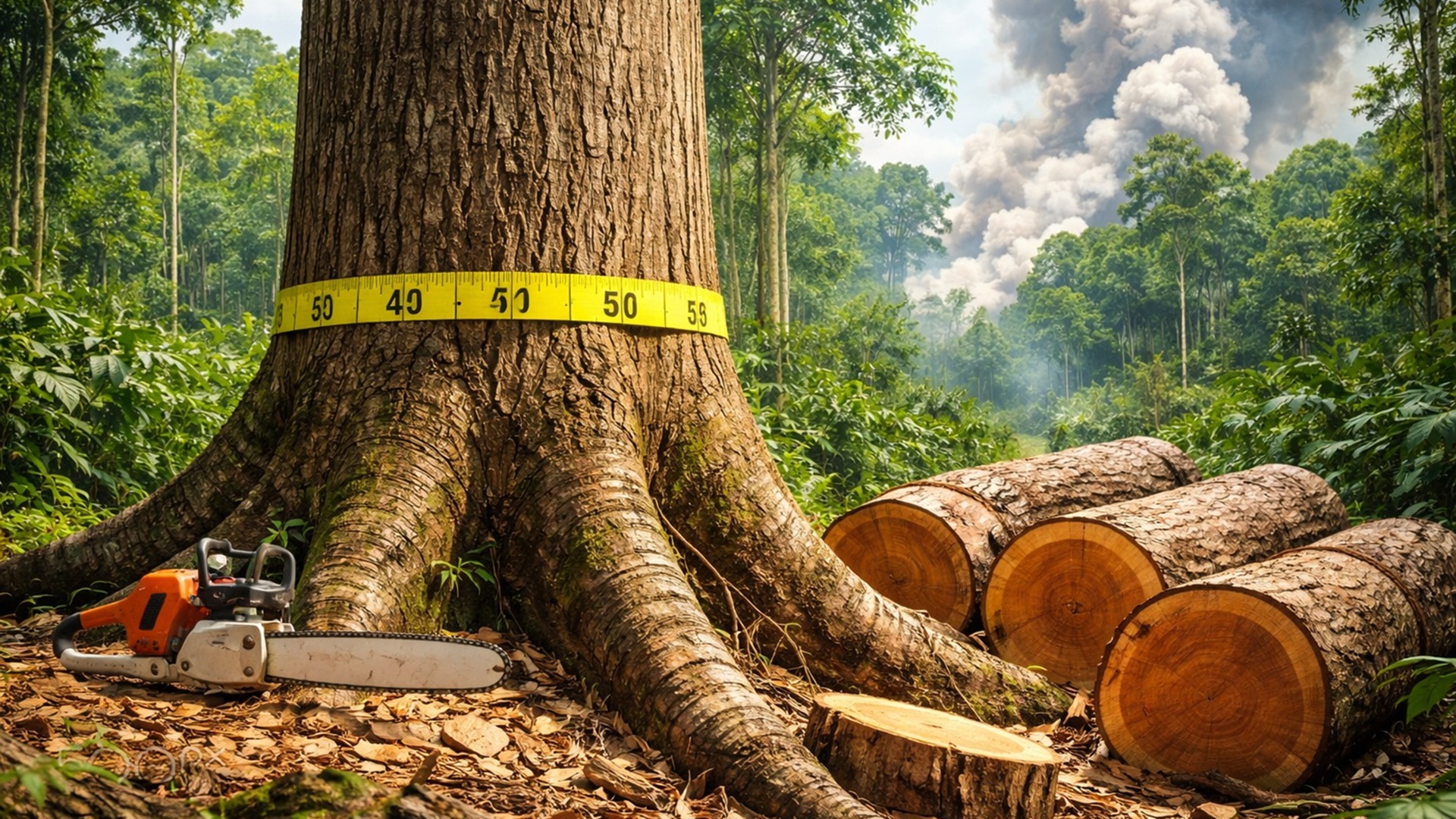


Study Published on January 25 Shows That Amazon Trees Over 40.6 cm Concentrate Between 88% and 93% of Carbon, While Peru Legislation Allows Selective Cutting Between 41 and 61 cm, Reaching Individuals with the Highest Stocks
The trees of the Amazon store most of the carbon in the Peruvian forests, but they are also the most cut down due to selective harvesting allowed between 41 and 61 cm in diameter, according to a study published on January 25 in the journal Frontiers in Forests and Global Change.
Nearly 60% of Peru’s territory is covered by forests, primarily in the Amazon region, which represents about 11% of the total area of the Amazon rainforest. In this context, the trees of the Amazon play a central role in carbon storage.
A new study points out that the largest trees in the Peruvian Amazon store a disproportionately greater amount of carbon compared to the smaller ones. However, they are also the most prone to being cut down, which releases more carbon into the atmosphere.
-
Motorola launched the Signature with a gold seal from DxOMark, tying with the iPhone 17 Pro in camera performance, Snapdragon 8 Gen 5 that surpassed 3 million in benchmarks, and a zoom that impresses even at night.

-
Satellites reveal beneath the Sahara a giant river buried for thousands of kilometers: study shows that the largest hot desert on the planet was once traversed by a river system comparable to the largest on Earth.

-
Scientists have captured something never seen in space: newly born stars are creating gigantic rings of light a thousand times larger than the distance between the Earth and the Sun, and this changes everything we knew about stellar birth.

-
Geologists find traces of a continent that disappeared 155 million years ago after separating from Australia and reveal that it did not sink, but broke into fragments scattered across Southeast Asia.

According to the researchers, this dynamic reduces the ability of these forests to act as carbon sinks. The removal of the largest trees from the Amazon returns a large portion of the accumulated carbon to the atmosphere.
Amazon Trees Concentrate Greater Carbon Storage Above and Below the Soil
To determine how much carbon is stored in the largest trees of the Amazon, Geomar Vallejos-Torres and colleagues measured hundreds of trees in five forests across the country. They recorded variables such as diameter, height, crown area, and wood density.
Based on this data, the researchers estimated the biomass both above and below ground and the stored carbon. Carbon storage increased disproportionately with the growth of the trunk diameter.
The study identified 40.6 cm as an important threshold. The forests analyzed sequestered up to 331 metric tons per hectare above ground and 47 metric tons per hectare below ground.
Between 88% and 93% of the total carbon, depending on the species, was concentrated in trees larger than 40.6 cm in diameter. Trees smaller than this threshold concentrated a significantly smaller fraction of the total.
In the case of the breadnut tree, Brosimum alicastrum, 11.4% of the total carbon above ground was in individuals less than 40.6 cm, while 88.7% was in larger trees.
Forest Policy Allows Cutting Between 41 and 61 cm in Diameter
Peru’s forest legislation allows selective harvesting when trees reach a minimum diameter between 41 and 61 centimeters, depending on the species. This range coincides with the group that concentrates the highest carbon stocks.
The terrain of the Peruvian Amazon makes it difficult to access and remove trees. Therefore, logging companies prefer larger trees, which yield more wood and reduce transportation, labor, and time costs.
These trees tend to be older and more mature, with denser, harder, and more stable wood. According to Vallejos-Torres, removing them returns a large portion of the stored carbon to the atmosphere.
“Given the urgency to keep carbon reserves out of the atmosphere, it is essential to conserve trees over 41 cm in diameter”, stated the researcher. He also mentioned benefits for biodiversity, microfauna, and microclimate protection.
Debate Over Size, Age, and Storage Time
Not all researchers agree that size is the most important factor. Ulf Büntgen from the University of Cambridge, who did not participate in the research, stated that the time of carbon storage is more relevant.
According to him, the article does not deeply address the age of the trees and ignores the residence time of carbon, which is generally low in the tropics. The critique was made in an interview with Live Science.
Vallejos-Torres countered the argument, stating that larger trees continue to accumulate carbon for centuries. Conversely, smaller trees grow very slowly to compensate for the difference.
He stated that the regeneration of smaller trees is slow, uncertain, and often limited by degradation, disturbances, and microclimatic changes, which prevents the recovery of lost carbon in time scales relevant for climate mitigation.
Forest Management and Economic Interests in Peru
Martin Perez Lara from the World Wildlife Fund stated that the relationship between diameter and carbon stocks is empirically valid and relatively intuitive. However, he said that focusing solely on size is not the best strategy.
He emphasized that well-designed management systems, including selective harvesting with trees around 40 cm, can contribute positively to climate mitigation and reduce degradation risks.
Despite the urgency to preserve carbon sinks, Vallejos-Torres expressed little faith in implementing the necessary changes in Peru’s forest policy.
According to him, a legal reform that protects larger trees would directly affect the economic interests of the timber sector, which relies on harvesting these high-value individuals and holds significant weight in the country’s forest policy decisions.








Quando uma árvore é cortada ela não libera carbono. O carbono se mantem na madeira. O que libera carbono é a sua queima. Sem falar que árvore velha (é um ser vivo) não sequestra mais carbono. O que sequestra eo crescimento da árvore. Sugiro que pesquisem a fórmula da fotossintese.
Estoy molesta porque siendo seres humanos racionales actuamos lo contrario. No valoramos la creación de Dios que todo lo hizo perfecto y con propósito.
Embora pareça muito estranho e muitíssimo lento, ESTA É REALMENTE A MELHOR FORMA DE EXPELIR OXIGÊNIO MAIS DE CAPTURAR MUITO CARBONO A ESTOCAR PELO MENOS POR MAIS 200 ANOS SE NA FORMA DE MOBILIARIO OU DE HABITACOES. MUITO MELHOR DO QUE SER QUEIMADA POR INCÊNDIOS OU POR SERRARIAS APENAS PARA ESCORAS